Federalism Concerns and Parliamentary Delimitation Debates
Source:Indian Express ↗
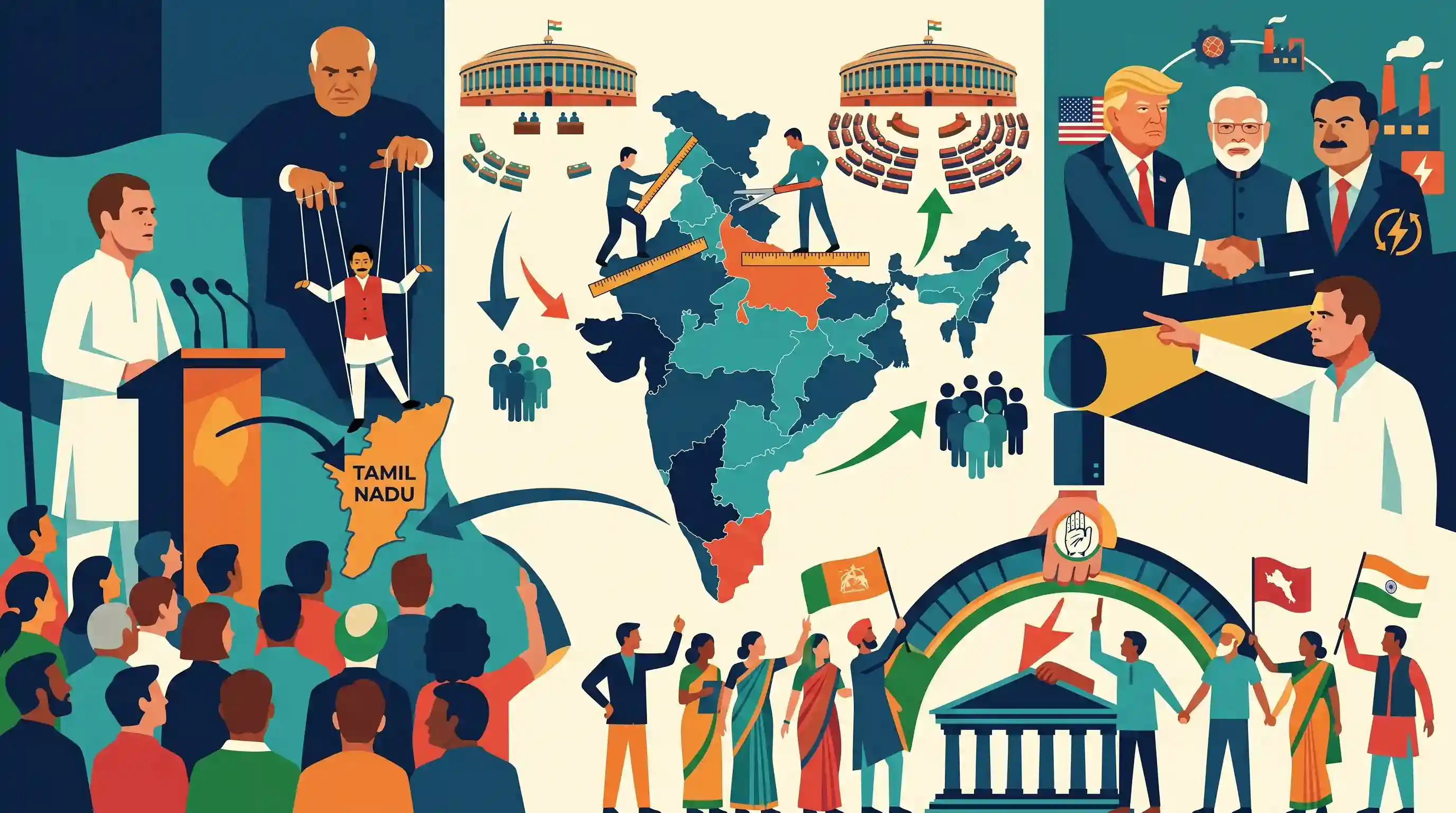
Why It Matters
The political rhetoric underscores key constitutional and governance issues, particularly the impending debate over delimitation and its potential impact on the representation of southern states that have successfully controlled their populations. It also highlights the persistent friction between the Centre's centralizing tendencies and states' demands for autonomy.
Summary
During an election rally in Tamil Nadu, Rahul Gandhi accused the BJP of attempting to control the state through a proxy government by using the AIADMK. He also raised concerns about potential delimitation policies that could marginalize southern states by reducing their representation in the Lok Sabha. Furthermore, Gandhi leveled allegations against PM Modi involving US President Donald Trump and Gautam Adani, while emphasizing the need to protect India's federal structure and regional autonomy from centralization.
Key Points
- Rahul Gandhi accused the BJP of trying to rule Tamil Nadu through a 'puppet' Chief Minister using the AIADMK as a front.
- He alleged that a recently failed Constitutional amendment was intended to pave the way for delimitation, which could reduce the political representation of southern and smaller states in the Lok Sabha.
- The speech emphasized federalism, state autonomy, and Tamil Nadu's legacy of social justice against perceived centralization efforts by the Union Government.
- Gandhi made unverified claims alleging PM Modi is compromised by former US President Donald Trump and highlighted financial links with Gautam Adani.
Important Terms
Federalism

A system of government where power is divided between a central authority and constituent units. India follows a 'quasi-federal' model with a strong centralizing tilt.
UPSC context
GS II: Functions and responsibilities of the Union and the States; issues and challenges pertaining to the federal structure.
Delimitation Commission
A high-powered statutory body appointed by the President to redraw the boundaries of Lok Sabha and State Assembly constituencies based on the latest census data to ensure equal representation.
UPSC context
GS II: Appointment to various Constitutional posts, powers, functions, and responsibilities of various Constitutional Bodies; Election Commission.
Centre-State Relations
The constitutional framework (Part XI and XII) governing the distribution of legislative, administrative, and financial powers between the Union and the State governments.
UPSC context
GS II: Constitutional provisions, Part XI (Articles 245-263) and Part XII (Articles 264-300).
Regional Parties
Political organizations whose support base is confined to a specific state or region, typically articulating local linguistic, cultural, or developmental aspirations.
UPSC context
GS II: Pressure groups and formal/informal associations and their role in the Polity; federalism.
Parliamentary Representation
The allocation of seats in the Lok Sabha to states based on population, ensuring the democratic principle of 'one person, one vote, one value.'
UPSC context
GS II: Parliament and State Legislatures—structure, functioning, conduct of business, powers & privileges.
AIADMK
A major regional political party in Tamil Nadu founded by M.G. Ramachandran, emphasizing Dravidian identity and state autonomy within the federal framework.
UPSC context
GS II: Role of regional parties in Indian democracy and their impact on coalition politics.
Prelims Trap
"The orders of the Delimitation Commission can be modified by Parliament to ensure federal balance."
Delimitation Commission orders possess the force of law and cannot be challenged in court. Furthermore, neither Parliament nor State Legislatures can modify its orders.
Static Concepts Connected
What is the constitutional mechanism and authority of the Delimitation Commission?
- Constitutional Basis: Under Article 82, Parliament enacts a Delimitation Act after every Census to readjust constituencies.
- Finality of Orders: The orders issued by the Commission have the force of law and cannot be challenged in any court.
- No Legislative Modification: When orders are laid before the Lok Sabha or State Assembly, they cannot effect any modification to them.
Why was the reallocation of Lok Sabha seats frozen, and under which Constitutional Amendments?
- Initial Freeze (1976): The 42nd Amendment (1976) froze the number of seats based on the 1971 Census to incentivize state-level family planning initiatives.
- Extension to 2026: The 84th Amendment (2001) extended this freeze until the relevant figures for the first Census taken after the year 2026 are published.
- Federal Equity Rationale: The freeze prevents states that successfully stabilized their populations (largely Southern states) from being penalized with reduced political representation.
Cross-Topic Patterns
Demographic performance vs Political representation
The 15th and 16th Finance Commissions reward demographic performance to offset revenue losses for Southern states. Delimitation creates the exact opposite tension by strictly linking sheer population size to political power.
Inter-State Council and federal mediation
The impending post-2026 delimitation crisis will likely revive demands to empower the Inter-State Council (Article 263) as a mandatory mediation mechanism for structural federal disputes over representation and resource allocation.

Post-2026 delimitation and the North-South federal tension over Lok Sabha seat reallocation is highly likely for 2026 Mains Polity.
Linked PYQs · 2
Linked PYQs · 2
- 2022MainsGS2
“While the national political parties in India favour centralisation, the regional parties are in favour of State autonomy.” Comment.
- 2024MainsGS2
What changes has the Union Government recently introduced in the domain of Centre-State relations ? Suggest measures to be adopted to build the trust between the Centre and the States and for strengthening federalism.
