Modi and Trump discuss Gaza peace plan and bilateral trade progress
Source:Indian Express ↗
Why It Matters
Highlights India's diplomatic balancing, its consistent policy against third-party mediation in the India-Pakistan dispute, and its interest in Middle East stability for strategic and trade purposes.
Summary
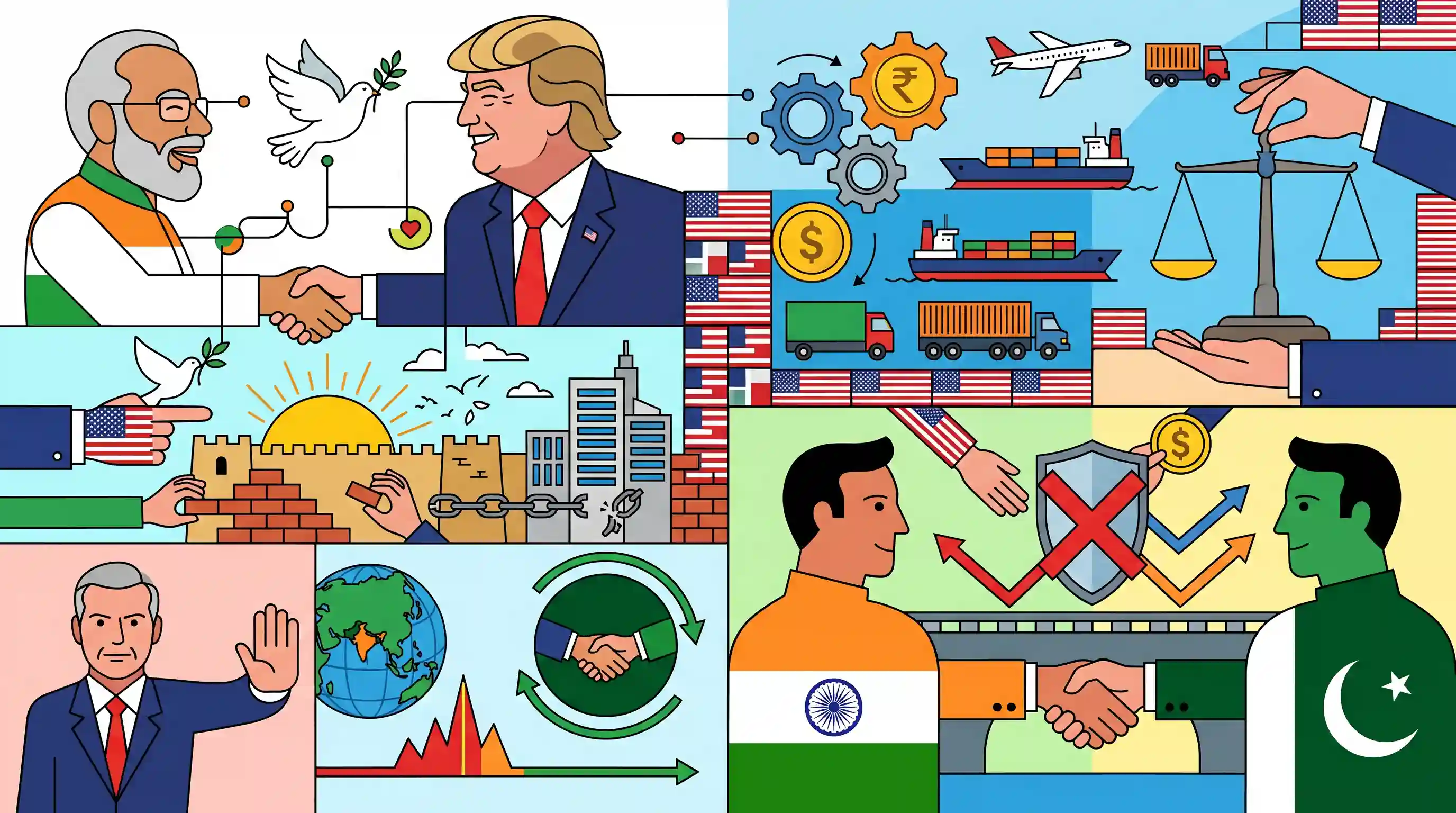
Prime Minister Narendra Modi congratulated US President Donald Trump on the success of the historic Gaza peace plan between Israel and Hamas. The two leaders also reviewed progress in India-US trade negotiations. While praising Trump's role in West Asia, India maintained its firm stance against any third-party mediation in the India-Pakistan dispute. Foreign Secretary Vikram Misri explicitly refuted Trump's earlier claims of brokering a ceasefire between India and Pakistan after the Pahalgam terror attack and Operation Sindoor, stating that the de-escalation occurred entirely through direct bilateral channels.
Key Points
- PM Modi praised US President Trump's 'historic Gaza peace plan' involving Hamas and Israel.
- Modi and Trump reviewed the progress of ongoing bilateral trade negotiations.
- Trump previously claimed to have stopped a potential nuclear war between India and Pakistan following the Pahalgam terror attack and Operation Sindoor by threatening tariffs.
- India's Foreign Secretary Vikram Misri officially refuted Trump's claim, clarifying that India-Pakistan military cessation occurred via bilateral channels at Pakistan's request.
- India reaffirmed its long-standing policy of rejecting third-party mediation in its dispute with Pakistan.
Important Terms
Gaza peace plan

A 2025 U.S.-brokered 20-point framework between Israel and Hamas involving a ceasefire, hostage release, and reconstruction of Gaza under international supervision.
UPSC context
GS-II: International Relations. Relevant for West Asia geopolitics and India's response to global peace initiatives.
Operation Sindoor
India's 2025 tri-service military operation involving precision strikes on terror camps in Pakistan and PoK following the Pahalgam terror attack.
UPSC context
GS-III: Internal Security. Tests knowledge of India's counter-terrorism doctrine and surgical-style precision responses.
Hamas
The Palestinian group governing Gaza; its participation in the 2025 peace plan and resistance to full disarmament are central to West Asian stability.
UPSC context
GS-II: International Relations. Key actor in the Israel-Palestine conflict affecting global security and oil prices.
Third-party mediation
Intervention by an external state or body to resolve a bilateral dispute; India consistently rejects this for the Kashmir issue.
UPSC context
GS-II: Indian Foreign Policy. Tests understanding of Shimla Agreement (1972) and bilateralism in India-Pakistan ties.
Pahalgam terror attack
A 2025 terror attack in Jammu & Kashmir that killed 26 tourists, leading to heightened India-Pakistan military tensions and Operation Sindoor.
UPSC context
GS-III: Internal Security. Significant event influencing regional security and domestic counter-terror strategies.
Vikram Misri
Current Foreign Secretary of India; he has played a lead role in articulating India’s bilateral stance following the 2025 crisis.
UPSC context
General Awareness/Interviews. Key figure in Indian diplomacy and external affairs administration.
Prelims Trap
India accepts informal US mediation to de-escalate India-Pakistan military border disputes.
The 1972 Simla Agreement firmly binds India and Pakistan to resolve disputes bilaterally. India legally and politically rejects any third-party mediation, including by the US.
Static Concepts Connected
What are the core tenets of the 1972 Simla Agreement?
- Strict Bilateralism: All disputes between India and Pakistan must be settled peacefully through direct bilateral negotiations without any third-party intervention.
- Line of Control: It converted the 1949 UN ceasefire line into the Line of Control (LoC), requiring both sides to respect it without altering it unilaterally.
What is India's 'De-hyphenation' policy in West Asia?
- Standalone Ties: India pursues its relationships with Israel and Palestine as independent, mutually exclusive partnerships rather than viewing them through a zero-sum lens.
- Balanced Stance: It allows India to maintain deep strategic and defense ties with Israel while continuing unwavering support for the Two-State Solution for Palestinians.
Cross-Topic Patterns
Trade leverage in geopolitical disputes
Trump's alleged threat of tariffs to enforce military de-escalation demonstrates the rising use of economic statecraft, intertwining BTA negotiations with hard security levers.
Deterrence below the nuclear threshold
Operation Sindoor illustrates India's evolving doctrine of 'limited but effective conventional retaliation,' signaling robust deterrence capabilities against terror infrastructure that stay deliberately below the nuclear threshold.

Look for 2026 questions contrasting India's West Asia de-hyphenation policy with its strict bilateralism under the 1972 Simla Agreement.
Linked PYQs · 3
Linked PYQs · 3
- 2023MainsGS2
‘The expansion and strengthening of NATO and a stronger US-Europe strategic partnership works well for India.’ What is your opinion about this statement ? Give reasons and examples to support your answer.
- 2018MainsGS2
“India’s relations with Israel have, of late, acquired a depth and diversity, which cannot be rolled back.” Discuss.
- 2015MainsGS2
Terrorist activities and mutual distrust have clouded India-Pakistan relations. To what extent the use of soft power like sports and cultural exchanges could help generate goodwill between the two countries? Discuss with suitable examples.
