India UK Vision 2035 and Trade Deal Highlight Prime Minister UK Visit
Source:The Hindu ↗
Why It Matters
The India-U.K. FTA marks a massive shift in India's global trade posture, impacting domestic sectors like clean energy and financial services through increased competition. Concurrently, reinforcing diplomatic ties with the Maldives underscores India's strategic necessity to maintain regional stability and counter external influences in the Indian Ocean under its Neighbourhood First Policy.
Summary
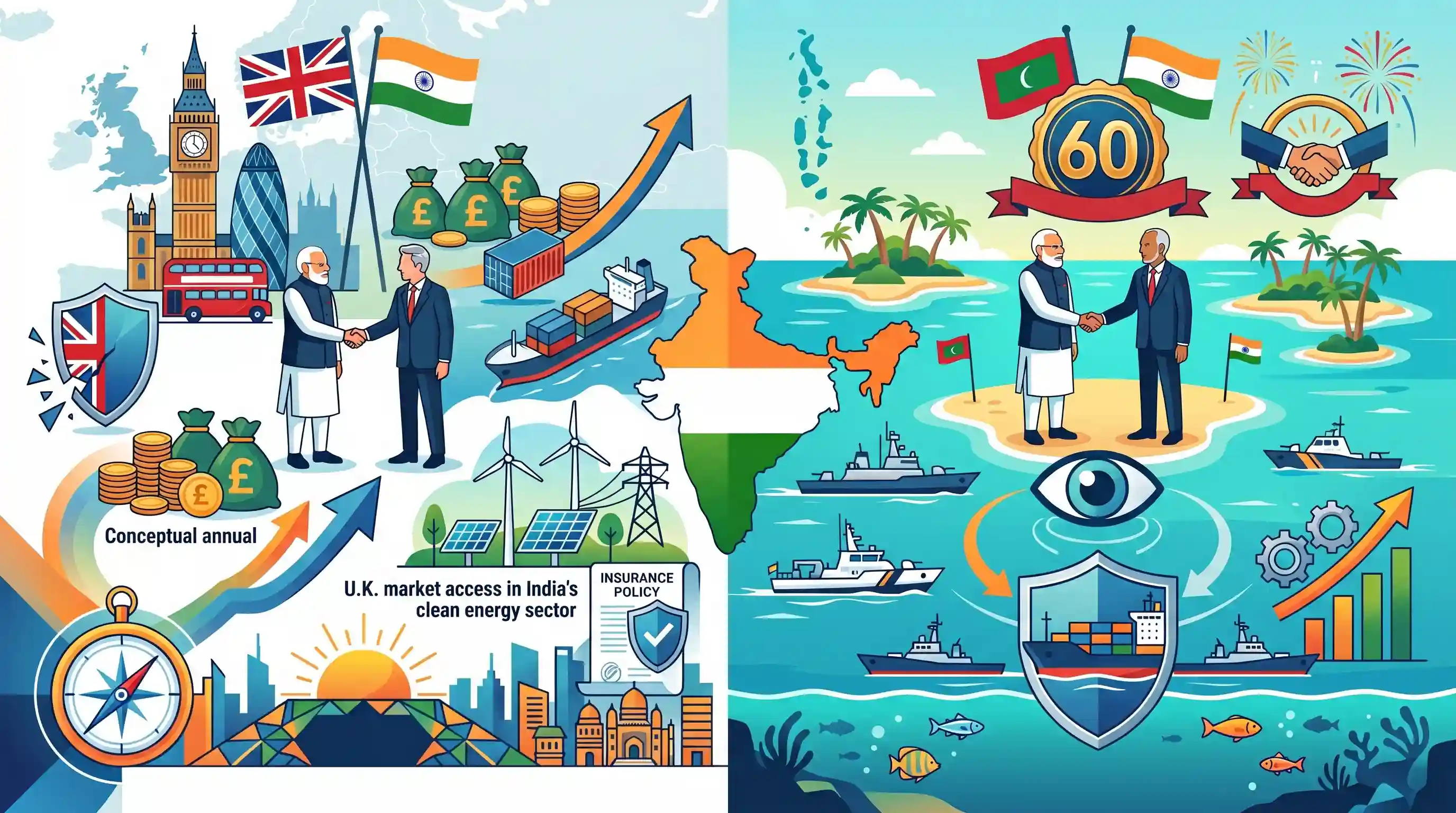
Prime Minister Narendra Modi has commenced a two-nation tour beginning in the United Kingdom, where India and the U.K. are poised to sign a landmark Free Trade Agreement (FTA) and unveil a new bilateral framework, 'The UK-India Vision 2035'. The comprehensive FTA is anticipated to boost bilateral trade by £25.5 billion annually, slashing average tariff rates and providing U.K. companies with significant market access in India's clean energy procurement and insurance sectors. Following his U.K. visit, PM Modi will travel to the Maldives to celebrate 60 years of diplomatic relations, meeting President Mohamed Muizzu to bolster maritime security and strengthen the Comprehensive Economic and Maritime Security Partnership in the Indian Ocean Region.
Key Points
- India and the U.K. are set to sign a landmark Free Trade Agreement (FTA), expected to boost bilateral trade by £25.5 billion annually.
- The two nations will replace their previous '2030 Roadmap' by unveiling a new bilateral framework titled 'The UK-India Vision 2035'.
- The FTA will facilitate a drop in average tariff rates from 15% to 3%, granting the U.K. unprecedented access to India's clean energy procurement market and bringing parity to U.K. financial services within the Indian insurance sector.
- PM Modi's trip also includes a visit to the Maldives to mark the 60th anniversary of diplomatic ties and Maldivian independence, highlighting India's 'Neighbourhood First Policy'.
- In the Maldives, talks with President Mohamed Muizzu will focus on advancing a joint vision for a Comprehensive Economic and Maritime Security Partnership to ensure stability in the Indian Ocean Region.
Important Terms
Free Trade Agreement (FTA)

A bilateral treaty to reduce or eliminate trade barriers like tariffs and quotas. The India-UK agreement aims to double bilateral trade and provide significant market access in insurance and energy.
UPSC context
GS Paper II: Bilateral agreements. Tests understanding of trade diplomacy, tariff barriers, and economic integration with developed nations.
UK-India Vision 2035
A 10-year strategic roadmap (2025–2035) replacing the 2030 Roadmap to elevate India-UK ties. It focuses on the "BRISK" philosophy: Business, Research, Innovation, Science & Technology, and Knowledge.
UPSC context
GS Paper II: Bilateral groupings. Tests knowledge of evolving long-term strategic frameworks and high-tech defense cooperation.
Technology and Security Initiative (TSI)
A 2024 initiative between India and the UK to collaborate on seven critical technologies: Telecom, Critical Minerals, Semiconductors, AI, Quantum, Biotechnology/Health-tech, and Advanced Materials.
UPSC context
GS Paper III: Science & Technology. Relevant for questions on critical emerging technologies and international research partnerships.
Comprehensive Economic and Maritime Security Partnership
A 2024 strategic framework between India and the Maldives focusing on economic resilience, financial support (currency swaps), and maritime domain awareness in the Indian Ocean Region.
UPSC context
GS Paper II: India and its Neighborhood. Tests understanding of maritime security and financial diplomacy in the IOR.
Neighbourhood First Policy
India's guiding foreign policy principle that prioritizes strengthening relations and providing "first responder" assistance to immediate neighbors to ensure regional peace and prosperity.
UPSC context
GS Paper II: India and its Neighborhood. A foundational concept for analyzing India's regional diplomacy and strategic interests.
2030 Roadmap
The 2021 strategic framework that initially elevated India-UK ties to a 'Comprehensive Strategic Partnership'. It served as the precursor to the more advanced Vision 2035.
UPSC context
GS Paper II: International Relations. Useful for tracing the chronological evolution of bilateral strategic goals.
Prelims Trap
"The India-UK Free Trade Agreement eliminates all tariffs across all sectors, ensuring a zero-tariff regime."
UPSC frequently uses extreme words like 'all'. The India-UK FTA slashes average tariffs from 15% to 3% but does not enforce a blanket zero-tariff mandate.
Static Concepts Connected
How does an FTA differ from a CEPA or CECA?
- FTA Scope: Primarily focuses on reducing or eliminating customs duties and non-tariff barriers on goods traded between partner countries.
- CEPA/CECA Scope: More comprehensive than FTAs, covering trade in services, investments, and regulatory aspects like intellectual property rights and competition.
Why is the Maldives strategically significant for India's maritime security?
- Critical SLOCs: Located near major Sea Lanes of Communication (SLOCs) in the Indian Ocean, essential for safeguarding India's energy imports and maritime trade routes.
- Net Security Provider: Crucial for India to project power, counter piracy, and monitor extra-regional naval presence (like China's String of Pearls) in the IOR.
Cross-Topic Patterns
Trade deals driving green transitions
The UK FTA grants access to India's clean energy procurement market, reflecting a growing trend where modern FTAs integrate environmental standards and green tech sharing.
Insurance sector FDI and trade parity
The FTA grants parity to UK financial services in India's insurance sector, linking international diplomacy with domestic financial sector reforms and FDI liberalization.

A 2026 multi-statement question will likely test modern FTA features, specifically the inclusion of clean energy procurement and insurance.
Linked PYQs · 2
Linked PYQs · 2
- 2024MainsGS2
Discuss the geopolitical and geostrategic importance of Maldives for India with a focus on global trade and energy flows. Further also discuss how this relationship affects India's maritime security and regional stability amidst international competition ?
- 2025MainsGS3
What are the challenges before the Indian economy when the world is moving away from free trade and multilateralism to protectionism and bilateralism? How can these challenges be met?
