Bangladesh normalises mob violence as new political instrument
Source:Indian Express ↗
Why It Matters
Political instability in Bangladesh directly impacts India's internal security and strategic interests in South Asia. Understanding the dynamics of democratic backsliding and mob violence in a neighbouring country is crucial for formulating effective border management and foreign policy responses.
Summary
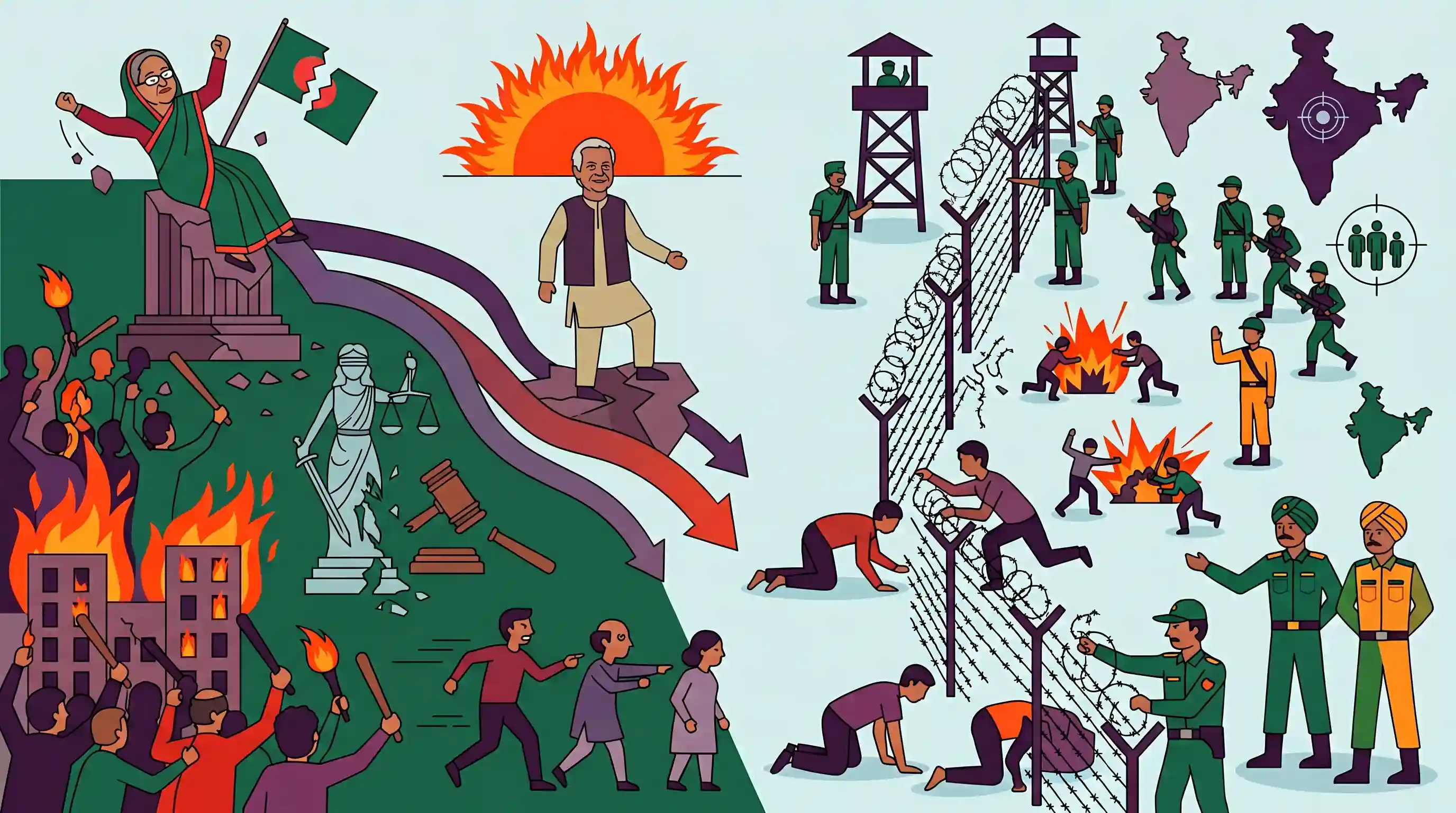
The article discusses the escalating political instability and normalisation of mob violence in Bangladesh following the ouster of Sheikh Hasina's government. Under the interim administration of Muhammad Yunus, vigilante justice is being framed as 'New Politics', leading to the systematic targeting of minorities and political opponents alongside a collapse of the rule of law. This democratic backsliding and institutional decay not only threaten the internal stability of Bangladesh but also present significant strategic and security challenges for India, including risks of spillover violence and illegal cross-border migration.
Key Points
- Following the ouster of Sheikh Hasina, Bangladesh's interim government led by Muhammad Yunus has overseen a period of severe political instability.
- Mob violence is increasingly being normalised and rationalised as 'New Politics', leading to a breakdown of the rule of law.
- Minorities and political opponents, particularly Awami League supporters, are systematically targeted while the legal system is weaponised against them.
- The institutional decay and democratic backsliding in Bangladesh pose significant strategic, geopolitical, and internal security challenges for India, including the risk of illegal transborder migration.
Important Terms
Awami League

A major secular political party in Bangladesh that led the 1971 liberation movement. It dominated politics from 2009-2024 under Sheikh Hasina before being ousted and later banned.
UPSC context
GS Paper II: International Relations. Essential for analyzing the history of India-Bangladesh ties and current regional political shifts.
Muhammad Yunus
A Nobel Peace Prize laureate and economist who became the Chief Adviser of Bangladesh’s interim government in August 2024 following the mass ouster of the previous regime.
UPSC context
GS Paper II: International Relations. Focuses on key regional leaders and their impact on India’s diplomatic and strategic interests.
Interim Government
A temporary administration formed to manage state affairs during a transition period, such as after a revolution or government collapse, until new elections can be held.
UPSC context
GS Paper II: Comparative Polity. Relevant for understanding constitutional crises, the 'doctrine of necessity,' and democratic transitions in the neighborhood.
Democratic Backsliding
The gradual erosion of democratic institutions, norms, and the rule of law within a country, often leading toward authoritarianism or institutional decay.
UPSC context
GS Paper II: Governance and Polity. A critical concept for evaluating the health of democracies and challenges to global democratic stability.
Vigilantism
The act of self-appointed groups or individuals taking the law into their own hands to punish perceived offenders, often bypassing formal judicial processes.
UPSC context
GS Paper III: Internal Security. Tests understanding of law and order challenges, social unrest, and the collapse of state authority.
Rule of Law
A foundational legal principle where all individuals and institutions are accountable to laws that are publicly promulgated, equally enforced, and independently adjudicated.
UPSC context
GS Paper II: Indian Constitution and Polity. A 'Basic Structure' concept tested via its application in governance and human rights protections.
Prelims Trap
"India shares its longest land border with China, followed by Bangladesh and Pakistan."
India shares its longest land border with Bangladesh (4,096.7 km), not China. This immense, porous border makes domestic crises in Dhaka an immediate internal security threat to India.
Static Concepts Connected
What makes the Indo-Bangladesh border highly porous and difficult to manage?
- Riverine terrain: Over 1,100 km of the border is riverine, with shifting river channels making physical fencing virtually impossible.
- Dense populations: Villages extend right up to the Zero Line on both sides, complicating policing and facilitating easy cross-border movement, illegal migration, and smuggling.
How does Bangladesh's stability anchor India's Act East Policy?
- Northeast transit: It provides vital geographic contiguity and multi-modal transit to the landlocked Northeast via Chittagong and Mongla ports.
- Economic linchpin: As India's largest trading partner in South Asia, Bangladesh is the economic linchpin for sub-regional growth initiatives like BBIN.
- Insurgency control: Stable regimes in Dhaka deny safe havens to North-East insurgent groups, ensuring peace required for developmental projects.
Cross-Topic Patterns
Border Security + CAA/NRC dynamics
Instability and targeted violence against minorities in Bangladesh directly exacerbate India's domestic political fault lines surrounding the Citizenship Amendment Act and cross-border migration politics in border states.
Act East + Supply Chains
Prolonged chaos threatens the BBIN Motor Vehicles Agreement and seamless transit to India's Northeast, fundamentally stalling the Act East Policy's key connectivity pillars.

Expect a GS2/GS3 question linking Bangladesh's instability to border management challenges, illegal migration, and Act East connectivity.
Linked PYQs · 3
Linked PYQs · 3
- 2014MainsGS3
How does illegal transborder migration pose a threat to India's security? Discuss the strategies to curb this, bringing out the factors which give impetus to such migration.
- 2016MainsGS2
Increasing cross-border terrorist attacks in India and growing interference in the internal affairs of several member-states by Pakistan are not conducive for the future of SAARC (South Asian Association for Regional Cooperation)." Explain with suitable examples.
- 2025MainsGS2
Civil Society Organizations are often perceived as being anti-State actors than non-State actors. Do you agree? Justify.
