Patna Mob Disrupts Railway Traffic Over Competitive Exam Trains
Source:The Hindu ↗
Why It Matters
The incident serves as a critical case study for UPSC aspirants on how structural unemployment and the desperation for secure jobs can boil over into public order issues and mob violence, turning the demographic dividend into a demographic challenge. It also highlights governance challenges in infrastructure and crowd management.
Summary
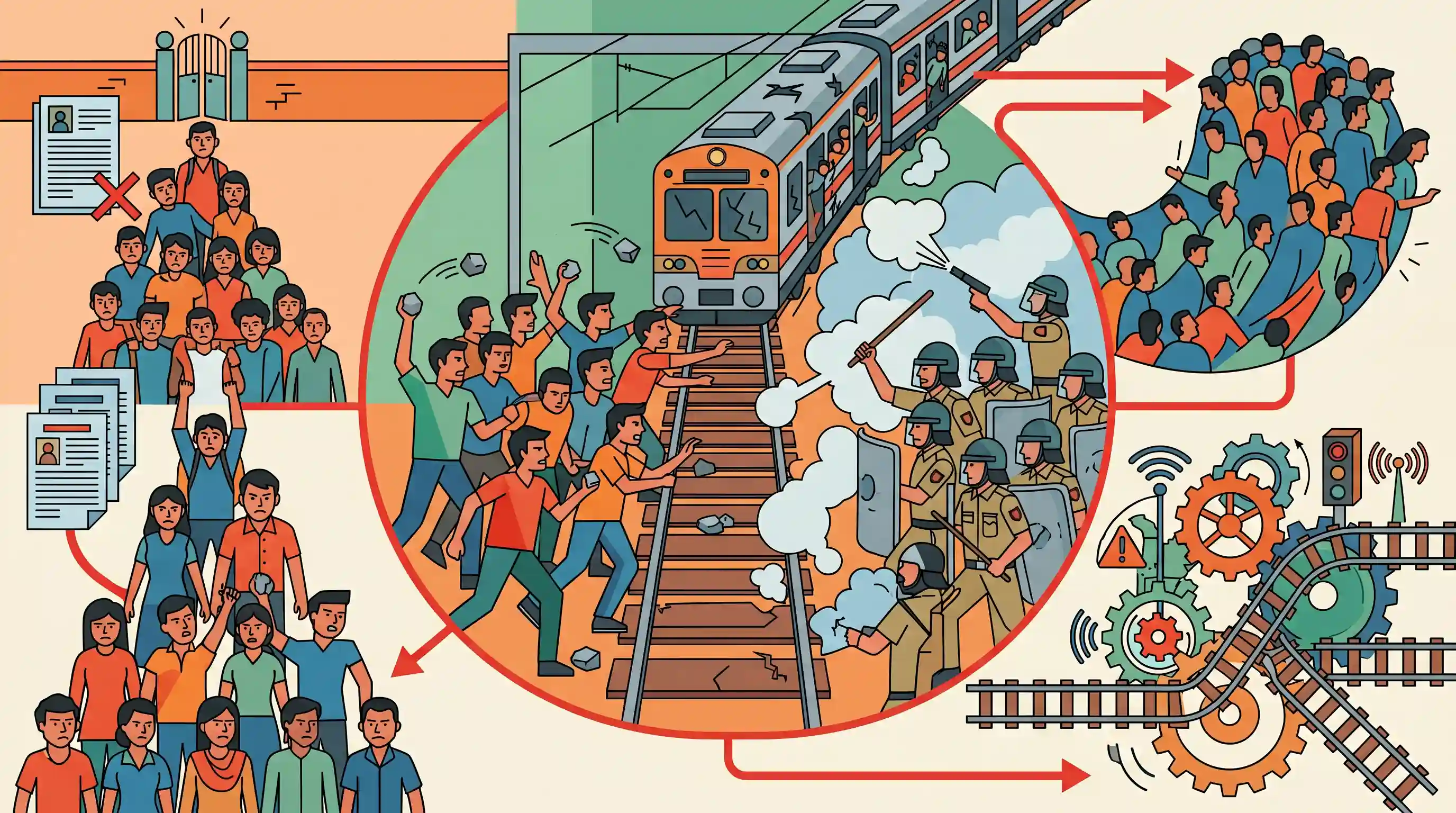
A mob of over 200 young men, claiming to be candidates for a competitive exam, violently disrupted railway traffic near Patna's Patliputra station to protest the lack of adequate trains. The escalating situation, which included stone-pelting, forced the police to deploy tear gas, lathi-charges, and aerial firing to clear the tracks. The incident underscores not only the logistical failures in managing infrastructure during mass competitive exams but also the deep-seated frustration and desperation among the youth regarding unemployment and the scarcity of government jobs.
Key Points
- Over 200 youths disrupted railway traffic near Patliputra station in Patna, demanding special trains for candidates appearing in an Excise Department competitive exam.
- The mob resorted to stone-pelting, prompting the police to use lathi-charges, tear gas, and warning shots to control the situation and restore public order.
- The incident exposes severe logistical inadequacies in public transport infrastructure during large-scale state-level competitive exams.
- The massive turnout and subsequent violent frustration highlight underlying socio-economic issues, particularly structural unemployment and the intense desperation for government jobs among the youth.
Important Terms
Indian Railways

The state-owned national railway system under the Ministry of Railways, serving as a critical infrastructure backbone for freight and passenger transport.
UPSC context
GS-3 (Infrastructure); tests knowledge of transport connectivity and its role in national socio-economic integration.
Demographic Dividend
The economic growth potential resulting from a shift in a population's age structure, where the working-age population (15-64) exceeds the dependent population.
UPSC context
GS-1 (Social Issues) and GS-3 (Human Resources); tests understanding of India's youth advantage versus unemployment challenges.
Structural Unemployment
A persistent form of joblessness caused by a mismatch between workers' skills and the specific requirements of available jobs in the market.
UPSC context
GS-3 (Economy); tests comprehension of labor market dynamics and the impacts of industrial shifts on employment.
Public Order
A state of societal peace and harmony; it is a State List subject under the Seventh Schedule (Entry 1) of the Indian Constitution.
UPSC context
GS-2 (Polity/Governance); tests understanding of federal divisions of power and the state's duty to maintain community safety.
Excise Department
A government body responsible for regulating the production and sale of specific goods (like alcohol) and collecting excise duty, a key state revenue source.
UPSC context
GS-2 (Statutory Bodies) and GS-3 (Taxation); tests knowledge of Entry 51 of the State List and administrative regulation.
Prelims Trap
"The desperation for government jobs highlights frictional unemployment in the economy."
Aspirants often confuse frictional or cyclical unemployment with structural unemployment, which is India's actual challenge: a fundamental mismatch between skills and available jobs.
Static Concepts Connected
What are the key types of unemployment prevalent in the Indian economy?
- Structural Unemployment: Mismatch between workforce skills and available jobs; the root cause of intense competition for government posts.
- Disguised Unemployment: More people engaged in an activity (like agriculture) than actually required for maximum productivity.
- Frictional Unemployment: Temporary joblessness occurring when individuals are transitioning between different jobs.
What are the core components of NDMA's Crowd Management Guidelines?
- Capacity Planning: Assessing venue/transport limits and arranging special provisions like extra trains based on projected footfalls.
- Risk Assessment: Identifying potential bottlenecks, structural weaknesses, and vulnerability to stampedes at major transit hubs.
- Information Dissemination: Using public address systems and displays to provide real-time updates, preventing panic and rumor-mongering.
Cross-Topic Patterns
Demographic Dividend vs Internal Security
The direct link between structural unemployment and mob violence bridges GS3 Economy (jobless growth) with GS3 Internal Security (youth radicalization and unrest).
Infra stress during mass transit
Connects everyday logistical failures (like exam transit) to disaster vulnerability, highlighting the critical need for NDMA crowd management protocols at railway stations.

Expect a GS3 Mains question linking jobless growth, structural unemployment, and the rising internal security threat of youth unrest.
Linked PYQs · 4
Linked PYQs · 4
- 2017MainsGS3
Mob violence is emerging as a serious law and order problem in India. By giving suitable examples, analyze the causes and consequences of such violence.
- 2014MainsGS3
While we flaunt India's demographic dividend, we ignore the dropping rates of employability. What are we missing while doing so? Where will the jobs that India desperately needs come from? Explain.
- 2023MainsGS3
Most of the unemployment in India is structural in nature. Examine the methodology adopted to compute unemployment in the country and suggest improvements.
- 2015MainsGS3
The nature of economic growth in India in recent times is often described as jobless growth. Do you agree with this view ? Give arguments in favour of your answer.
