Mob Attacks Police Outpost in Shahjahanpur Following Arrest
Source:The Hindu ↗
Why It Matters
This incident highlights critical UP-specific governance and legal issues: the administrative accountability and legal liabilities of local Gram Pradhans under the UP Panchayat Raj Act, the application of stringent child protection frameworks (POCSO), and police administration challenges related to public order and encounters in Uttar Pradesh.
Summary
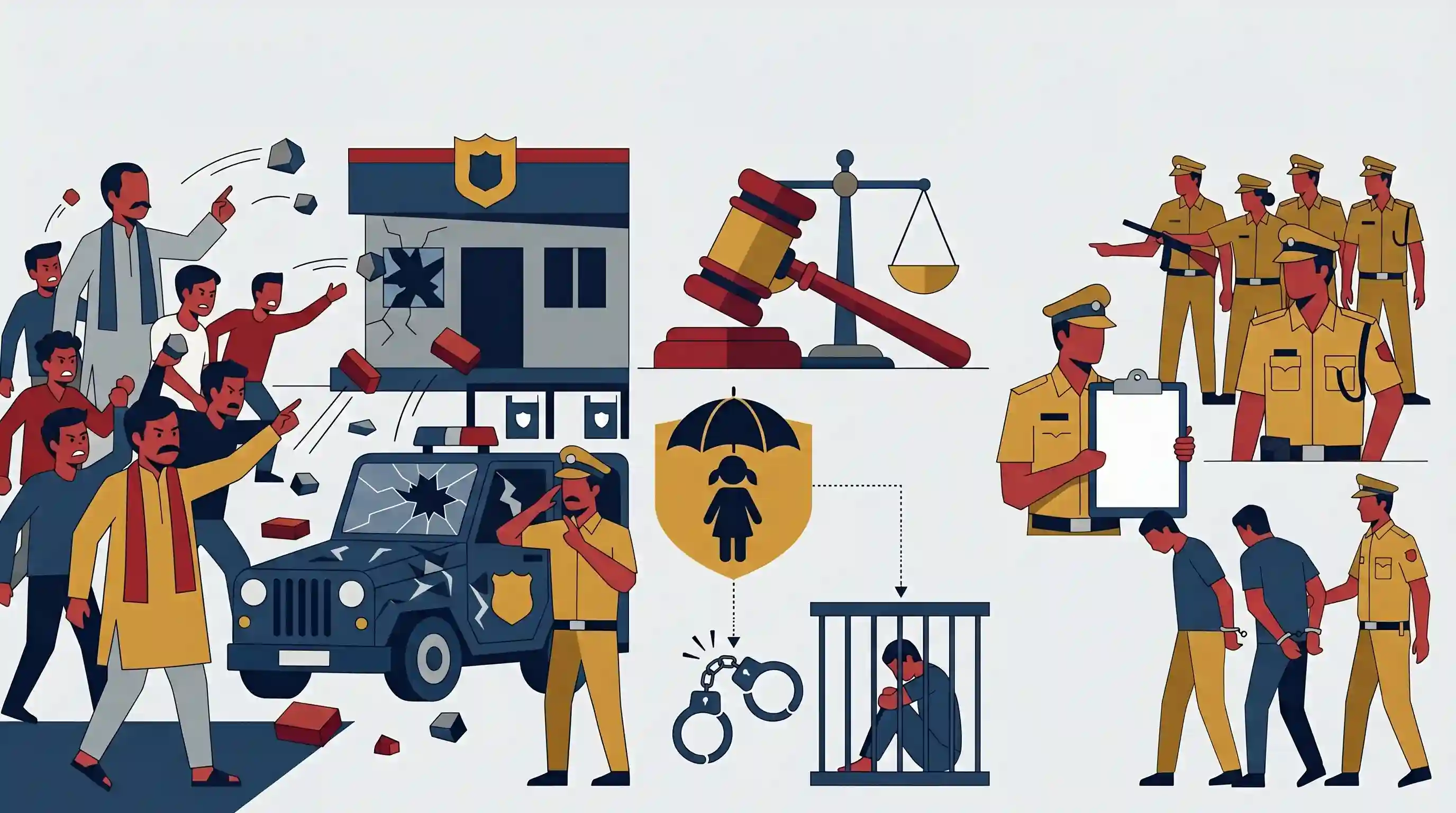
A violent mob, led by a local village head (Gram Pradhan) named Shobhit Kumar, attacked a police outpost in Shahjahanpur, Uttar Pradesh, demanding the release of Guddu Sharma, an accused arrested after a police encounter for allegedly raping a one-year-old toddler. The mob threw stones and targeted police vehicles, prompting a legal crackdown, including an FIR against the village head and the arrest of three individuals for rioting and damage to public property.
Key Points
- A mob led by village head (Gram Pradhan) Shobhit Kumar attacked a police outpost under the Khutar police station area in Shahjahanpur, Uttar Pradesh.
- The protest claimed that Guddu Sharma—arrested and injured in both legs during a police encounter for allegedly raping a one-year-old child—is innocent.
- The mob resorted to stone-pelting and attempted to overturn police vehicles, leading the police to use force to restore order.
- An FIR was registered against the village head and others under charges of rioting, damage to public property, and attacking public servants, resulting in the immediate arrest of three individuals (Basant, Rajendra, and Mohit).
Important Terms
Bharatiya Nyaya Sanhita (BNS)

The primary official criminal code of India, effective July 1, 2024, which replaced the colonial-era Indian Penal Code (IPC) of 1860, consolidating and modernizing criminal offenses and punishments.
UPSC context
GS Paper II (Polity & Governance) and GS Paper III (Internal Security); tests criminal justice reforms, legal updates, and human rights.
Protection of Children from Sexual Offences (POCSO) Act, 2012
A comprehensive Indian legislation designed to protect children under 18 from sexual assault, harassment, and pornography, establishing child-friendly investigation procedures and fast-track Special Courts.
UPSC context
GS Paper II (Social Justice/Vulnerable Sections); tests welfare schemes, institutional safeguards, and legislative measures for child protection and child rights.
Uttar Pradesh Recovery of Damage to Public and Private Property Act, 2020
A state law enabling the Uttar Pradesh government to set up tribunals for recovering financial compensation from perpetrators of property damage during riots, bandhs, protests, or public commotion.
UPSC context
GS Paper II (Judiciary & Executive) and GS Paper III (Law & Order); tests administrative mechanisms, public safety, and legal accountability.
Uttar Pradesh Panchayat Raj Act, 1947
The principal legislative framework governing the establishment, financial administration, duties, and executive functioning of rural local self-governments (Gram Panchayats) in Uttar Pradesh.
UPSC context
GS Paper II (Local Governance & Panchayati Raj Institutions); tests structural aspects, decentralization challenges, and grassroot-level accountability.
Indian Penal Code (IPC)
The historic criminal code of India enacted during the colonial era in 1860, which defined major offenses and prescribed punishments until its replacement by the BNS.
UPSC context
GS Paper II (Polity & Constitution); tests historical evolution of criminal law in India, judicial reforms, and legal transitions.
Prelims Trap
The State Election Commission has the constitutional power to remove a Gram Pradhan for criminal misconduct.
The State Election Commission only conducts elections. The power to suspend or remove local representatives lies with the State Government under state-specific laws.
Static Concepts Connected
How does the removal of a Gram Pradhan differ from that of MPs or MLAs?
- Governing Statutes: MPs and MLAs are disqualified under Articles 102/191 and the RPA 1951, whereas Gram Pradhans are governed entirely by state-specific Panchayati Raj Acts.
- Removal Authority: State executives (like District Magistrates) have direct statutory powers to suspend local body heads, unlike the judicial or gubernatorial processes required for legislators.
What legal mechanisms govern damage to public property during violent protests?
- Central Legislation: The Prevention of Damage to Public Property Act, 1984 prescribes up to five years of rigorous imprisonment for vandalism.
- Judicial Guidelines: The Supreme Court's Thomas Committee guidelines recommended shifting the burden of proof and creating strict liability for damages on organizers.
- State Interventions: Several states have enacted specific recovery laws allowing executive tribunals to confiscate personal assets of perpetrators to compensate for public damage.
Cross-Topic Patterns
PRI Autonomy vs District Law & Order
Decentralization can clash with district police administration when local elites leverage community mobilization to shield criminals, testing the delicate balance between grassroots governance and rule of law.
POCSO neutrality and BNS convergence
The BNS, 2023 introduces stringent minimum sentences for child sexual assault, requiring seamless procedural integration with the gender-neutral POCSO Act, 2012.

The authority of state executives to suspend PRI heads under state laws versus constitutional protections under Part IX is ripe for 2026.
Linked PYQs · 3
Linked PYQs · 3
- 2020UPPSC_PRELIMSGS1
The superintendence, direction and control of all elections to the Panchayats are vested in
- 2014UPPSC_PRELIMSGS1
Which one of the following statements is correct about an amendment in an article of Penal Code made by the Parliament of Morocco on 23rd January, 2014?
- 2024UPPSC_PRELIMSGS1
Which of the following are envisaged by the Right against Exploitation in the Constitution of India ? 1. Abolition of untouchability 2. Prohibition of human trafficking and forced labour 3. Prohibition of employment of children in factories and mines 4. Protection of interests of minorities Select the correct answer from the codes given below :
