Green Energy and Port Infrastructure Initiatives at VOC Port
Source:The Hindu ↗
Why It Matters
Showcases a concrete roadmap for India's maritime sector to achieve Net Zero emissions, acting as an excellent case study for sustainable port operations, clean tech integration, and the creation of green fuel corridors.
Summary
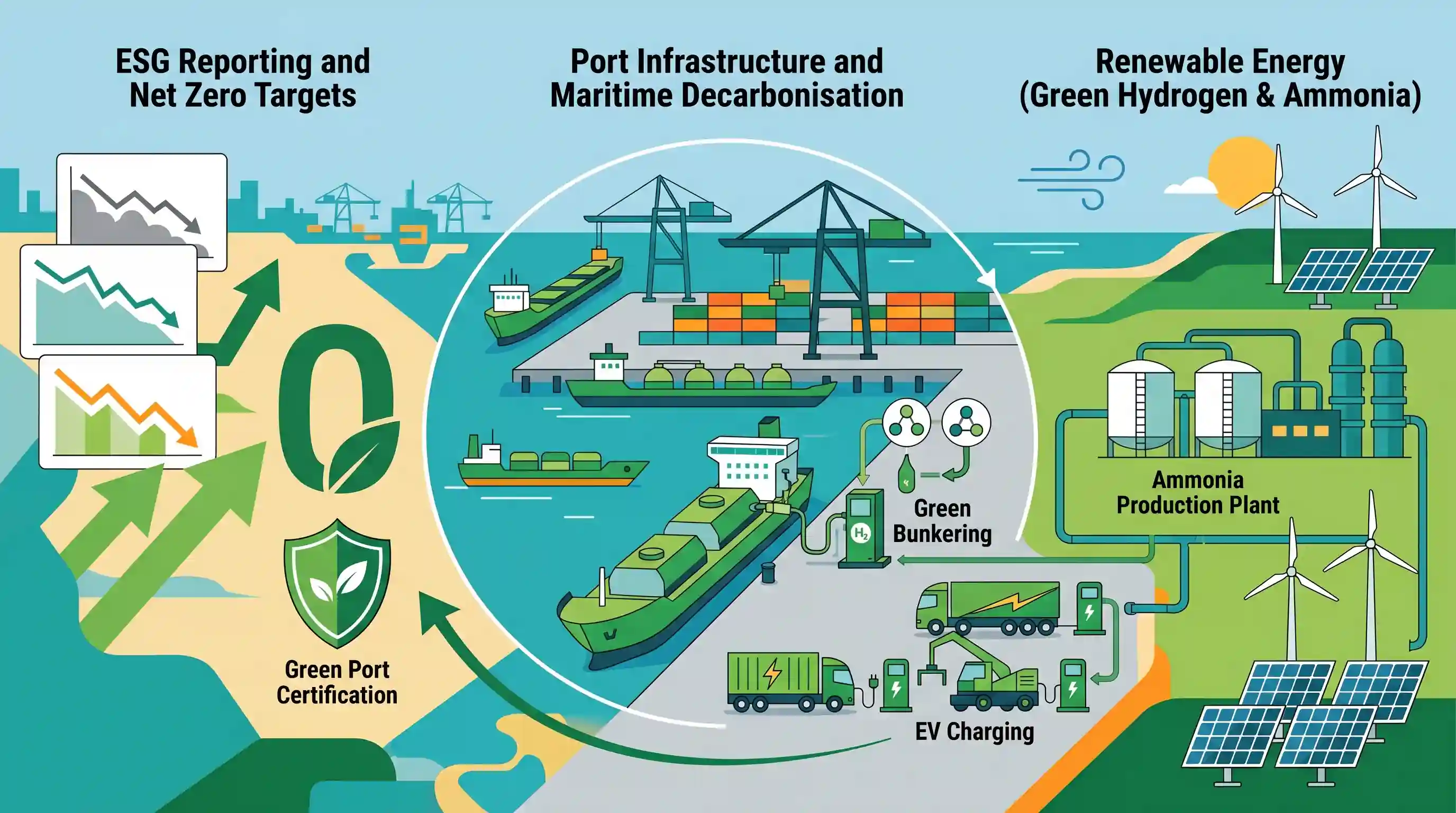
The Ministry of New and Renewable Energy (MNRE) reviewed sweeping green infrastructure initiatives at the V.O. Chidambaranar (VOC) Port in Thoothukudi. Driving India's maritime energy transition, the port signed MoUs with Bureau Veritas for green port certification and ESG reporting, and with AM Green Ammonia for a 1-million-ton ammonia production plant and bunkering infrastructure. The port is positioning itself as a hub for green fuel corridors to Europe and Asia, integrating green hydrogen, wind power, EV charging, and green ethanol bunkering to accelerate decarbonisation and achieve Net Zero emissions.
Key Points
- The MNRE Secretary reviewed comprehensive green infrastructure initiatives at VOC Port, positioning it as a model for India's maritime energy transition.
- An MoU with Bureau Veritas covers green port certification, ESG reporting, emissions accounting, and the establishment of a Centre of Excellence for green fuels and sustainability.
- An MoU with AM Green Ammonia aims to develop a 1-million-ton per annum ammonia production plant alongside green ammonia handling, storage, and bunkering infrastructure.
- The initiatives are designed to facilitate the creation of green fuel corridors connecting VOC Port with markets in Europe and Asia.
- The port's ongoing decarbonisation efforts include a green hydrogen pilot plant, wind power projects, EV charging, and green ethanol bunkering facilities to achieve Net Zero emissions.
Important Terms
Ministry of New and Renewable Energy (MNRE)

The nodal ministry for renewable energy in India, responsible for the National Green Hydrogen Mission and achieving the country’s 500 GW non-fossil capacity target by 2030.
UPSC context
GS-II (Governance) & GS-III (Energy); tests institutional roles in India's energy transition and climate policy implementation.
V.O. Chidambaranar Port (VOC Port)
A major port in Thoothukudi, Tamil Nadu, designated as one of India's first Green Hydrogen Hubs to facilitate sustainable maritime fuel production and exports.
UPSC context
GS-I (Geography) & GS-III (Infrastructure); tests port-led development and maritime decarbonization strategies.
National Green Hydrogen Mission (NGHM)
A flagship government initiative aiming to produce 5 MMT of green hydrogen annually by 2030, positioning India as a global hub for production and export.
UPSC context
GS-III (Environment/Energy); tests flagship policy objectives and strategic sectoral interventions (SIGHT).
Green Ammonia
A carbon-neutral derivative of green hydrogen produced via renewable-powered electrolysis, serving as a zero-emission shipping fuel and a feedstock for decarbonizing the fertilizer industry.
UPSC context
GS-III (S&T/Environment); tests understanding of alternative fuels and decarbonization of hard-to-abate sectors.
ESG Reporting
Disclosures regarding Environmental, Social, and Governance metrics, essential for corporate accountability and sustainable finance under SEBI's Business Responsibility and Sustainability Reporting (BRSR) framework.
UPSC context
GS-III (Economy/Corporate Governance); tests regulatory compliance and sustainable investment mechanisms.
Green Shipping Corridors
Zero-emission maritime routes established through international collaboration to pilot and scale low-carbon fuels like green methanol and ammonia in global trade.
UPSC context
GS-III (Infrastructure/International Relations); tests global climate cooperation and logistics innovation.
Prelims Trap
"VOC Port is the sole major Indian port designated as a Green Hydrogen Hub."
False. Under the National Green Hydrogen Mission, both Deendayal Port (Kandla) and VOC Port (Thoothukudi) were initially identified to be developed as green hydrogen hubs.
Static Concepts Connected
What are the core objectives of the 'Harit Sagar' Green Port Guidelines?
- Zero Carbon Goal: Maximizing renewable energy use at major Indian ports to slash Scope 1 and 2 greenhouse gas emissions and achieve Net Zero.
- ESG Integration: Mandates the establishment of Environmental, Social, and Governance (ESG) reporting frameworks for port operations and emissions accounting.
- Nature-based Solutions: Promotes green cover expansion, safe reuse of dredging material, and coastal habitat protection alongside infrastructure development.
How is 'Green Ammonia' produced compared to conventional methods?
- Renewable Hydrogen: It uses hydrogen produced by splitting water (electrolysis) powered exclusively by renewable energy, rather than extracting it from natural gas (Grey/Blue Ammonia).
- Atmospheric Nitrogen: Nitrogen is separated directly from the ambient air using specialized air separation units.
- Zero-Carbon Synthesis: The hydrogen and nitrogen are combined via the Haber-Bosch process without relying on fossil fuels, creating a viable zero-emission marine fuel.
Cross-Topic Patterns
Maritime Decarbonisation + Green Hydrogen Mission
Port infrastructure upgrades (like bunkering) are essential downstream enablers for India's National Green Hydrogen Mission target of reaching 5 MMT of annual production capacity by 2030.
ESG in Public Infra + SEBI's BRSR
Ports proactively adopting ESG reporting and emissions accounting mirrors the broader regulatory push seen in SEBI's Business Responsibility and Sustainability Reporting (BRSR) for top corporate entities.

Expect a 2026 Prelims question pairing green shipping corridors with specific major ports (VOC/Deendayal) and 'Harit Sagar' guidelines.
Linked PYQs · 4
Linked PYQs · 4
- 2025MainsGS3
How can India achieve energy independence through clean technology by 2047? How can biotechnology can play a crucial role in this endeavour?
- 2023MainsGS3
The adoption of electric vehicles is rapidly growing worldwide. How do electric vehicles contribute to reducing carbon emissions and what are the key benefits they offer compared to traditional combustion engine vehicles?
- 2023PrelimsGS1
With reference to green hydrogen, consider the following statements: 1. It can be used directly as a fuel for internal combustion. 2. It can be blended with natural gas and used as fuel for heat or power generation. 3. It can be used in the hydrogen fuel cell to run vehicles. How many of the above statements are correct?
- 2023PrelimsGS1
Consider the following heavy industries: 1. Fertilizer plants 2. Oil refineries 3. Steel plants Green hydrogen is expected to play a significant role in decarbonizing how many of the above industries?
