Solar Upstream Manufacturing Capex Relief and Energy Security
Source:Indian Express ↗
Why It Matters
Highlights a critical vulnerability in India's clean energy transition—the lack of upstream solar manufacturing capacity (polysilicon and wafers). It underscores the need for targeted industrial policies beyond the PLI scheme to achieve true self-reliance and energy security against global supply chain shocks.
Summary
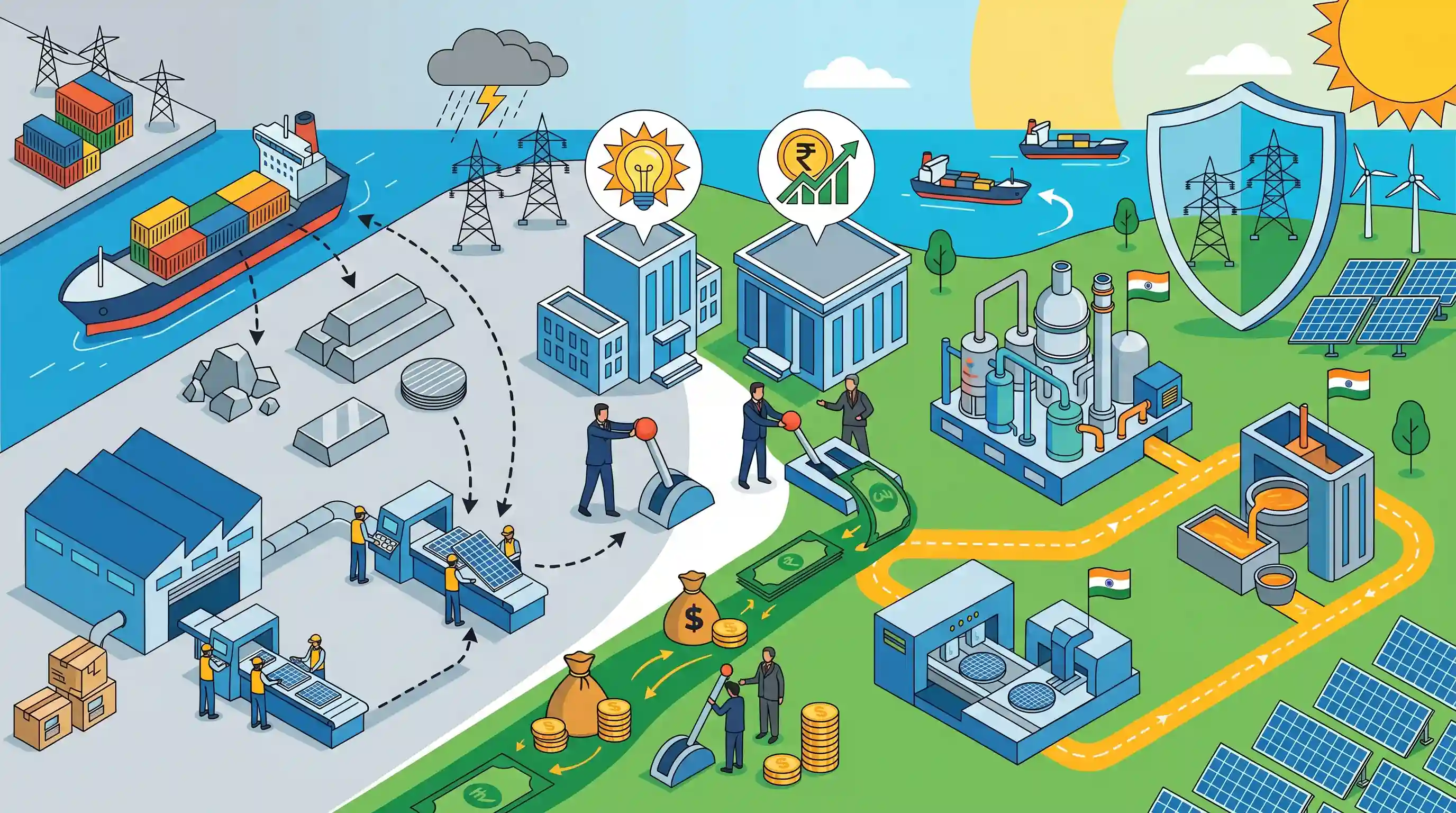
The Ministry of New and Renewable Energy (MNRE) and the Finance Ministry are in discussions to provide capital expenditure (capex) relief to domestic manufacturers of upstream solar components, including ingots, wafers, and polysilicon. Currently, India’s solar manufacturing capacity is heavily concentrated in the downstream stages (cell and module assembly), leaving the country heavily dependent on imports—predominantly from China—for upstream raw materials. While the Production Linked Incentive (PLI) scheme for high-efficiency solar PV modules aims to boost integrated manufacturing, specific capex subsidies for the highly capital-intensive upstream stages are being considered to reduce import dependency, enhance energy security, and fully realize the Aatmanirbhar Bharat vision in the renewable energy sector.
Key Points
- The MNRE and Finance Ministry are discussing capital expenditure (capex) relief to incentivize the domestic manufacturing of upstream solar components such as polysilicon, ingots, and wafers.
- India currently has significant capacity in downstream solar module and cell assembly but relies almost entirely on imports (predominantly from China) for upstream raw materials like silicon wafers.
- The proposed capex subsidies aim to complement the existing Production Linked Incentive (PLI) scheme, which may not adequately offset the massive initial capital costs required for establishing upstream polysilicon and ingot facilities.
- Developing an end-to-end domestic solar supply chain is critical for ensuring energy security, preventing supply chain disruptions, and reducing the foreign exchange burden of solar imports.
Important Terms
PLI Scheme for High-Efficiency Solar PV Modules

A central government program providing performance-linked incentives to boost domestic manufacturing of solar cells and modules. It aims to reduce import dependence and enhance local value addition in the renewable sector.
UPSC context
GS III (Economy/Energy); tests understanding of industrial policy and indigenous manufacturing strategies in high-tech sectors.
Aatmanirbhar Bharat
A national mission launched in 2020 focusing on self-reliance through five pillars: Economy, Infrastructure, System, Demography, and Demand. It prioritizes domestic production and import substitution to secure India's global economic position.
UPSC context
GS III (Economy/Infrastructure); central theme for questions on economic development, self-sufficiency, and post-COVID recovery.
Polysilicon, Ingots, and Wafers
The core upstream stages of the solar manufacturing chain. Polysilicon is refined silicon melted into blocks (ingots) and sliced into thin sheets (wafers), which serve as the base material for solar cells.
UPSC context
GS III (Energy/Environment); crucial for understanding technical barriers in the renewable energy supply chain and import dependency.
Capital Expenditure (Capex)
Investment funds used by companies to acquire or upgrade physical assets like machinery and factories. High capex requirements in upstream solar manufacturing necessitate government support like subsidies or tax relief.
UPSC context
GS III (Economy); relevant for fiscal policy, investment models, and government-led incentive frameworks.
Ministry of New and Renewable Energy (MNRE)
The nodal Indian government agency responsible for policy formulation and implementation in the renewable energy sector. It oversees the National Solar Mission and the PLI solar scheme.
UPSC context
GS II (Government Policies); relevant for questions regarding India’s energy transition and climate change commitments.
Energy Security
The continuous and affordable availability of energy sources. In solar policy, it focuses on domesticating the supply chain to prevent disruptions from geopolitical tensions or global market fluctuations.
UPSC context
GS III (Environment) and GS II (International Relations); key concept for discussions on national sovereignty and sustainable development.
Prelims Trap
The PLI scheme for Solar PV modules provides upfront capital subsidies to domestic manufacturers.
PLI provides financial incentives based on incremental sales post-production. It does not fund upfront capital expenditure, which is why separate capex relief is being proposed.
Static Concepts Connected
What are the stages of the Solar Photovoltaic (PV) manufacturing value chain?
- Raw Material: Mining silica and refining it into metallurgical-grade silicon.
- Upstream Stages: Producing high-purity polysilicon, melting it to cast solid ingots, and slicing them into ultra-thin wafers. This is highly capital and energy-intensive.
- Downstream Stages: Treating wafers to create photoelectric solar cells, and assembling these cells into final solar panels (modules) for deployment.
How does the PLI scheme structurally differ from capital expenditure (capex) subsidies?
- Outcome-based Sales: PLI provides financial rewards calculated as a percentage of incremental sales of domestically manufactured goods over a base year.
- Upfront Risk: Unlike capex subsidies that help fund the initial purchase of land, machinery, and factory setup, PLI requires companies to absorb the initial setup risk.
Cross-Topic Patterns
Supply Chain Resilience & Quad
The push for upstream solar indigenization aligns directly with India's Critical Minerals Mission and the Quad's Supply Chain Resilience Initiative (SCRI) to break Chinese monopolies in green tech.
Trade Defense & WTO Compliance
India couples tariff barriers like Basic Customs Duty (BCD) on solar imports with domestic subsidies (PLI/Capex) to achieve import substitution without violating WTO national treatment principles.

Expect a 2026 prelims question distinguishing PLI's sales-based incentives from upfront capex, mapped to the solar PV supply chain stages.
Linked PYQs · 4
Linked PYQs · 4
- 2025MainsGS3
Discuss the rationale of the Production Linked Incentive (PLI) scheme. What are its achievements? In what way can the functioning and outcomes of the scheme be improved?
- 2020MainsGS3
Describe the benefits of deriving electric energy from sunlight in contrast to the conventional energy generation. What are the initiatives offered by our Government for this purpose?
- 2018PrelimsGS1
With reference to solar power production in India, consider the following statements : 1. India is the third largest in the world in the manufacture of silicon wafers used in photovoltaic units. 2. The solar power tariffs are determined by the Solar Energy Corporation of India. Which of the statements given above is/are correct?
- 2014PrelimsGS1
With reference to technologies for solar power production, consider the following statements: 1. 'Photovoltaics' is a technology that generates electricity by direct conversion of light into electricity, while 'Solar Thermal' is a technology that utilizes the Sun's rays to generate heat which is further used in electricity generation process. 2. Photovoltaics generates Alternating Current (AC), while Solar Thermal generates Direct Current (DC). 3. India has manufacturing base for Solar Thermal technology, but not for Photovoltaics. Which of the statements given above is/are correct?
