MMDR Amendment Act Streamlines Mineral Taxation and Boosts Investment
Source:The Hindu ↗
આ શા માટે મહત્વનું છે
The amendment is a significant economic and federal reform that centralizes the taxation framework for minerals to ensure business predictability. It addresses the friction between State revenue generation and national industrial growth, aiming to secure critical raw materials and attract foreign and domestic capital.
સારાંશ
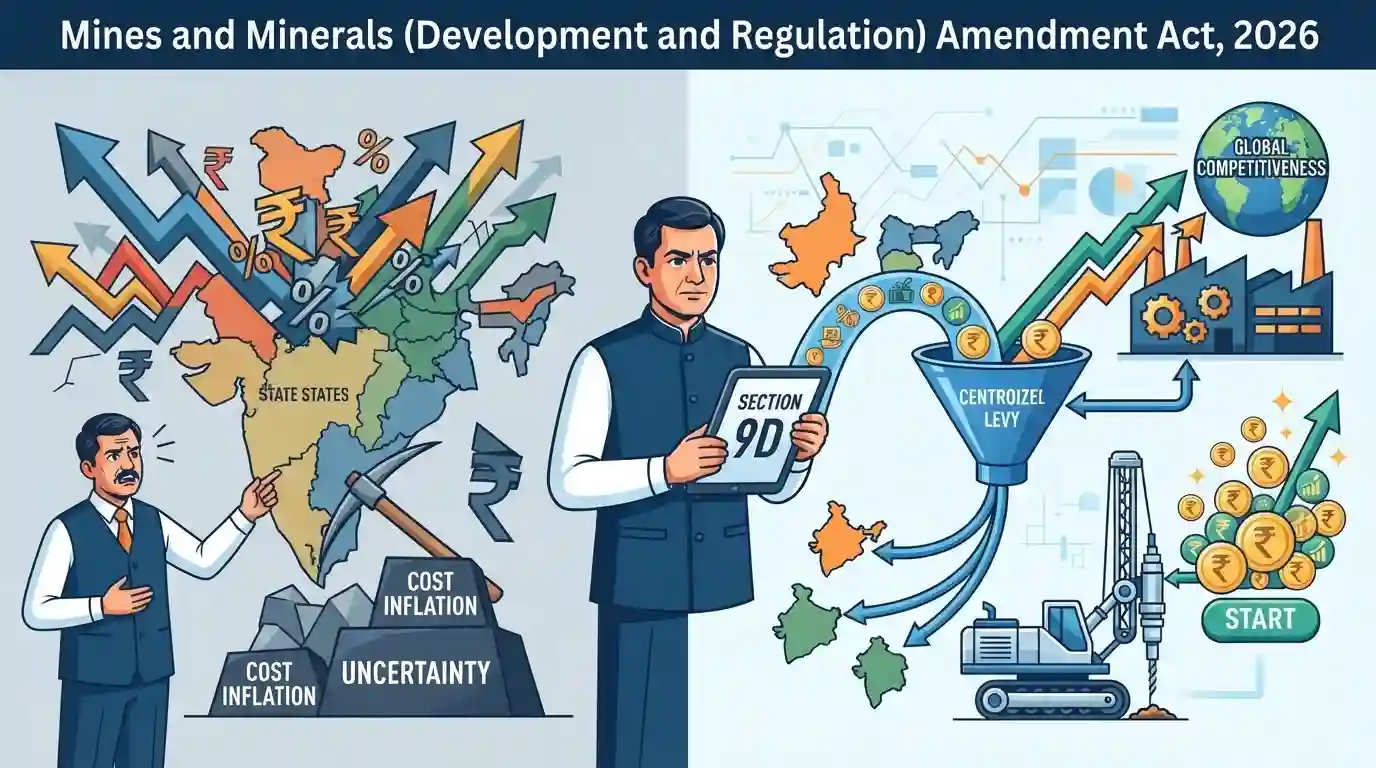
The Mines and Minerals (Development and Regulation) Amendment Act, 2026, recently passed by Parliament, is set to overhaul the regulatory and taxation framework of India's mining sector. The amendment curtails the power of states to levy non-uniform taxes and unexpected cesses, which previously inflated extraction costs. By introducing Section 9D, the Act empowers the Centre to implement a streamlined, predictable levy system on mineral-bearing lands. Industry figures, including FICCI Mining Committee Chair Amitava Mukherjee, note that this uniformity will attract fresh capital investment, accelerate exploration, and make domestic mineral production globally competitive.
મુખ્ય મુદ્દા
- Parliament has passed the MMDR Amendment Act, 2026, restricting State Governments' ability to impose arbitrary taxes and cesses on minerals.
- A newly introduced Section 9D grants the Central Government the power to streamline levies on mineral-bearing lands, ensuring a uniform and predictable tax regime nationwide.
- The reforms are aimed at mitigating high extraction costs previously exacerbated by fragmented and non-uniform state levies.
- Industry leaders expect the legislative change to stimulate fresh capital investments, fast-track mineral exploration, and boost the global competitiveness of India's domestic mineral production.
મહત્વપૂર્ણ શબ્દો
Mines and Minerals (Development and Regulation) Amendment Act, 2026

A 2026 Indian legislation that brings mineral-bearing lands under Union control and introduces Section 9D, restricting state governments from imposing arbitrary or non-uniform levies on mineral rights.
UPSC context
GS Paper III: Resource Mobilization; tests federal division of powers, resource taxation, and critical mining reforms.
National Mineral Development Corporation
India's largest iron ore producer and a Navratna Central Public Sector Enterprise under the Ministry of Steel, engaged in resource exploration, mechanized mining, and ensuring domestic mineral security.
UPSC context
GS Paper III: Public Sector Undertakings; tests state-run mining and raw material self-reliance.
Federation of Indian Chambers of Commerce & Industry
Established in 1927, India's oldest and largest apex non-governmental business organization, representing private and public industry interests and serving as a key policy advocacy bridge.
UPSC context
GS Paper III: Economic Policy; tests the influence of trade associations on government policymaking.
પ્રિલિમ્સ ટ્રેપ
The MMDR Amendment Act, 2026 strips State governments of all mining-related revenue, including royalties, auction premiums, and DMF payments.
States still retain approximately 90% of mining-sector revenues; the Act only bars them from imposing additional, arbitrary taxes and cesses on mineral-bearing lands.
સંલગ્ન સ્થિર ખ્યાલો
What constitutional entries govern the distribution of mineral regulatory powers?
- Entry 54 (Union): Covers regulation of mines and mineral development declared by Parliament to be of public interest.
- Entry 23 (State): Covers regulation of mines subject to Union List provisions (Entry 54).
- Entry 50 (State): Permits states to tax mineral rights, subject to limitations imposed by Parliament's laws.
What is the core distinction between Entry 49 and Entry 50 of the State List?
- Entry 49: Covers taxes on lands and buildings; states have argued this permits taxing physical land beneath minerals.
- Entry 50: Covers taxes on mineral rights, which can be limited by parliamentary legislation passed under Entry 54.
- Conflict resolution: Parliament can limit state taxation under Entry 50, but historically not under Entry 49 unless overriding legislation is passed.
આંતર-વિષય પેટર્ન
Judicial Overrules and Fiscal Federalism
Explores how parliamentary amendments override landmark Supreme Court judgments, impacting federal tax devolution and state fiscal autonomy.
Mineral Security and Ease of Doing Business
Links uniform national taxation to attracting foreign direct investment (FDI) in high-risk deep-seated critical mineral exploration.

Expect a question on the conflict between Entry 49/50 of the State List and Entry 54 of the Union List post-MADA ruling override.
સંલગ્ન PYQ · 4
સંલગ્ન PYQ · 4
- 2025MainsGS2
Examine the evolving pattern of Centre-State financial relations in the context of planned development in India. How far have the recent reforms impacted the fiscal federalism in India?
- 2025PrelimsGS1
Consider the following statements : Statement I: In India, State Governments have no power for making rules for grant of concessions in respect of extraction of minor minerals even though such minerals are located in their territories. Statement II: In India, the Central Government has the power to notify minor minerals under the relevant law. Which one of the following is correct in respect of the above statements?
- 2019PrelimsGS1
With reference to the management of minor minerals in India, consider the following statements: 1. Sand is a 'minor mineral' according to the prevailing law in the country. 2. State Governments have the power to grant mining leases of minor minerals, but the powers regarding the formation of rules related to the grant of minor minerals lie with the Central Government. 3. State Governments have the power to frame rules to prevent illegal mining of minor minerals. Which of the statements given above is/are correct?
- 2025PrelimsGS1
Consider the following statements : I. India has joined the Minerals Security Partnership as a member. II. India is a resource-rich country in all the 30 critical minerals that it has identified. III. The Parliament in 2023 has amended the Mines and Minerals (Development and Regulation) Act, 1957 empowering the Central Government to exclusively auction mining lease and composite license for certain critical minerals. Which of the statements given above are correct?
