Strategic Friction and Trade Negotiations in India US Relations
Source:The Hindu ↗
Why It Matters
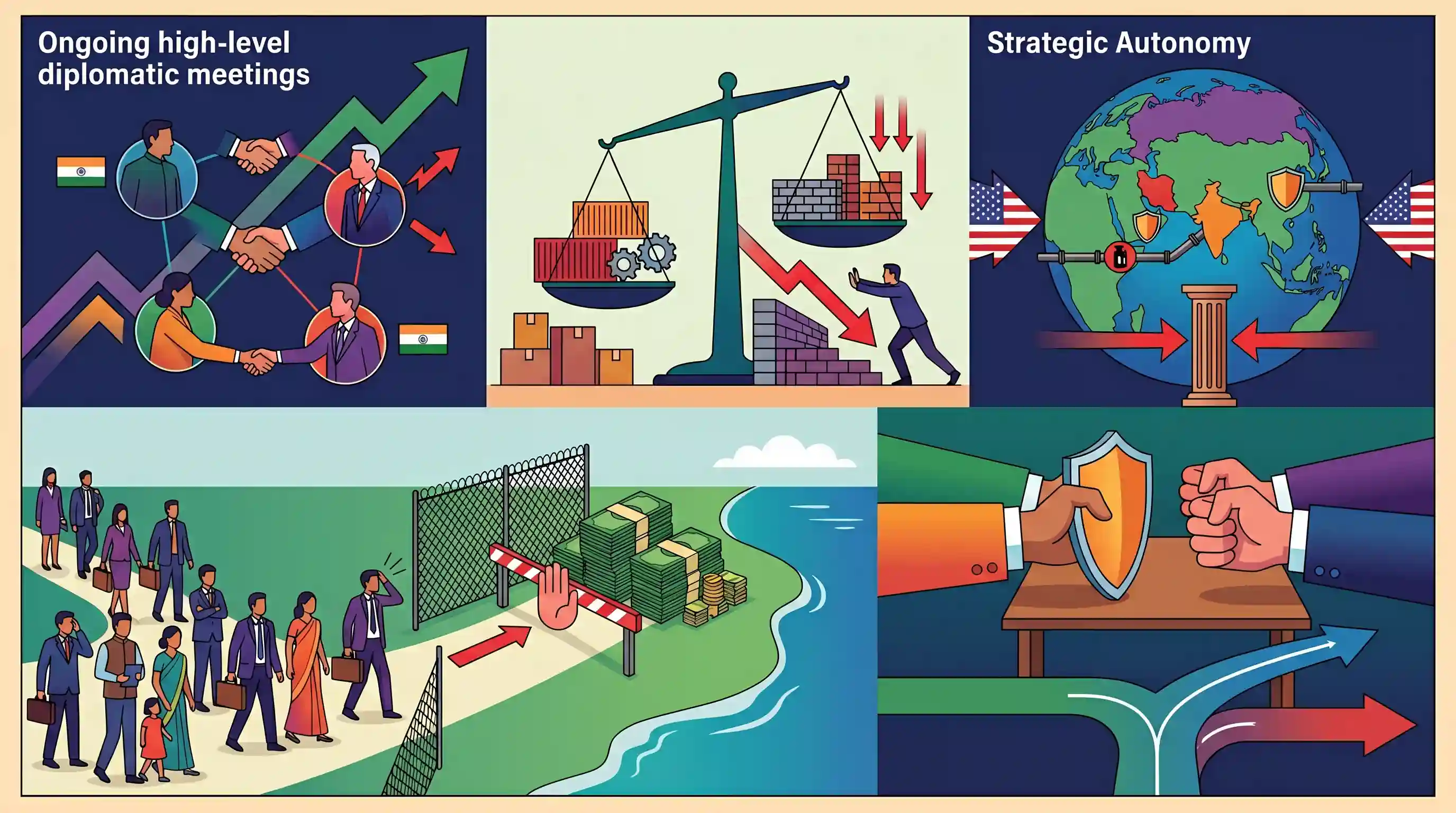
The article provides a critical evaluation of the shifting dynamics in the India-US strategic partnership. It directly addresses key UPSC Mains themes such as the impact of US policies on India's strategic autonomy (e.g., Russian oil purchases, Iran sanctions) and economic interests (trade tariffs, H-1B visas), making it highly relevant for International Relations.
Summary
The article analyzes the evolving India-U.S. bilateral relationship ahead of potential leadership meetings, highlighting a mix of strategic cooperation and emerging friction points under the new Trump administration. While high-level diplomatic visits and negotiations on trade and defence are resuming, the U.S. has intensified pressure on India through actions like revoking the Chabahar port sanctions waiver, proposing an exorbitant $100,000 H-1B visa fee, and pressing India to curb Russian oil purchases. The editorial suggests that while trade concessions may be necessary, India must adopt a firm negotiating stance and be willing to walk away rather than yield to coercive tactics aimed at limiting its strategic autonomy.
Key Points
- Diplomatic engagements are regaining momentum, marked by visits from the U.S. Secretary of State and a potential Modi-Trump meeting at upcoming summits.
- The U.S. is demanding greater market access for its agriculture, dairy, and GM foods, while India seeks a broader Free Trade Agreement (FTA) and U.S. investments.
- Tensions have risen due to the new Trump administration's revocation of the sanctions waiver for India's Chabahar port operations and a proposed $100,000 fee for H-1B visas.
- The U.S. is intensifying pressure on India to halt Russian oil imports and is offering to mediate the India-Pakistan conflict, challenging India's strategic autonomy.
- The editorial advises India to maintain a firm negotiating stance and be prepared to walk away from talks rather than cave to coercive pressure tactics.
Important Terms
H-1B Visa

A non-immigrant U.S. visa allowing companies to hire foreign workers in specialty occupations (STEM, IT) requiring technical expertise; predominantly used by the Indian diaspora.
UPSC context
GS Paper 2 (Indian Diaspora). Tests knowledge of migration policy's impact on India-US economic ties and IT services.
Strategic Autonomy
India's policy of making independent foreign and defense decisions based on national interest, resisting external pressure or formal military alliances with any single power.
UPSC context
GS Paper 2 (International Relations). Core concept for analyzing India's multi-alignment and balancing acts between global powers.
Chabahar Port
Iran’s only oceanic deep-sea port, developed with Indian investment to bypass Pakistan and provide a strategic trade gateway to Afghanistan and Central Asia.
UPSC context
GS Paper 2 (Bilateral Relations). Essential for understanding regional connectivity, the INSTC, and India's geopolitical reach.
CAATSA
A 2017 U.S. law that imposes sanctions on countries conducting 'significant transactions' with Russia’s defense or intelligence sectors, often used as leverage in trade talks.
UPSC context
GS Paper 2 (Effect of policies of developed countries on India). Crucial for defense procurement and energy security discussions.
Free Trade Agreement (FTA)
A pact between nations to reduce or eliminate tariffs and trade barriers; often a major point of negotiation in India-US economic relations.
UPSC context
GS Paper 3 (Indian Economy/Trade). Tests understanding of market access, protectionism, and bilateral economic integration.
Quad
A strategic security dialogue between India, the US, Japan, and Australia focused on maintaining a free and open Indo-Pacific region.
UPSC context
GS Paper 2 (Regional Groupings). Key for analyzing maritime security and India's evolving partnership with Western allies.
Sanctions Waiver
An official exemption granted by a government (e.g., the US) allowing a third party (e.g., India) to bypass certain sanctions for specific projects or trade.
UPSC context
GS Paper 2 (International Relations). Tests knowledge of diplomatic leverage and tools used to manage strategic interests amidst conflict.
Prelims Trap
The UN or friendly nations like the US can officially mediate the India-Pakistan dispute.
The 1972 Shimla Agreement strictly establishes that all disputes between India and Pakistan must be resolved bilaterally, legally barring any third-party mediation.
Static Concepts Connected
How do secondary sanctions like CAATSA impact India's strategic projects?
- Secondary Sanctions: Penalize third-country entities (like Indian firms) for doing business with sanctioned nations (like Iran or Russia), cutting them off from the US financial system.
- CAATSA: Countering America's Adversaries Through Sanctions Act (CAATSA) is the US law impacting India's defence deals with Russia and port connectivity projects in Iran.
- Waiver Mechanism: The US President can grant specific waivers on national security grounds. The revocation of the Chabahar waiver exposes Indian operators to immediate sanctions risks.
Why does India restrict dairy and GM crop imports from the United States?
- SPS Measures: Sanitary and Phytosanitary (SPS) measures under the WTO allow India to restrict agricultural imports for human, animal, or plant health and safety reasons.
- Cultural Norms: India rejects US dairy imports because US cattle are often fed with animal-blood or bone meal, which violates domestic cultural and religious norms regarding vegetarianism.
- Biosafety Concerns: India strictly regulates Genetically Modified (GM) foods through the GEAC (under MoEFCC) due to biosafety concerns, resisting US demands for unrestricted market access.
Cross-Topic Patterns
Chabahar, INSTC & Central Asia Transit
Revoking the Chabahar waiver doesn't just affect bilateral India-Iran ties; it cripples India's primary node for the International North-South Transport Corridor (INSTC) and its Central Asian connectivity bypassing Pakistan.
Energy Security vs. Domestic Inflation
US pressure to halt Russian oil purchases clashes directly with India's domestic inflation management, where discounted crude has acted as a crucial macroeconomic shock absorber over the last three years.

Expect a 2026 Prelims question linking CAATSA secondary sanctions, the geographical location of Chabahar port, and the INSTC route.
Linked PYQs · 5
Linked PYQs · 5
- 2020MainsGS2
Quadrilateral Security Dialogue (Quad)' is transforming itself into a trade bloc from a military alliance, in present times - Discuss.
- 2012MainsGS2
How have the US sanctions against Iran affected India's bilateral relations with Iran?
- 2018MainsGS2
In what ways would the ongoing US-Iran Nuclear Pact Controversy affect the national interest of India? How should India respond to this situation?
- 2020MainsGS2
Indian diaspora has a decisive role to play in the politics and economy of America and European Countries'. Comment with examples.
- 2018MainsGS2
What are the key areas of reform if the WTO has to survive in the present context of "Trade War', especially keeping in mind the interest of India?
