Mission Mausam Initiative for Weather Readiness and Climate Adaptation
Source:The Hindu ↗
Why It Matters
Mission Mausam represents a significant technological leap in India's disaster preparedness and climate adaptation strategy, directly relevant to GS3 (Disaster Management and Environment). Its integration of IoT and crowd-sourcing into early warning systems presents a strong case study for Mains answers on mitigating climate-induced extreme weather events.
Summary
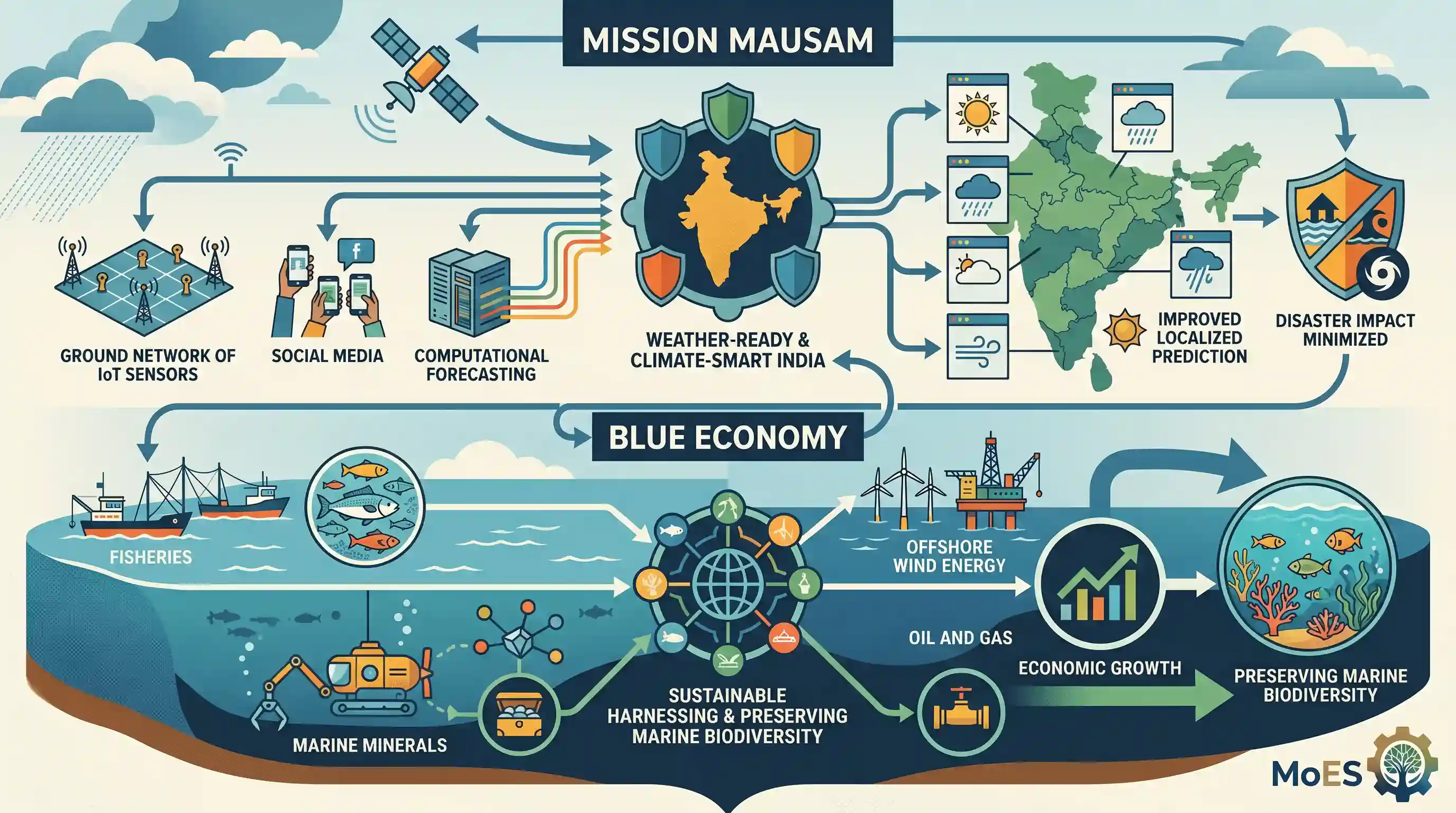
The Ministry of Earth Sciences has highlighted 'Mission Mausam', a Union Government initiative aimed at making India 'weather-ready' and 'climate-smart'. Delivering a memorial lecture in Visakhapatnam, the MoES Secretary detailed the mission's reliance on real-time data assimilation via IoT, social media, and ensemble forecasting to improve localized weather prediction and minimize disaster impacts. He also emphasized the immense potential of India's Blue Economy—advocating for the sustainable harnessing of fisheries, marine minerals, offshore wind energy, and oil and gas to accelerate economic growth while preserving marine biodiversity.
Key Points
- Mission Mausam aims to make India weather-ready and climate-smart by leveraging IoT platforms, crowd-sourced observations, and ensemble forecasting.
- The initiative focuses on reducing the socio-economic impacts of natural disasters through early warnings and jargon-free weather dissemination.
- The Ministry highlighted the ocean as an 'ocean of opportunities' emphasizing the Blue Economy's potential in fisheries, offshore oil and gas, and wind energy.
- Sustainable utilization of marine resources, marine minerals, desalinated water, and geo-heritage coastal tourism were deemed vital for economic growth and maintaining ocean ecosystem health.
Important Terms
Mission Mausam

A Ministry of Earth Sciences initiative launched in 2024 to enhance India's weather forecasting and climate resilience through advanced technologies like AI/ML, aiming for 'Panchayat-level' accuracy by 2030.
UPSC context
GS Paper 3 (Science & Technology; Disaster Management). Tests knowledge of national missions for climate adaptation and disaster risk reduction.
Ministry of Earth Sciences
The nodal government body in India responsible for meteorological, oceanographic, and seismological services, managing agencies like the IMD, IITM, and NCMRWF to provide weather and disaster alerts.
UPSC context
GS Paper 2 (Governance) & GS Paper 3 (Disaster Management). Relevant for understanding the institutional framework for managing natural hazards.
Viksit Bharat
The Indian government's vision to transform the nation into a developed country by 2047, focusing on four pillars: Yuva (Youth), Garib (Poor), Mahilayen (Women), and Annadata (Farmers).
UPSC context
GS Paper 3 (Economic Development; Infrastructure). Key for essays and questions on India's long-term developmental roadmap and self-reliance.
Blue Flag certification
A globally recognized eco-label awarded by the Foundation for Environmental Education (FEE), Denmark, to beaches and marinas meeting 33 stringent environmental, safety, and accessibility criteria.
UPSC context
GS Paper 3 (Environment & Ecology). Important for topics related to coastal management, sustainable tourism, and marine conservation.
Indian Meteorological Society
A non-profit professional organization founded in 1956 dedicated to the advancement and dissemination of meteorological and allied sciences in India, facilitating collaboration between scientists and the public.
UPSC context
GS Paper 3 (Science & Tech). Represents the role of professional societies and civil society in scientific research and public awareness.
Andhra University
A prominent state university in Visakhapatnam that hosts the Coastal Atmospheric Research Testbed (C-ART), a significant ₹180 crore research facility under Mission Mausam for monitoring coastal weather systems.
UPSC context
GS Paper 3 (S&T). Relevant as a case study for academic-government collaboration in high-end scientific research and climate monitoring.
Prelims Trap
Mission Mausam is a flagship initiative of the Ministry of Environment, Forest and Climate Change.
Aspirants often see 'climate' and default to MoEFCC. Mission Mausam is a core technological and observational initiative under the Ministry of Earth Sciences (MoES).
Static Concepts Connected
What is Ensemble Weather Forecasting?
- Multiple Simulations: Running multiple computer model simulations (ensembles) with slightly varied initial conditions to predict the future state of the atmosphere.
- Probabilistic Forecasting: Instead of a single deterministic outcome, it generates a range of possible scenarios to assess the likelihood of extreme weather events.
- Error Mitigation: It accounts for the inherently chaotic nature of the atmosphere and minor errors in initial data, vastly improving long-term forecast reliability.
What are the key pillars of India's Blue Economy?
- Resource Extraction: Sustainable extraction of marine minerals (like polymetallic nodules) and scaling up offshore wind, oil, and gas energy.
- Marine Ecology: Conservation of marine biodiversity, implementation of marine spatial planning, and preserving coastal ecosystems (e.g., Blue Flag beaches).
- Emerging Technologies: Leveraging ocean resources for desalination to solve freshwater crises, alongside developing geo-heritage coastal tourism and port-led development.
Cross-Topic Patterns
Mission Mausam + Sendai Framework targets
Mission Mausam's focus on localized, jargon-free early warnings via IoT directly implements the Sendai Framework's global target to substantially increase availability of multi-hazard early warning systems by 2030.
Blue Economy + Deep Ocean Mission
The push for marine minerals and offshore energy in the Blue Economy complements India's Deep Ocean Mission, which aims to explore polymetallic nodules in the Central Indian Ocean Basin.

Expect a 2026 prelims question on Mission Mausam pairing its MoES nodal authority with the technical concepts of ensemble forecasting.
Linked PYQs · 5
Linked PYQs · 5
- 2020MainsGS3
Discuss the recent measures initiated in disaster management by the Government of India departing from the earlier reactive approach.
- 2014MainsGS1
Critically evaluate the various resources of the oceans which can be harnessed to meet the resource crisis in the world.
- 2025MainsGS1
Give a geographical explanation of the distribution of off-shore oil reserves of the world. How are they different from the on-shore occurrences of oil reserves?
- 2024MainsGS3
Flooding in urban areas is an emerging climate-induced disaster. Discuss the causes of this disaster. Mention the features of two such major floods in the last two decades in India. Describe the policies and frameworks in India that aim at tackling such floods.
- 2017MainsGS1
What characteristics can be assigned to monsoon climate that succeeds in feeding more than 50 percent of the world population residing in Monsoon Asia?
