Johannesburg G20 summit focuses on Global South and African Union
Source:The Hindu ↗
Why It Matters
Provides crucial insights into India's role in amplifying the voice of the Global South, shifting geopolitical dynamics within the G-20 due to U.S. foreign policy changes, and emerging global governance issues like the drug-terror nexus and critical minerals.
Summary
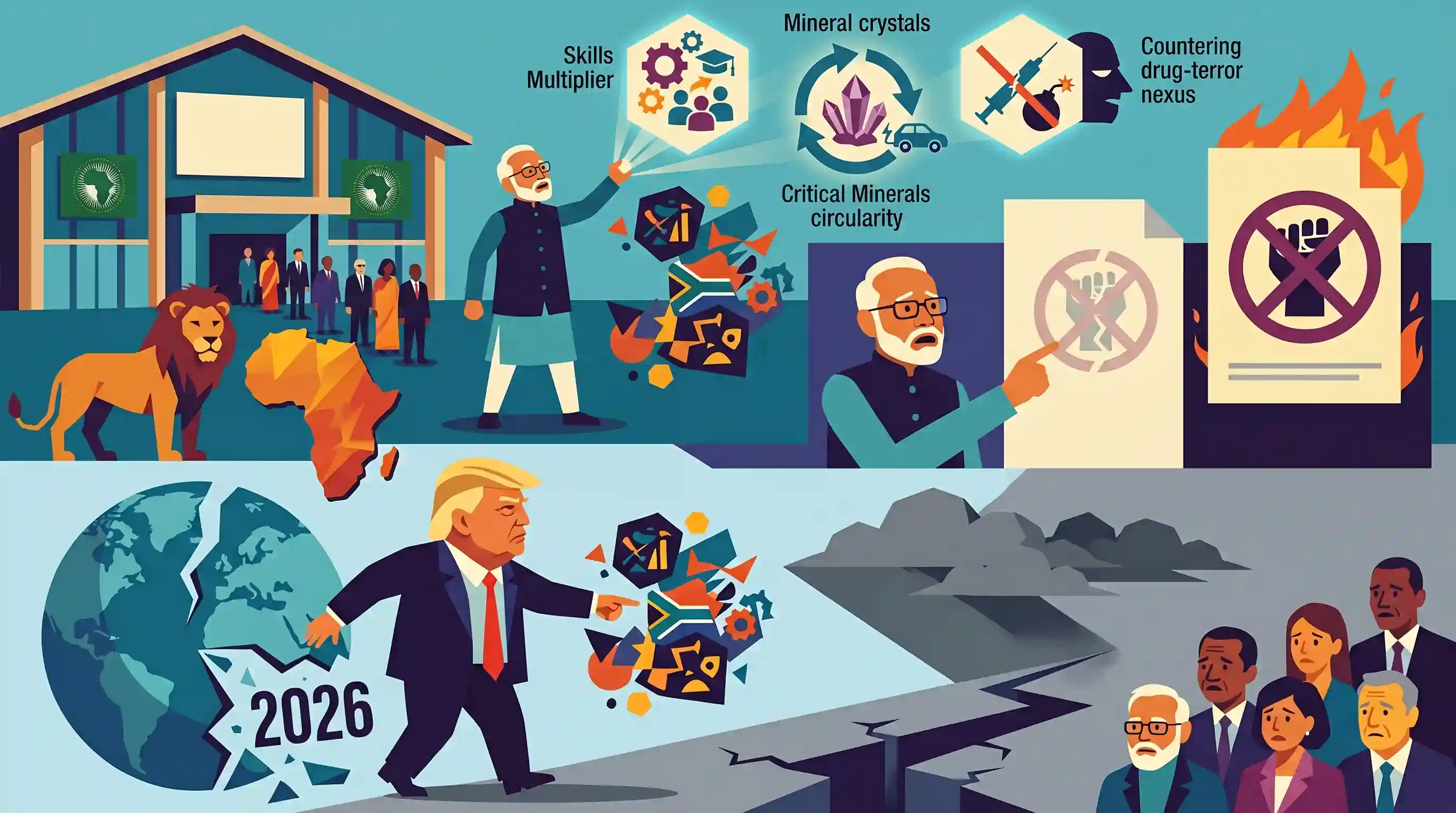
The first G-20 leaders’ summit hosted by an African nation concluded in Johannesburg, focusing on the priorities of the Global South and the African Union's integration. India proactively shaped the agenda, with Prime Minister Modi proposing six new initiatives, ranging from the G20-Africa Skills Multiplier to a Critical Minerals Circularity initiative and measures to counter the drug-terror nexus. Despite these positive steps, India noted disappointment with the summit's weak condemnation of terrorism compared to the previous New Delhi declaration. Furthermore, a U.S. boycott led by President Donald Trump—citing internal South African issues—has cast a shadow over future G-20 multilateralism, particularly as the United States takes the presidency in 2026.
Key Points
- The first G-20 summit held on African soil took place in Johannesburg, deeply imbued with the spirit of 'Ubuntu' and focused on the challenges of the Global South.
- Prime Minister Narendra Modi proposed six major initiatives for India to lead, including the G20-Africa Skills Multiplier Initiative, Open Satellite Data Partnership, and an Initiative on Countering the Drug-Terror Nexus.
- The Indian government expressed disappointment over the diluted condemnation of terrorism in the summit's declaration, contrasting it with the strong stance taken in the 2023 New Delhi declaration.
- The U.S. boycotted the summit under President Donald Trump over allegations of discrimination against white minority farmers in South Africa, raising doubts about the U.S. commitment to G-20 multilateralism as it prepares to assume the presidency next year.
Important Terms
G20-Africa Skills Multiplier Initiative

An Indian proposal to train one million certified trainers across Africa over a decade, utilizing a 'train-the-trainer' model to empower youth and enhance local capacity.
UPSC context
GS II: International Relations. Tests understanding of India-Africa cooperation and India's role in promoting the demographic dividend of the Global South.
G20 Critical Minerals Circularity initiative
India-led framework promoting recycling, 'urban mining', and second-life battery innovations to secure critical mineral supply chains for sustainable, low-carbon growth.
UPSC context
GS III: Environment & Security. Relevant for energy transition, resource diplomacy, and reducing import dependency on strategic minerals.
Initiative on Countering the Drug-Terror Nexus
A proposed framework to disrupt the 'drug-terror economy' by unifying financial, governance, and security tools to combat trafficking (e.g., fentanyl) used to fund extremist groups.
UPSC context
GS III: Internal Security. Tests knowledge of the linkages between organized crime and terrorism, a core UPSC security theme.
African Union
A continental union consisting of 55 member states of the African continent; it became a permanent member of the G20 during India's 2023 presidency.
UPSC context
GS II: International Groupings. Key for understanding regional representation in global governance and India's 'Vishwa Mitra' policy.
Global South
Nations in Africa, Asia, and Latin America, generally characterized by developing economies, which increasingly seek a collective voice and equitable representation in global decision-making.
UPSC context
GS II: International Relations. A central theme in Indian foreign policy and discussions on reforming multilateralism.
New Delhi declaration
The consensus document from the 2023 G20 Summit in India, known for achieving middle-ground language on conflicts and prioritizing inclusive development and AU membership.
UPSC context
GS II: Bilateral and Global Groupings. Acts as a benchmark for measuring progress in subsequent G20 summits.
Open Satellite Data Partnership
A proposed partnership to share satellite data from G20 space agencies with developing nations to improve disaster management, agriculture, and fisheries.
UPSC context
GS III: Science and Technology. Relevant for space diplomacy and the use of technology for social development.
Global Healthcare Response Team
A proposed cadre of medical experts from G20 nations designed for rapid deployment to manage global health emergencies and natural disasters.
UPSC context
GS II: Social Justice/Health. Tests knowledge of international cooperation in public health and disaster management.
Prelims Trap
The African Union was officially inducted as a permanent G-20 member at the Johannesburg summit.
The African Union was officially inducted as a permanent member during India's presidency at the 2023 New Delhi Summit, not at this 2025 Johannesburg summit.
Static Concepts Connected
How does the G-20 Troika function and who currently comprises it?
- Structure: It consists of the past, current, and future G-20 presidencies to ensure agenda continuity.
- Current Composition: For 2025, the Troika consists of Brazil (2024), South Africa (2025), and the USA (2026).
What defines "Critical Minerals" and what is mineral circularity?
- Definition: Minerals essential for modern technologies (EVs, renewables, defense) that face high risks of supply chain disruption.
- Circularity: An economic model focused on recycling, recovering (urban mining), and reusing critical minerals to reduce import dependency and environmental impact.
Cross-Topic Patterns
Narco-Terrorism + Internal Security
India's push against the drug-terror nexus at the G-20 links its multilateral diplomatic agenda directly to core GS-3 internal security challenges involving the Golden Crescent and Golden Triangle.
Mineral Circularity vs. Supply Monopolies
The 'Critical Minerals Circularity' proposal acts as a strategic counter to China’s dominance in raw mineral processing by emphasizing urban mining, recycling, and resilient supply chains.
US Isolationism + Multilateral Decay
The US boycott over domestic South African issues signals deep fractures in multilateral consensus, accelerating the transition of the G-20 into a primary platform for Global South leadership.

Expect a 2026 MCQ linking India's G-20 "Critical Minerals Circularity" proposal to urban mining, recycling, and supply chain resilience.
Linked PYQs · 5
Linked PYQs · 5
- 2025MainsGS2
India-Africa digital partnership is achieving mutual respect, co-development and long-term institutional partnerships. Elaborate.
- 2015MainsGS2
Increasing interest of India in Africa has its pros and cons. Critically examine.
- 2024MainsGS3
Explain how narco-terrorism has emerged as a serious threat across the country. Suggest suitable measures to counter narco-terrorism.
- 2021MainsGS3
Analyse the complexity and intensity of terrorism, its causes, linkages and obnoxious nexus. Also suggest measures required to be taken to eradicate the menace of terrorism.
- 2022MainsGS3
Discuss the types of organised crimes. Describe the linkages between terrorists and organised crime that exist at the national and transnational levels.
