Russian Missile Strikes Target Ukrainian Energy Infrastructure
Source:The Hindu ↗
Why It Matters
The article illustrates the intersection of warfare, energy security, and foreign policy, showing how infrastructure like the Druzhba pipeline can act as a geopolitical pressure point that fractures regional alliances (like the EU) and complicates international sanctions regimes.
Summary
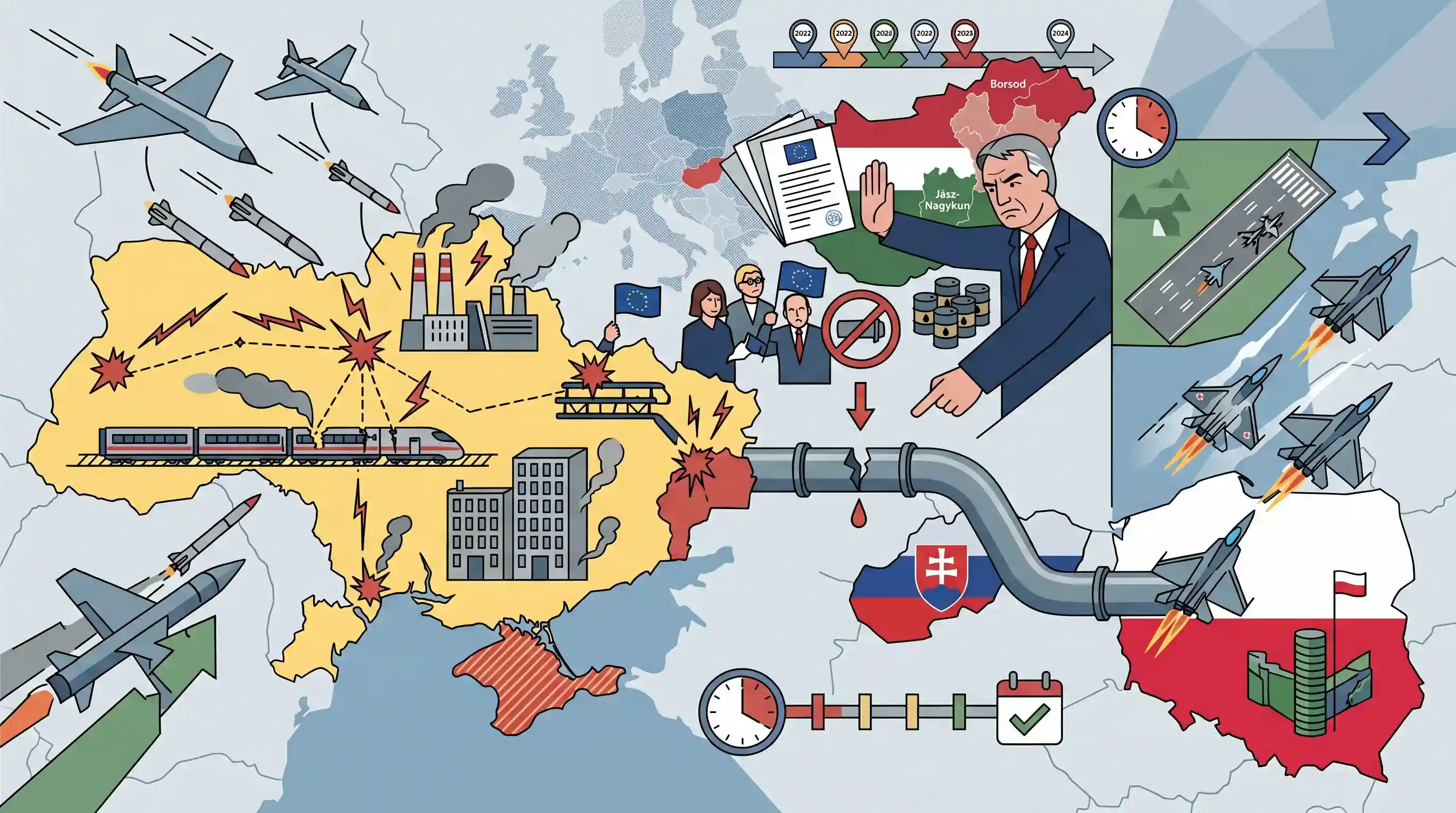
As the fourth anniversary of Russia's full-scale invasion of Ukraine approaches, widespread Russian drone and missile strikes have targeted critical energy and rail infrastructure, as well as residential areas in Kyiv and Lviv. The attacks have not only caused domestic power and transit disruptions but also triggered regional geopolitical friction. Hungary has threatened to block new European Union sanctions against Russia unless the Druzhba oil pipeline—crucial for energy supplies to Hungary and Slovakia and recently damaged by strikes—is restored. The escalation further prompted Poland to scramble fighter jets, highlighting the ongoing threat the conflict poses to broader European stability and energy security.
Key Points
- Russia launched massive drone and missile attacks on Ukraine’s energy, rail infrastructure, and residential areas in Kyiv and Lviv ahead of the fourth anniversary of the invasion.
- Hungary threatened to veto EU sanctions against Russia unless the Druzhba oil pipeline, which supplies oil to Hungary and Slovakia and was damaged by strikes, is reopened.
- The escalation prompted NATO member Poland to scramble fighter jets due to the proximity of Russian long-range aviation.
- The strikes reflect Russia's persistent strategy of crippling Ukraine’s critical infrastructure, which has wide-ranging impacts on European energy security and geopolitical cohesion.
Important Terms
Druzhba oil pipeline

One of the world's longest pipeline networks, it carries Russian crude oil to Central and Eastern Europe, specifically supplying refineries in Hungary, Slovakia, and Germany through its northern and southern branches.
UPSC context
Relevant for GS Paper II (International Relations) regarding energy diplomacy, global supply chains, and European energy dependency during the Russia-Ukraine conflict.
EU sanctions
Restrictive measures (assets freezes, travel bans, trade embargoes) imposed by the 27-member bloc to exert economic pressure on Russia and degrade its military capacity following the invasion of Ukraine.
UPSC context
Significant for GS Paper II (Global Groupings) and GS Paper III (Economics); tests understanding of economic statecraft and multilateral responses to geopolitical crises.
European Union
A supranational political and economic union of 27 European countries that operates as a single market, coordinating regional policy on security, energy, and foreign affairs.
UPSC context
Core topic for GS Paper II (Important International Institutions); relevant for studying regional integration and India-EU strategic relations.
Energy Security
The uninterrupted availability of energy sources at an affordable price, encompassing physical infrastructure protection and the diversification of supply to mitigate geopolitical risks.
UPSC context
Key theme in GS Paper III (Infrastructure/Energy) and GS Paper II (International Relations) regarding how resource dependency shapes foreign policy.
REPowerEU
The European Commission's 2022 plan to end the EU's dependence on Russian fossil fuels by diversifying energy supplies, accelerating the green transition, and improving energy efficiency.
UPSC context
Specifically relevant for GS Paper III (Environment/Energy) as a model for policy response to energy crises and climate goals.
Prelims Trap
Decisions regarding EU sanctions and foreign policy are passed by a qualified majority vote.
EU foreign policy and sanctions require absolute unanimity among all member states, not a majority. This allows a single country (like Hungary) to exercise a veto.
Static Concepts Connected
How are decisions on foreign policy and sanctions made in the European Union?
- Unanimity Rule: The Common Foreign and Security Policy (CFSP), which includes economic sanctions, requires unanimous agreement from all EU member states in the European Council.
- Qualified Majority Voting (QMV): While used for most EU legislation, QMV is expressly excluded for sensitive areas like foreign policy and taxation to protect national sovereignty.
- Veto Power: Because unanimity is required, individual member states can leverage their veto power to extract concessions or protect domestic interests, complicating unified action.
What is the geographic and strategic significance of the Druzhba Pipeline?
- Origin and Route: Meaning 'Friendship', it originates in Russia and splits into Northern (Belarus, Poland, Germany) and Southern (Ukraine, Slovakia, Hungary) branches.
- Strategic Dependency: Landlocked Central European nations like Hungary and Slovakia rely heavily on the Southern branch for crude oil, making it a critical geopolitical leverage point in the region.
Cross-Topic Patterns
Energy dependency dictating foreign policy
Hungary's veto threat highlights how landlocked, import-dependent nations are forced to prioritize domestic energy security over broader regional geopolitical consensus, complicating collective actions like EU sanctions.
NATO's Eastern Flank vulnerability
Poland scrambling jets emphasizes the vulnerability of NATO's frontier. The geography of borders around Ukraine, Belarus, and Kaliningrad (Suwałki Gap) is crucial for understanding spillover risks.

Mapping questions in 2026 will likely combine energy infrastructure (Druzhba pipeline) with NATO eastern flank borders in a single MCQ.
Linked PYQs · 3
Linked PYQs · 3
- 2025MainsGS2
"The reform process in the United Nations remains unresolved, because of the delicate imbalance of East and West and entanglement of the USA vs. Russo-Chinese alliance.” Examine and critically evaluate the East-West policy confrontations in this regard.
- 2025MainsGS2
"Energy security constitutes the dominant kingpin of India's foreign policy, and is linked with India's overarching influence in Middle Eastern countries.” How would you integrate energy security with India's foreign policy trajectories in the coming years?
- 2025MainsGS2
"With the waning of globalization, post-Cold War world is becoming a site of sovereign nationalism.” Elucidate.
