India dismisses safety threat claims regarding Bangladesh diplomats
Source:The Hindu ↗
Why It Matters
The strained India-Bangladesh relationship has significant implications for India's 'Neighbourhood First' policy, cross-border security, and regional stability. It also underscores the relevance of international treaties like the Vienna Convention in managing diplomatic friction and highlights the sensitive issue of minority rights in South Asia.
Summary
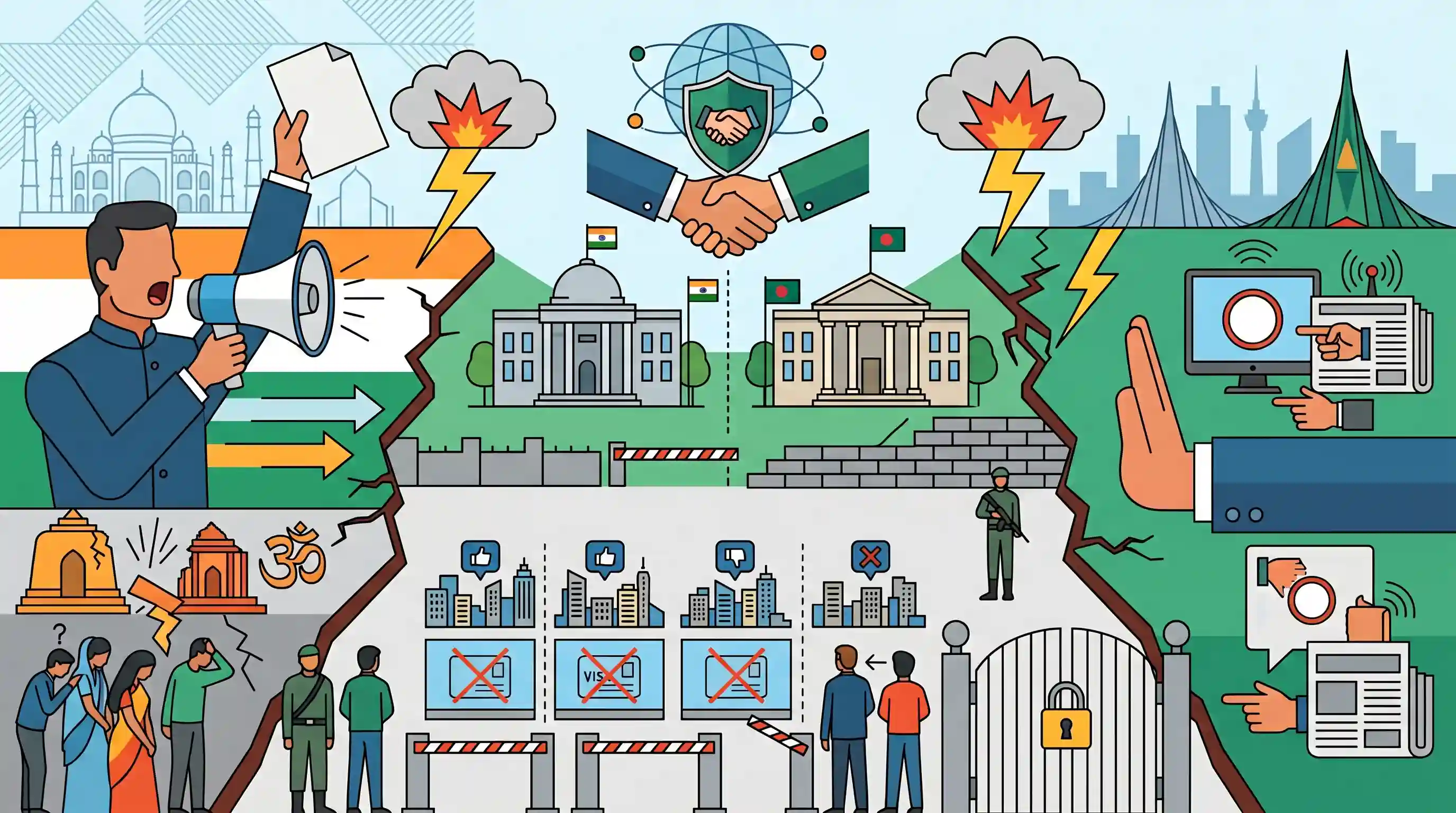
Following the killing of a minority Hindu youth in Bangladesh, diplomatic tensions between India and Bangladesh have escalated. The Ministry of External Affairs (MEA) strongly condemned the murder while simultaneously rejecting claims made by Bangladeshi media that its diplomats in India face life threats, labeling such reports as 'misleading propaganda'. Amidst growing security concerns, India has suspended operations at its visa application centers in multiple Bangladeshi cities. Additionally, New Delhi reiterated the importance of the Vienna Convention, emphasizing the reciprocal obligation to ensure the safety and security of diplomatic missions.
Key Points
- India officially condemned the 'horrendous' killing of a Hindu youth, Dipu Chandra Das, in Mymensingh, Bangladesh.
- The MEA dismissed reports by Dhaka-based media alleging threats to the lives of Bangladeshi diplomats in India as 'misleading propaganda'.
- India reminded Bangladesh of its obligations under the Vienna Convention, emphasizing that India fulfills its duty to protect foreign missions while expecting reciprocity for its own missions in Bangladesh.
- Operations at Indian Visa Application Centres (IVACs) in four Bangladeshi cities (Chittagong, Dhaka, Rajshahi, Khulna) were indefinitely suspended due to security concerns following hostile incidents.
Important Terms
Vienna Convention on Diplomatic Relations

A 1961 international treaty defining the framework for diplomatic relations, including the privileges and immunities of envoys and the inviolability of mission premises.
UPSC context
Core IR topic for GS Paper II; tests understanding of diplomatic immunity and host country obligations.
Ministry of External Affairs (MEA)
The central government ministry responsible for India's foreign relations, representing the nation at the UN and managing bilateral treaties and consular services.
UPSC context
Key institution for GS Paper II; essential for studying India’s foreign policy formulation and international representation.
Indian Visa Application Centres (IVACs)
Authorized centers that manage the administrative tasks related to Indian visa applications for foreign nationals, such as those in Dhaka and Chittagong.
UPSC context
Relevant for GS Paper II (Bilateral Relations); signifies the functional impact of regional security unrest on people-to-people ties.
Bangladesh High Commission
The principal diplomatic mission of Bangladesh in New Delhi, serving as the official channel for bilateral communication and representing Dhaka's interests in India.
UPSC context
Bilateral relations topic in GS Paper II; central to discussions on reciprocal security and diplomatic protocols.
Akhand Hindu Sena
A right-wing group involved in protests at diplomatic missions; cited by Bangladeshi media as the source of security threats to its envoys in India.
UPSC context
GS Paper II (IR); illustrates how fringe groups and media narratives can escalate diplomatic tensions between neighboring states.
Prelims Trap
Host nations must provide a formal explanation before declaring a foreign diplomat 'persona non grata'.
Under Article 9 of the Vienna Convention, a host state can declare any member of a diplomatic staff persona non grata without having to explain its decision.
Static Concepts Connected
What are the key protections and limitations under the Vienna Convention on Diplomatic Relations?
- Inviolability: Mission premises and diplomatic agents are protected from intrusion, arrest, or detention by the host state.
- Persona non grata: The host state can expel any diplomatic agent without providing a reason.
- Waiver of Immunity: Immunity is not absolute; it can be explicitly waived by the sending state.
How does India implement international treaties like the Vienna Convention domestically?
- Constitutional backing: Article 253 grants Parliament exclusive power to make laws implementing international treaties or conventions.
- Statutory framework: The Diplomatic Relations (Vienna Convention) Act, 1972 gives legal force to the privileges and immunities under the Convention.
Cross-Topic Patterns
Visa halts as diplomatic leverage
Just like the 2023 India-Canada visa suspension, the halt of IVAC operations in Bangladesh reflects India's growing use of consular access as a tool for diplomatic signaling and security leverage.
Trade resilience amidst political strife
Despite severe diplomatic escalations and border tensions, Bangladesh remains India's largest trading partner in South Asia, showing how economic interdependence often outlasts political regime changes.

Vienna Convention nuances like 'persona non grata' rules and immunity waivers are prime candidates for a 2026 Prelims statement question.
Linked PYQs · 3
Linked PYQs · 3
- 2015MainsGS2
Project 'Mausam' is considered a unique foreign policy initiative of the Indian Government to improve relationship with its neighbours. Does the project have a strategic dimension? Discuss.
- 2022MainsGS2
Do you think that BIMSTEC is a parallel organisation like the SAARC ? What are the similarities and dissimilarities between the two ? How are Indian foreign policy objectives realized by forming this new organisation?
- 2024MainsGS2
‘Terrorism has become a significant threat to global peace and security.’ Evaluate the effectiveness of the United Nations Security Council's Counter Terrorism Committee (CTC) and its associated bodies in addressing and mitigating this threat at the international level.
