Jamia Masjid closure on Shab-e-Barat sparks security debate
Source:Indian Express ↗
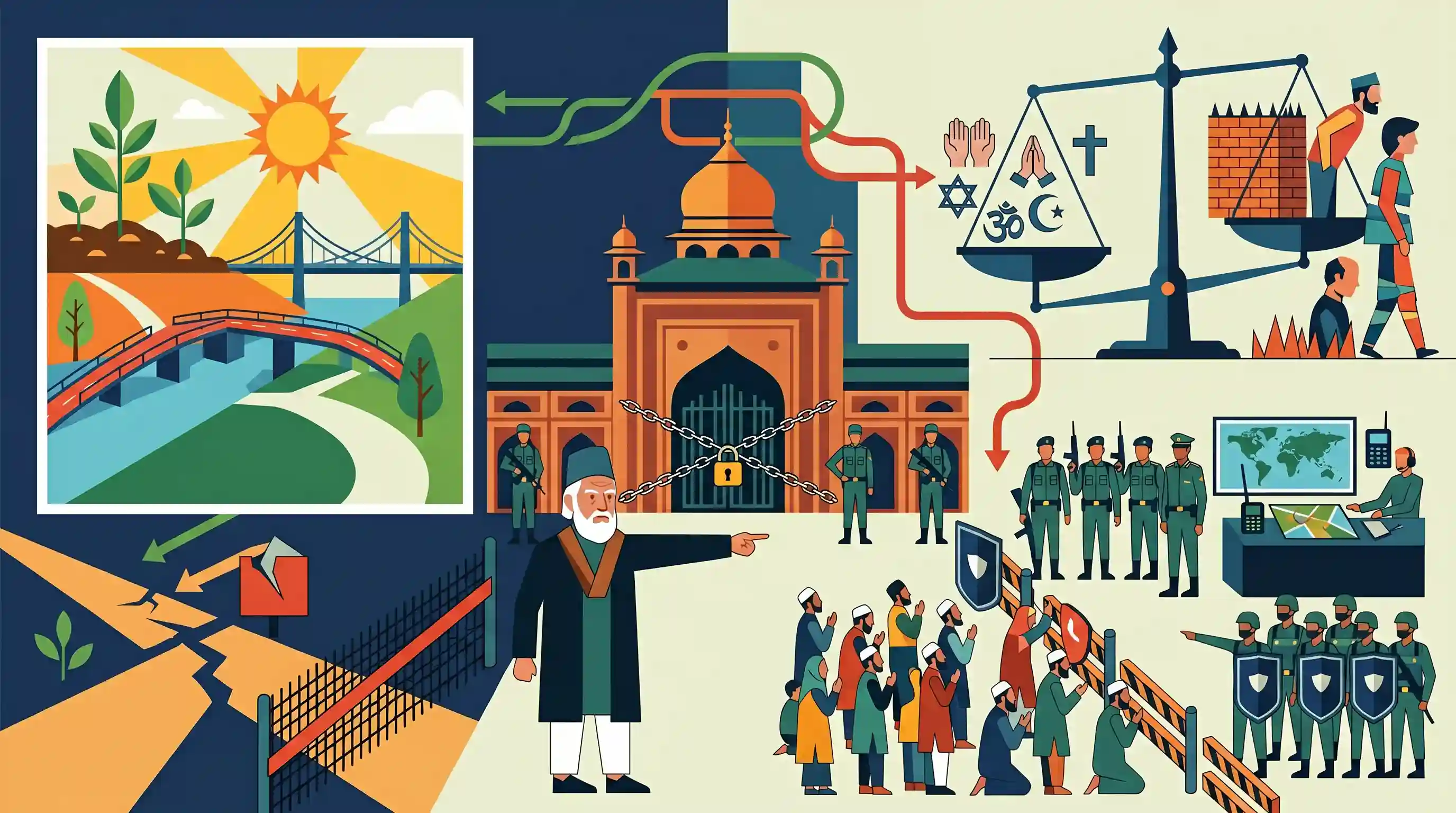
Why It Matters
The article highlights the tension between state security measures and civil liberties in Jammu and Kashmir. It is highly relevant for UPSC Mains GS-3 (Internal Security) regarding the 'hearts and minds' approach to conflict resolution, and GS-2 (Polity) concerning the scope of Article 25 (Freedom of Religion) and its reasonable restrictions on the grounds of public order.
Summary
Hurriyat Conference chairman Mirwaiz Umar Farooq has strongly criticized the Jammu and Kashmir administration for locking down the historic Jamia Masjid in Srinagar on the auspicious occasion of Shab-e-Barat. He argued that the repeated restriction of congregational prayers contradicts the government's narrative of restored peace and the creation of a 'Naya Kashmir'. While authorities often cite public order and security to justify such closures, critics warn that infringing upon fundamental religious freedoms risks alienating the local population and undermining efforts to build trust and normalcy in the region.
Key Points
- Authorities in Jammu and Kashmir closed the historic Jamia Masjid in Srinagar, preventing congregational prayers on the significant religious occasion of Shab-e-Barat.
- Hurriyat leader Mirwaiz Umar Farooq condemned the shutdown, arguing that such restrictions undermine the government's claims of normalcy and a 'Naya Kashmir' (New Kashmir).
- The administration frequently invokes public order and security concerns to justify the closure of major religious spaces in the region.
- Critics argue that denying the right to religious assembly creates alienation among the local population, complicating conflict resolution and the goal of winning 'hearts and minds'.
Important Terms
Hurriyat Conference

An umbrella alliance of political, social, and religious organizations in Jammu and Kashmir formed in 1993 to seek self-determination. It currently exists as two main factions (Mirwaiz and Geelani).
UPSC context
GS Paper III (Internal Security). Tests knowledge of separatist movements, their impact on regional stability, and the state's response to secessionism.
Mirwaiz
The traditional title of Kashmir's head priest and spiritual leader at Srinagar’s Jamia Masjid. The office historically combines religious authority with significant political influence in the Kashmir Valley.
UPSC context
GS Paper III (Internal Security). Relates to local leadership dynamics and the role of religious institutions in conflict-prone regions.
Jamia Masjid (Srinagar)
A historic 14th-century Indo-Saracenic mosque in Srinagar, notable for its unique wooden architecture. It serves as a major center for Friday congregations and socio-political discourse in Kashmir.
UPSC context
GS Paper I (Art & Culture) and GS Paper III (Public Order). Tests awareness of regional heritage and management of sensitive religious sites.
Naya Kashmir
Originally a 1944 socio-economic manifesto; in current discourse, it refers to the government's post-2019 vision for Jammu and Kashmir, emphasizing peace, development, and integration after Article 370's abrogation.
UPSC context
GS Paper II (Governance) and GS Paper III (Internal Security). Tests understanding of policy narratives and the impact of administrative reforms in J&K.
Freedom of Religion (Article 25)
Fundamental right under Article 25 guaranteeing freedom of conscience and the right to profess, practice, and propagate religion, subject to public order, morality, and health.
UPSC context
GS Paper II (Polity). Essential for questions on secularism, fundamental rights, and the extent of "reasonable restrictions" by the state.
Shab-e-Barat
An Islamic 'night of forgiveness' and destiny observed on the 15th of Shaban. Muslims engage in night-long prayers, seek mercy for sins, and visit ancestral graves.
UPSC context
GS Paper I (Society). Understanding cultural and religious practices in a diverse society and the state's role in facilitating religious observances.
Public Order
A constitutional ground for restricting fundamental rights (Articles 19 and 25). It refers to the state’s duty to maintain peace, safety, and tranquility in society.
UPSC context
GS Paper II (Polity/Governance). Tests the balance between state security powers and the protection of individual civil liberties.
Prelims Trap
"The 'Naya Kashmir' manifesto was first introduced by the Union Government in 2019 following the abrogation of Article 370."
The original 'Naya Kashmir' was actually a progressive blueprint drafted in 1944 by Sheikh Abdullah's National Conference to advocate for land reforms and universal education.
Static Concepts Connected
What are the distinct architectural features of the Jamia Masjid in Srinagar?
- No curved dome: It represents traditional Kashmiri wooden architecture with Persian influences, completely lacking a conventional curved dome.
- Pyramidal roofs: The structure features distinctive multi-level pyramidal sloping roofs and prominent wooden spires.
- Deodar pillars: The vast prayer hall is supported by 370 massive wooden pillars carved from local Deodar trees.
How does the Indian Constitution restrict the freedom of religion?
- Grounds for restriction: Article 25 is not absolute; it is explicitly subject to reasonable restrictions based on public order, morality, and health.
- Public Order distinction: The Supreme Court rules that public order is broader than law and order; an act must affect the community at large to justify restricting rights under this ground.
Cross-Topic Patterns
Fundamental Rights vs. Internal Security
The frequent invocation of 'public order' to restrict Article 25 in J&K highlights the ongoing friction between military counter-insurgency doctrines and constitutional mandates of religious freedom.
WHAM strategy in Conflict Zones
Restricting religious congregations poses a direct challenge to the 'Winning Hearts and Minds' (WHAM) counter-insurgency strategy, as perceived state overreach can inadvertently fuel local alienation and radicalization.

Expect a Prelims statement matching Kashmiri wooden architecture (like Jamia Masjid's Deodar pillars) to its unique lack of curved domes.
Linked PYQs · 1
Linked PYQs · 1
- 2023MainsGS3
Winning of 'Hearts and Minds' in terrorism-affected areas is an essential step in restoring the trust of the population. Discuss the measures adopted by the Government in this respect as part of the conflict resolution in Jammu and Kashmir.
