Lone Wolf Attacks and UAPA Legal Framework
Source:Indian Express ↗
Why It Matters
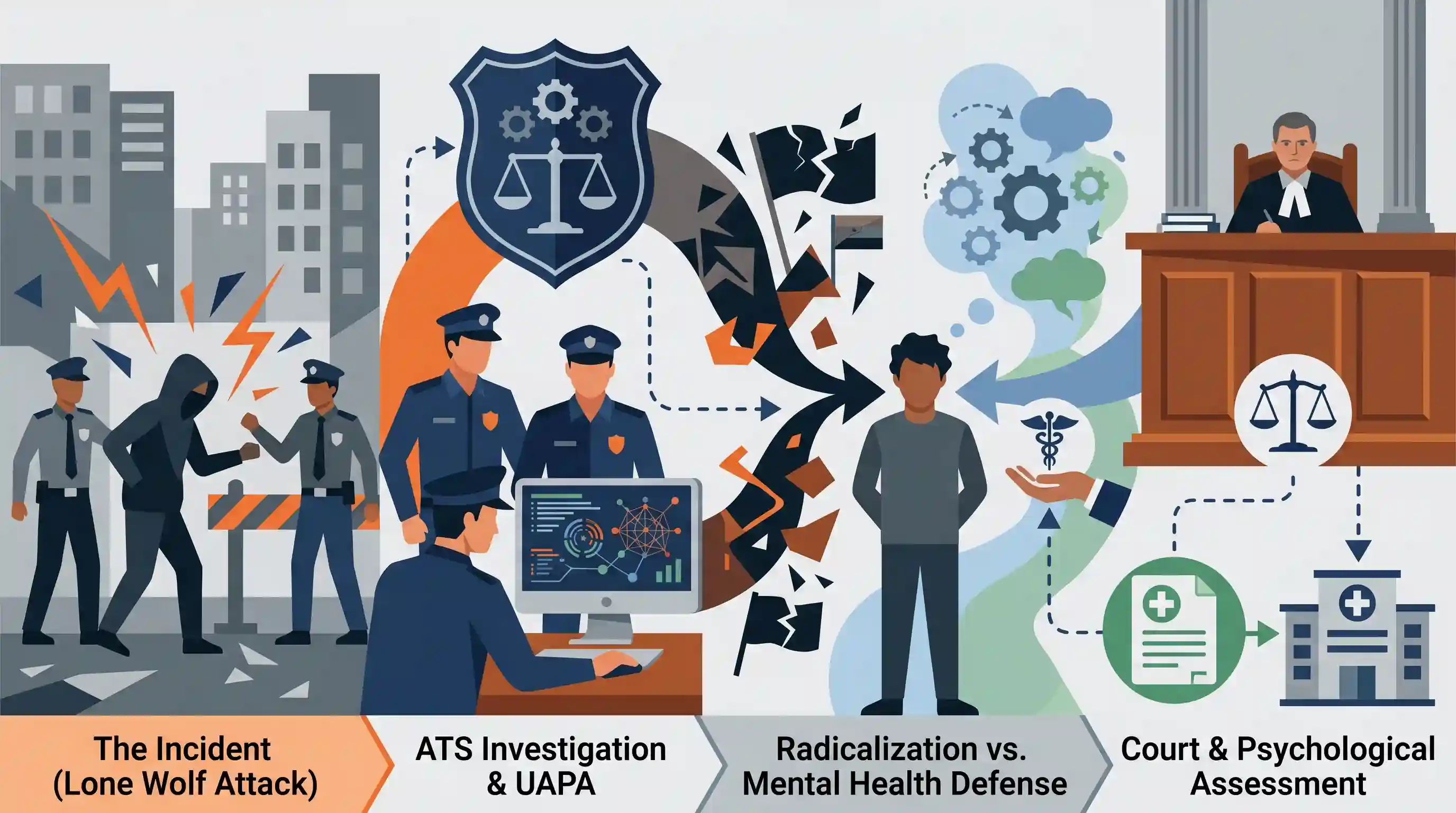
Illustrates the evolving nature of terrorism through 'lone wolf' attacks and self-radicalisation, the application of stringent laws like the UAPA, and the legal complexities introduced when mental health conditions (like schizophrenia) are presented as a defense in national security cases.
Summary
The Maharashtra Anti-Terrorism Squad (ATS) has invoked the Unlawful Activities (Prevention) Act (UAPA) against Zaib Zubair Ansari for a suspected 'lone wolf' attack on security guards in Mira Road. While the ATS investigates potential links to ISIS and efforts to radicalise others, the defense has cited schizophrenia, prompting the court to order a psychological assessment. The case highlights the intersection of stringent anti-terror laws, self-radicalisation, and mental health defenses in criminal jurisprudence.
Key Points
- The Maharashtra ATS has charged Zaib Zubair Ansari under Section 16 of the UAPA for a suspected 'lone wolf' stabbing attack on two security guards in Mira Road.
- Authorities recovered a chit mentioning an oath of allegiance to ISIS and are analyzing wiped forensic data from his mobile phone.
- The ATS is investigating potential international terror links and whether Ansari radicalised students he taught online in the UAE.
- The defense counsel has sought a psychological assessment, citing that the accused suffers from schizophrenia, prompting the special court to direct investigators to conduct a medical evaluation.
Important Terms
Unlawful Activities (Prevention) Act (UAPA)

India's primary anti-terror law (1967) targeting activities that threaten national sovereignty. It allows the government to designate individuals as terrorists and provides for extended pre-charge detention.
UPSC context
GS Paper III (Internal Security); tests knowledge of legal frameworks, 2019 amendments, and the tension between national security and fundamental rights.
Lone Wolf Attack
Terrorist acts performed by individuals acting alone without direct support or command from an organization, making them difficult for intelligence agencies to detect using traditional methods.
UPSC context
GS Paper III (Internal Security); relevant to evolving terror threats, decentralized modules, and the role of self-radicalisation.
Radicalisation
A process where an individual shifts from moderate views to extreme political or religious beliefs, eventually supporting or participating in violent extremism or terrorism.
UPSC context
GS Paper III (Internal Security); covers the socio-psychological roots of terrorism and the effectiveness of counter-radicalisation strategies.
Anti-Terrorism Squad (ATS)
Specialised state-level counter-terrorism units in India responsible for intelligence gathering and investigating terror modules, often coordinating with central agencies like the NIA.
UPSC context
GS Paper III (Security Forces/Agencies); tests understanding of India's multi-layered security architecture and state-central coordination.
ISIS (Islamic State of Iraq and Syria)
A transnational militant group that utilizes sophisticated digital propaganda to incite global radicalisation and has posed significant internal security challenges through 'lone wolf' inspiration.
UPSC context
GS Paper III (Terrorism); tests awareness of external non-state actors and the impact of global extremist movements on India.
Prelims Trap
State governments are empowered under the UAPA to designate individuals as terrorists.
The 2019 UAPA Amendment specifically empowered the Central Government—not state governments—to designate specific individuals as 'terrorists'. State ATS cannot designate individuals.
Static Concepts Connected
What makes bail exceptionally difficult under the Unlawful Activities (Prevention) Act (UAPA)?
- Section 43D(5): The court must deny bail if it finds reasonable grounds to believe the accusations are "prima facie true".
- Burden of proof: The burden effectively shifts to the accused to prove the charges are baseless to secure bail, reversing standard criminal law norms.
- Watali Judgment: The Supreme Court ruled that courts must not deeply analyze the merits of evidence at the bail stage, further restricting relief.
What is the legal framework for the 'insanity defense' in Indian criminal jurisprudence?
- Section 84 IPC: Protects individuals who are of "unsound mind" at the exact time of the act (now under Section 22 of the BNS).
- McNaughten Rules: Requires proving the accused was cognitively incapable of knowing the nature of the act or that it was illegal.
- Medical vs Legal: Courts only recognize 'legal insanity' (total lack of cognitive capacity during the act), not mere medical diagnoses like schizophrenia.
Cross-Topic Patterns
Online Radicalization & Lone Wolves
Self-radicalization via encrypted platforms bypasses traditional terror funding networks (like Hawala), shifting internal security focus from physical border infiltration to advanced cyber-surveillance and OSINT.
Stringent Laws vs. Mental Health Jurisprudence
The collision of stringent anti-terror laws (which presume guilt for bail) with mental health defenses tests the balance between national security and constitutional rights to a fair trial.

Expect a Mains question linking online self-radicalization to the rise of 'lone wolf' attacks, testing the adequacy of UAPA provisions.
Linked PYQs · 1
Linked PYQs · 1
- 2019MainsGS3
Indian Government has recently strengthened the anti-terrorism laws by amending the Unlawful Activities (Prevention) Act (UAPA), 1967 and the NIA Act. Analyze the changes in the context of prevailing security environment while discussing the scope and reasons for opposing the UAPA by human rights organizations.
