Ministry Urges Registrar General to Count PVTGs in Census
Source:Indian Express ↗
Why It Matters
Understanding the enumeration and welfare tracking of Particularly Vulnerable Tribal Groups (PVTGs) is vital for GS2 (Governance, Social Justice, and Vulnerable Sections) as well as Prelims, given the emphasis on targeted welfare delivery schemes like PM-JANMAN.
Summary
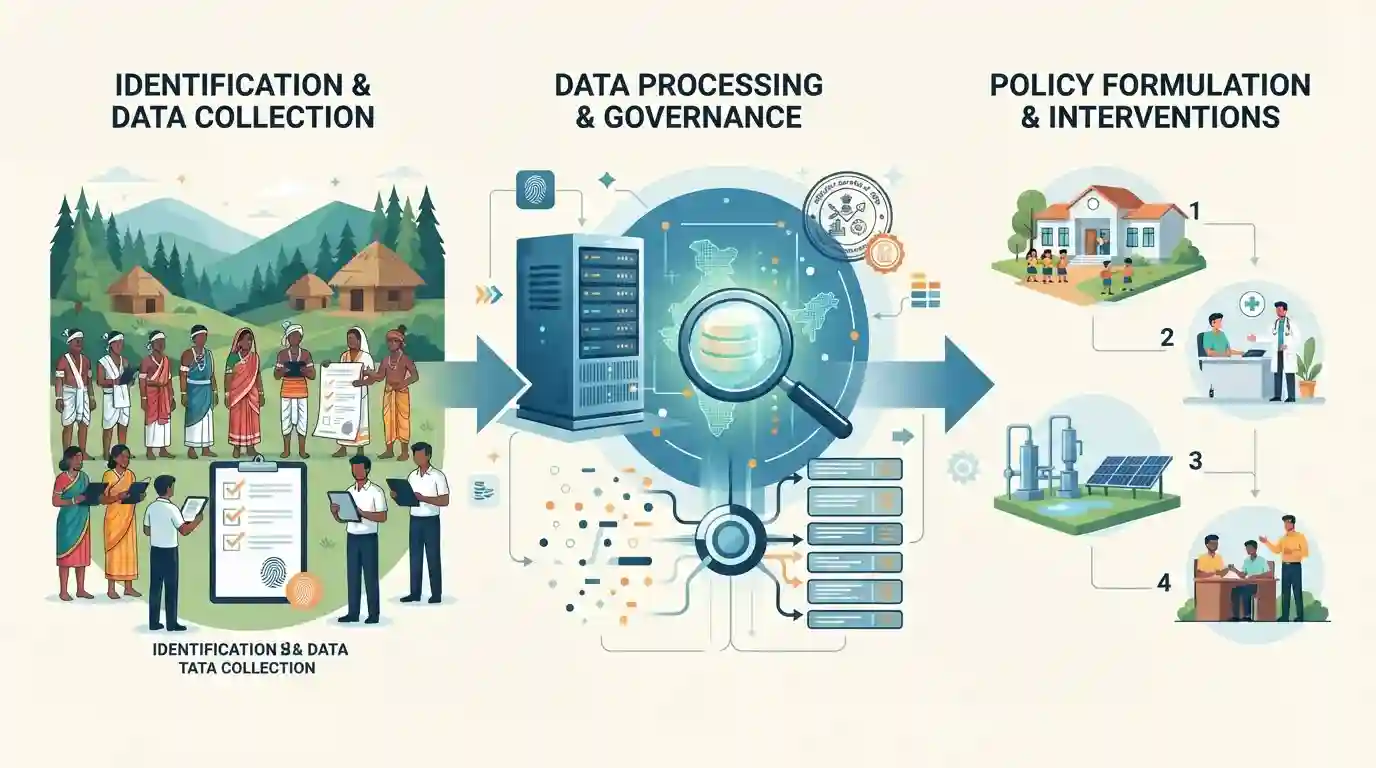
The Ministry of Tribal Affairs has moved to ensure that Particularly Vulnerable Tribal Groups (PVTGs) are specifically counted and documented by the Registrar General of India (RGI) in the national Census. The move is designed to plug data gaps and improve policy formulation, last-mile delivery, and resource allocation for these highly marginalized communities.
Key Points
- The Ministry of Tribal Affairs has urged the Registrar General of India (RGI) to specifically count and track Particularly Vulnerable Tribal Groups (PVTGs) during the upcoming Census.
- This step aims to generate precise demographic and socioeconomic data for the 75 identified PVTGs to better target welfare schemes like the PM-JANMAN package.
- Accurate enumeration helps address issues of geographic isolation, declining or stagnant populations, and lack of basic infrastructure among the most vulnerable tribal communities.
Important Terms
Ministry of Tribal Affairs

A centrally funded government ministry established in 1999 to coordinate policies, welfare programs, and socio-economic development initiatives specifically tailored for the Scheduled Tribes and tribal communities of India.
UPSC context
UPSC Prelims/Mains (GS Paper II): Crucial for questions on welfare schemes, governance, and institutional frameworks targeting vulnerable sections.
Registrar General of India (RGI)
The statutory authority under the Ministry of Home Affairs responsible for coordinating, directing, and conducting the decennial population Census and vital statistics collection in India.
UPSC context
UPSC Prelims/Mains (GS Paper II/III): Important for governance, administrative bodies, and demographic data collection mechanisms.
Census
The official, periodic enumeration of population, demographic features, and socio-economic indicators across India, conducted every ten years under the Census Act.
UPSC context
UPSC Prelims/Mains (GS Paper I/II): Essential for understanding population dynamics, resource allocation, and evidence-based policy formulation.
Prelims Trap
The Dhebar Commission originally recommended the classification of Particularly Vulnerable Tribal Groups (PVTGs) in 1973.
The Dhebar Commission coined the category as 'Primitive Tribal Groups' (PTGs) in 1973; they were renamed PVTGs only in 2006 by the Government of India, not at inception.
Static Concepts Connected
What are the criteria and historical background for identifying Particularly Vulnerable Tribal Groups (PVTGs) in India?
- Origin Commission: Dhebar Commission (1973): Recommended the creation of a separate sub-category called 'Primitive Tribal Groups' (PTGs) to focus on more backward tribal groups.
- Identification Criteria: Four Criteria: Pre-agricultural level of technology, stagnant or declining population, extremely low literacy, and a subsistence-level economy.
- Nomenclature Shift: Renaming (2006): The Government of India renamed Primitive Tribal Groups as Particularly Vulnerable Tribal Groups (PVTGs).
- Demographic Spread: Total Count: There are 75 officially recognized PVTGs out of 705 Scheduled Tribes, spread across 18 states and UT of Andaman & Nicobar.
Cross-Topic Patterns
PVTGs + PM-JANMAN Welfare Delivery Architecture
PM-JANMAN targets 75 PVTGs with a Rs 24,000 crore outlay, bridging data gaps from Census enumeration directly into habitation-level last-mile infrastructure delivery.
Constitutional Safeguards + Tribal Commission Legacies
The Dhebar Commission framework intersects Article 342 criteria for Scheduled Tribe notification and the FRA 2006 habitat rights provisions.

Expect a statement-based prelims question combining PVTG identification criteria (Dhebar commission) with statutory habitat rights under FRA 2006.
Linked PYQs · 1
Linked PYQs · 1
- 2019PrelimsGS1
Consider the following statements about Particularly Vulnerable Tribal Groups (PVTGs) in India : 1. PVTGs reside in 18 States and one Union Territory. 2. A stagnant or declining population is one of the criteria for determining PVTG status. 3. There are 95 PVTGS officially notified in the country so far. 4. Irular and Konda Reddi tribes are included in the list of PVTGs. Which of the statements given above are correct?
