Indus Waters Treaty Abeyance and Counter Terrorism Policy Measures
Source:The Hindu ↗
Why It Matters
The abeyance of the Indus Waters Treaty is a landmark geopolitical shift that breaks decades of hydro-diplomatic precedent. The event is critical for UPSC aspirants regarding topics of internal security in J&K, border management by security forces, and the strategic use of water sharing agreements (IWT) in bilateral relations with Pakistan.
Summary
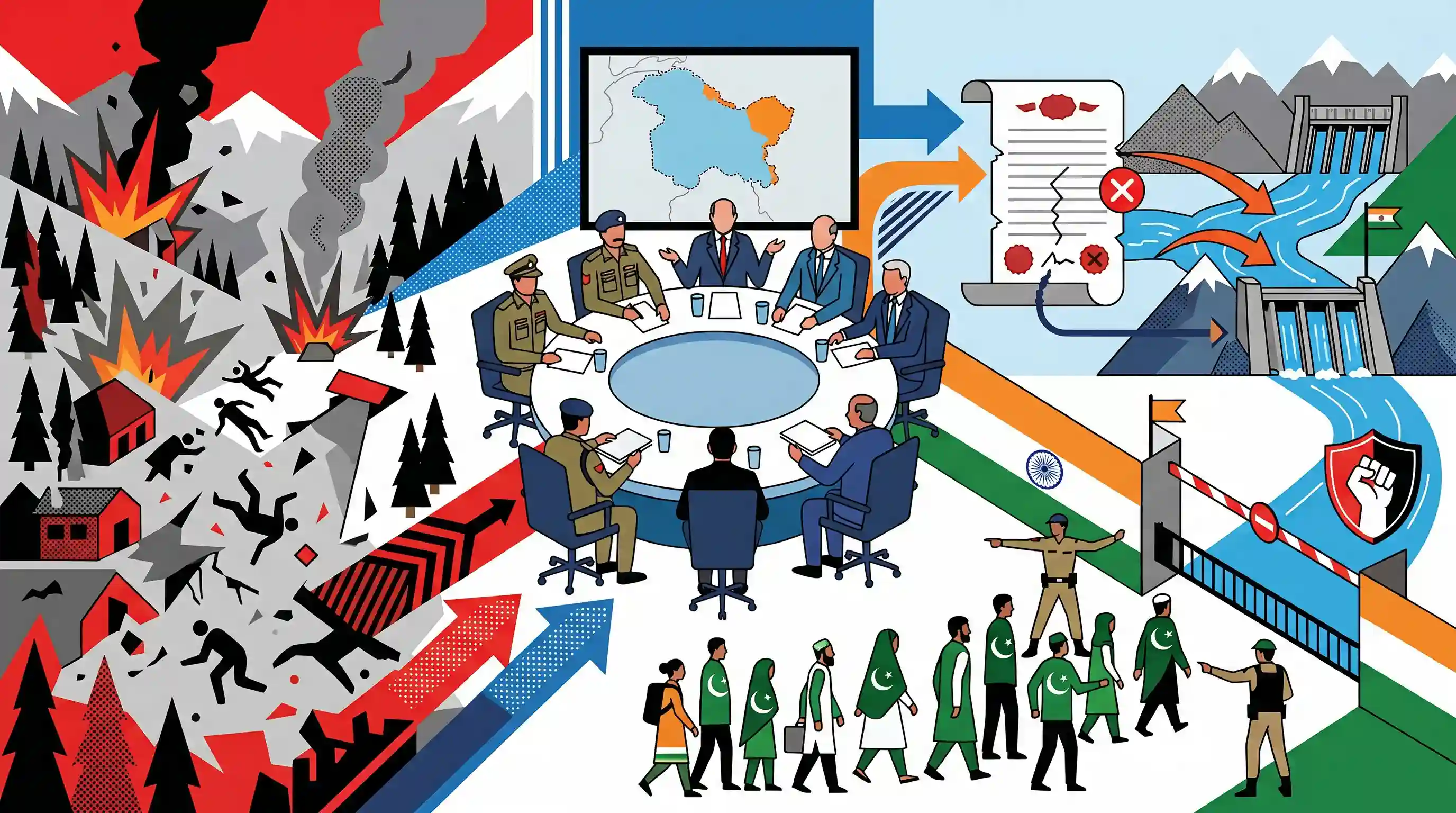
In the aftermath of a devastating terror attack at the Baisaran meadow in Pahalgam, Jammu & Kashmir, which claimed 26 lives, the Union Home Ministry convened a high-level security meeting with top officials of Central Armed Police Forces (CAPFs) and the National Security Guard. In a major diplomatic and strategic response, the Cabinet Committee on Security (CCS) announced the immediate abeyance of the 1960 Indus Waters Treaty, citing continuous breaches by Pakistan. Additionally, all Pakistani nationals have been ordered to leave India by April 29, 2025, reflecting a strict zero-tolerance policy against cross-border terrorism.
Key Points
- Union Home Secretary Govind Mohan chaired a high-level security meeting following the Pahalgam terror attack in Jammu & Kashmir which resulted in 26 casualties.
- In response to the attack and citing persistent breaches, the Cabinet Committee on Security put the 1960 Indus Waters Treaty in abeyance with immediate effect.
- The government ordered all Pakistani nationals to leave India by April 29, 2025, signaling severe diplomatic retaliation against state-sponsored terrorism.
- The Prime Minister reiterated a zero-tolerance approach, vowing to identify, track, and punish those responsible for orchestrating the attack.
Important Terms
Indus Waters Treaty (1960)

A 1960 water-sharing agreement brokered by the World Bank, allocating the three eastern rivers (Ravi, Beas, Sutlej) to India and three western rivers (Indus, Jhelum, Chenab) to Pakistan.
UPSC context
GS-II (International Relations); GS-III (Security). Tests understanding of trans-boundary water diplomacy and strategic levers in India-Pakistan relations.
Cabinet Committee on Security (CCS)
The apex executive body for national security, chaired by the Prime Minister; includes Ministers of Defence, Home Affairs, Finance, and External Affairs as permanent members.
UPSC context
GS-II (Governance); GS-III (Internal Security). Tests knowledge of India's highest security decision-making architecture and crisis management framework.
National Security Guard (NSG)
An elite counter-terrorism unit (Black Cats) under the Ministry of Home Affairs, established in 1984 as a federal contingency force to handle hostage rescue and hijackings.
UPSC context
GS-III (Security Forces and their Mandate). Tests familiarity with specialized agencies tasked with neutralizing high-end terrorist threats.
Central Armed Police Forces (CAPF)
The collective name for seven security forces under the Ministry of Home Affairs (BSF, CRPF, CISF, ITBP, SSB, NSG, AR) tasked with internal security and border guarding.
UPSC context
GS-III (Internal Security). Essential for understanding the multi-layered security infrastructure and division of labor between central and state forces.
Border Security Force (BSF)
A CAPF responsible for guarding India's borders with Pakistan and Bangladesh; established in 1965, it is considered India's 'First Line of Defence.'
UPSC context
GS-III (Border Management). Relevant for questions on the mandate of various security forces and challenges in securing international boundaries.
Ministry of Home Affairs (MHA)
The nodal ministry for internal security, police, and border management; it exercises administrative control over all Central Armed Police Forces.
UPSC context
GS-II (Polity/Governance). Tests understanding of the executive structure responsible for maintaining national integrity and public order.
Prelims Trap
"The Indus Waters Treaty contains a unilateral withdrawal clause invoked by the Cabinet Committee."
The Indus Waters Treaty (1960) has no unilateral exit or suspension provision. India's "abeyance" is a drastic geopolitical step outside standard treaty mechanics, making it legally unprecedented.
Static Concepts Connected
How are rivers allocated under the Indus Waters Treaty (1960)?
- Eastern Rivers: Ravi, Beas, and Sutlej are allocated to India for exclusive and unrestricted use.
- Western Rivers: Indus, Jhelum, and Chenab go to Pakistan; however, India retains limited rights for run-of-the-river hydroelectric projects and agriculture.
- Third-party Broker: The World Bank brokered the treaty and plays a structured role in its multi-tiered dispute resolution mechanism.
What is the composition and role of the Cabinet Committee on Security (CCS)?
- Apex Body: It is the highest executive decision-making body in India for matters of national security, defense policy, and strategic foreign affairs.
- Key Members: It is chaired by the Prime Minister and includes the Ministers of Defence, Home Affairs, Finance, and External Affairs.
Cross-Topic Patterns
Water as a geopolitical weapon
Linking the Indus Waters Treaty abeyance with China's dam-building on the Brahmaputra highlights the rising strategic trend of weaponizing transboundary rivers in South Asia.
Shift to non-kinetic coercion
Expelling nationals and suspending treaties shows a shift from kinetic military retaliation (like Balakot) to severe diplomatic and economic isolation of state sponsors of terrorism.

Expect a multi-statement Prelims question on the Indus Waters Treaty, covering river allocation, dispute resolution, and World Bank's role.
Linked PYQs · 5
Linked PYQs · 5
- 2012MainsGS2
The situation today is far different to that prevalent fifty years back when the Indus Water Treaty was signed." Highlight the complexity of the current challenges on both sides of the border in this regard. Do you think that a review of the Treaty is in India's best interests?
- 2020MainsGS3
Analyze internal security threats and transborder crimes along Myanmar, Bangladesh and Pakistan borders including Line of Control (LoC). Also discuss the role played by various security forces in this regard.
- 2023MainsGS3
Winning of 'Hearts and Minds' in terrorism-affected areas is an essential step in restoring the trust of the population. Discuss the measures adopted by the Government in this respect as part of the conflict resolution in Jammu and Kashmir.
- 2025MainsGS3
Terrorism is a global scourge. How has it manifested in India? Elaborate with contemporary examples. What are the counter measures adopted by the State? Explain.
- 2019MainsGS3
The banning of 'Jamaat-e-Islami' in Jammu and Kashmir brought into focus the role of over-ground workers (OGWs) in assisting terrorist organizations. Examine the role played by OGWs in assisting terrorist organizations in insurgency affected areas. Discuss measures to neutralize influence of OGWs.
