Bilateral Talks and Border Management at SCO Summit
Source:The Hindu ↗
Why It Matters
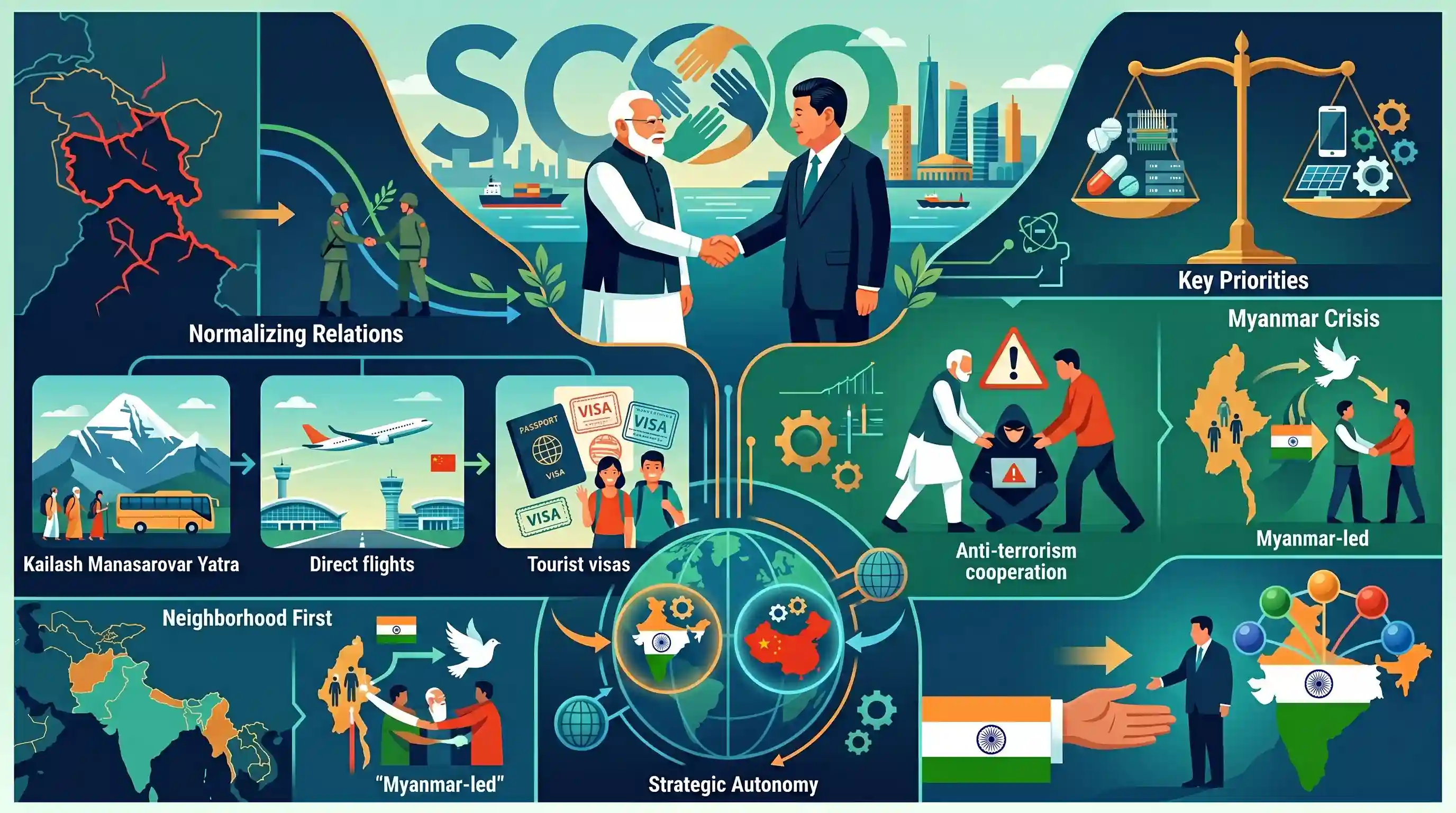
The meeting marks a significant thaw in India-China relations post-Galwan, showing efforts to separate border disputes from broader economic and diplomatic engagement. The mutual emphasis on strategic autonomy and a coordinated stance on regional issues like Myanmar reflects shifting geopolitical alignments, directly relevant to India's foreign policy and regional security.
Summary
Indian Prime Minister Narendra Modi and Chinese President Xi Jinping held significant bilateral discussions on the sidelines of the SCO summit in Tianjin. The talks focused on restoring normalcy after years of border tensions, with agreements to resume the Kailash Manasarovar Yatra, direct flights, and regular tourist visas. The leaders emphasized maintaining border peace, achieving balanced bilateral trade, and cooperating against terrorism. Notably, both sides highlighted their shared commitment to 'strategic autonomy' amid shifting global trade dynamics and backed a 'Myanmar-led' peace process to address the ongoing crisis in Myanmar. Modi also invited Xi to the 2026 BRICS summit in India.
Key Points
- Indian PM Narendra Modi and Chinese President Xi Jinping held comprehensive bilateral talks on the sidelines of the SCO summit in Tianjin, China.
- Agreements included resuming people-to-people connections, such as the Kailash Manasarovar Yatra, tourist visas, and direct flights between the two countries.
- Both leaders stressed the importance of maintaining peace and tranquility on the border and following through on recent disengagement agreements.
- They committed to balanced bilateral trade, global trade stability, and mutual cooperation in combating terrorism.
- The concept of 'strategic autonomy' was mutually emphasized, signaling a shared stance on independence from Western-led trade and security paradigms amid changing global dynamics.
- Both nations voiced support for a 'Myanmar-led and Myanmar-owned peace process' to resolve the crisis triggered by the 2021 military coup and ongoing ethnic conflicts.
- India formally invited President Xi Jinping to the upcoming 2026 BRICS summit.
Important Terms
Kailash Manasarovar Yatra

A trans-Himalayan pilgrimage to Tibet's Mount Kailash and Lake Mansarovar. Its resumption (planned for 2025/2026) signifies a major "thaw" in India-China bilateral relations.
UPSC context
GS-II: India-China relations. Tests understanding of "People-to-People ties" as a tool for de-escalating border tensions.
Tianjin Declaration
The 2025 SCO summit communiqué outlining collective stances on AI governance, counter-terrorism (condemning the Pahalgam attack), and a "more just" multipolar world order.
UPSC context
GS-II: International Treaties/Agreements. Tests knowledge of recent multilateral declarations and their impact on global governance.
Strategic Autonomy
A nation's ability to pursue its national interests and foreign policy independently, without being constrained by external pressures or alliance obligations.
UPSC context
GS-II: India’s Foreign Policy. A core doctrine tested in the context of India balancing ties between the US, Russia, and China.
Shanghai Cooperation Organisation (SCO)
A permanent intergovernmental organization for regional security and economic cooperation. India's participation helps it engage with Central Asia and balance its Eurasian interests.
UPSC context
GS-II: Bilateral, Regional and Global Groupings. Tests understanding of India’s role in non-Western multilateral forums.
BRICS
An expanded bloc of major emerging economies (including India, China, and Russia). India is set to host the BRICS summit in 2026.
UPSC context
GS-II: Multilateral Fora. Focuses on the "Global South" and India’s leadership in a multipolar world.
Myanmar-led peace process
A diplomatic stance favoring a resolution to Myanmar’s internal crisis that is managed by its own stakeholders, reflecting India’s non-interference policy.
UPSC context
GS-II: Neighborhood First Policy. Tests India’s security-driven pragmatism regarding border stability and ethnic conflict in Myanmar.
Prelims Trap
The Kailash Manasarovar Yatra is exclusively conducted via the Nathu La pass in Sikkim.
The Yatra is traditionally conducted through two distinct routes, not just one: the Lipulekh Pass in Uttarakhand and the Nathu La Pass in Sikkim.
Static Concepts Connected
What is the mandate of the SCO's Regional Anti-Terrorist Structure (RATS)?
- Core Mandate: To coordinate efforts to combat the "three evils" of terrorism, separatism, and extremism among SCO member states.
- Headquarters: Located in Tashkent, Uzbekistan, which is distinct from the main SCO Secretariat located in Beijing.
- Information Sharing: Facilitates joint counter-terrorism exercises (Peace Mission) and maintains a shared intelligence database of terrorist entities.
Which Himalayan passes traditionally facilitate India-China civilian and trade transit?
- Lipulekh Pass: A tri-junction pass in Uttarakhand, historically serving as the primary route for the Kailash Manasarovar Yatra.
- Nathu La: Located in Sikkim, it serves as an alternative Yatra route and a major border trade post.
- Shipki La: Located in Himachal Pradesh where the Sutlej river enters India, used primarily for localized cross-border trade.
Cross-Topic Patterns
Sino-Indian convergence on Myanmar
Both nations backing a 'Myanmar-led' peace process contrasts with Western sanctions. It links to their shared need to protect regional infrastructure (Kaladan Project, CMEC) from ethnic rebel conflict.
Strategic Autonomy & De-dollarization
The joint emphasis on strategic autonomy at the SCO connects to broader BRICS objectives of insulating emerging economies from Western-dominated trade paradigms and financial systems.

Expect a 2026 Prelims multi-statement question testing SCO/BRICS hosting timelines, Yatra border passes, and Myanmar's peace process.
Linked PYQs · 5
Linked PYQs · 5
- 2024MainsGS2
‘The West is fostering India as an alternative to reduce dependence on China's supply chain and as a strategic ally to counter China's political and economic dominance.’ Explain this statement with examples.
- 2014MainsGS2
With respect to the South China sea, maritime territorial disputes and rising tension affirm the need for safeguarding maritime security to ensure freedom of navigation and over flight throughout the region. In this context, discuss the bilateral issues between India and China.
- 2021MainsGS2
Critically examine the aims and objectives of SCO. What importance does it hold for India?
- 2023MainsGS2
‘Virus of Conflict is affecting the functioning of the SCO’ In the light of the above statement point out the role of India in mitigating the problems.
- 2016MainsGS2
Evaluate the economic and strategic dimensions of India's Look East Policy in the context of the post Cold War international scenario.
