Ministry of Education Plans NIOS Outreach for School Dropouts
Source:Indian Express ↗
Why It Matters
Provides vital data points (2 crore out-of-school youth, 62% school retention rate) for Mains GS-2 (Education Policy) and GS-3 (Employment/Skill Development) answers. The initiative demonstrates the practical application of Open and Distance Learning (ODL) in ensuring inclusive education and harnessing India's demographic dividend.
Summary
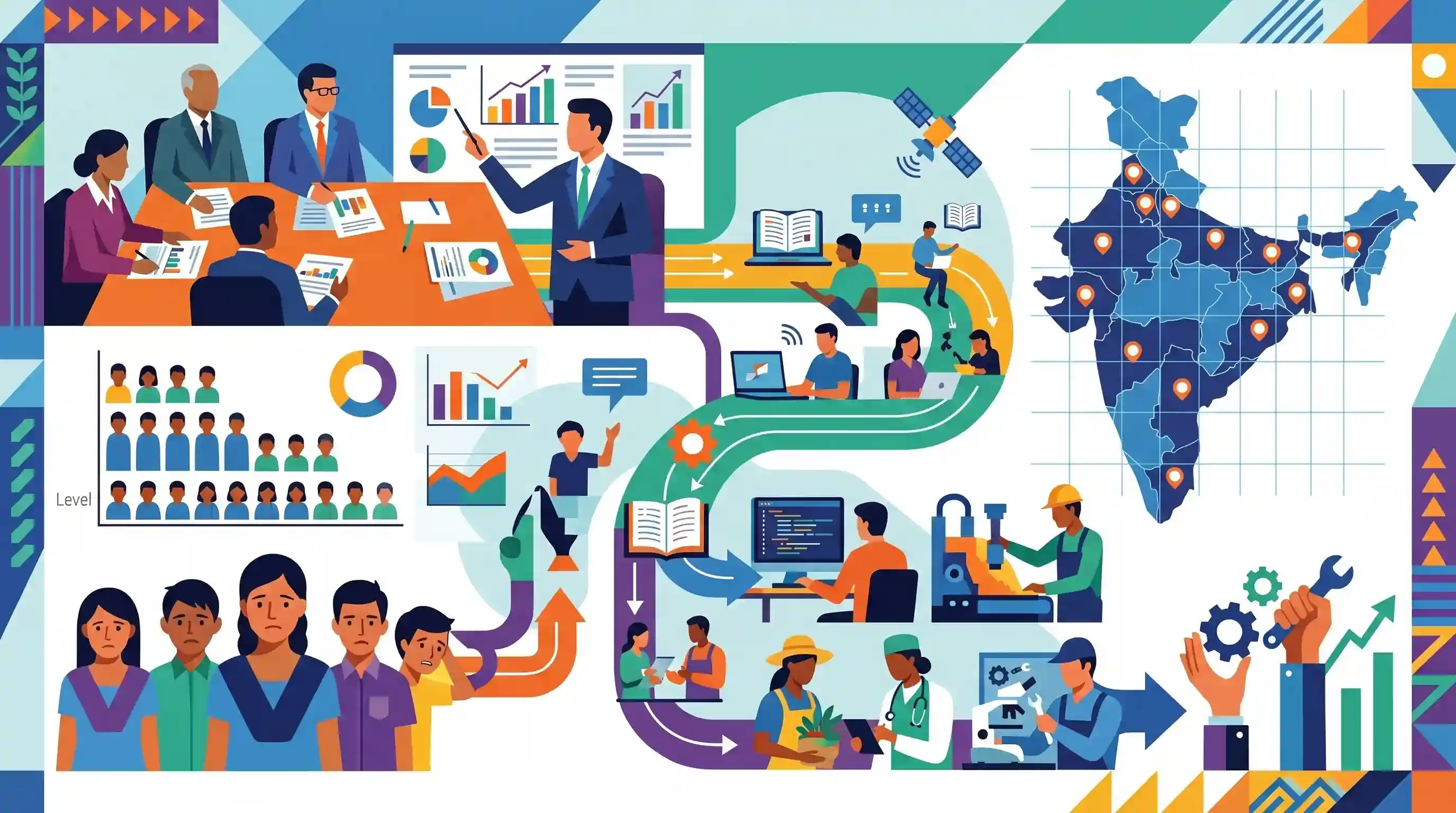
The Ministry of Education and the National Institute of Open Schooling (NIOS) held a high-level meeting to address India's pressing dropout crisis. Citing Periodic Labour Force Survey (PLFS) data, officials noted that over 2 crore children aged 14-18 are currently out of school, with only 62 of every 100 Class I students reaching Class 12. To tackle this, a new initiative will leverage Open and Distance Learning (ODL) to provide flexible education pathways. Beyond mere enrollment, the goal is to equip dropouts with practical, employable skills. The program will initially be piloted across 10 districts in 9 states with high concentrations of out-of-school children.
Key Points
- High Dropout Rate: Only 62% of children enrolled in Class I successfully reach Class 12, hindered primarily by socio-economic pressures like financial constraints and livelihood needs.
- PLFS Data: The latest Periodic Labour Force Survey highlights that over 2 crore children aged 14-18 are not attending any school.
- NIOS Intervention: The government is leveraging NIOS and State Open Schools' Open and Distance Learning (ODL) frameworks to provide flexible alternatives for children unable to attend conventional schools.
- Employable Skills: The initiative goes beyond basic enrollment, aiming to provide senior secondary education integrated with practical skills tied to local economic realities.
- Pilot Program: A phased rollout will begin with a pilot in 10 districts across high-dropout states including Odisha, Maharashtra, Bihar, Uttar Pradesh, and Delhi.
Important Terms
Periodic Labour Force Survey (PLFS)

A nationwide survey by the National Statistical Office (NSO) that provides timely data on employment, unemployment, and labor force participation since 2017.
UPSC context
GS Paper III (Economy/Employment); tests data-driven analysis of labor markets and social welfare.
National Institute of Open Schooling (NIOS)
An autonomous institution under the Ministry of Education providing flexible, distance-mode schooling; it is the world’s largest open school system catering to dropouts.
UPSC context
GS Paper II (Social Sector/Education); relevant for inclusive education and universal school enrollment.
Open and Distance Learning (ODL)
A flexible education mode where learners and teachers are physically separated, utilizing digital tools to improve access, equity, and affordability in schooling.
UPSC context
GS Paper II (Education/NEP 2020); tests strategies for digital literacy and bridging educational gaps.
Department of School Education & Literacy (DoSEL)
The branch of the Ministry of Education responsible for elementary/secondary education, adult literacy, and implementing the Right to Education (RTE) Act.
UPSC context
GS Paper II (Governance/Social Justice); tests administrative frameworks for fundamental educational rights.
State Open Schools (SOSs)
State-level bodies that offer open schooling to provide flexible pathways for students unable to attend formal secondary schools within specific states.
UPSC context
GS Paper II (Federalism/Education); relevant for center-state collaboration in achieving 100% Gross Enrolment Ratio.
Prelims Trap
"The Right to Education (RTE) Act mandates government intervention for out-of-school dropouts aged 14 to 18 years."
RTE (Article 21A) strictly applies to children aged 6-14. The 14-18 cohort falls outside this fundamental right, making interventions like NIOS legally necessary but non-justiciable.
Static Concepts Connected
What are the core features of the Periodic Labour Force Survey (PLFS)?
- Nodal Agency: Conducted by the National Statistical Office (NSO) under MoSPI since 2017 to yield frequent employment data.
- Frequency: Yields quarterly bulletins for urban areas (Current Weekly Status) and an annual report for both rural and urban areas.
- Key Indicators: Measures LFPR, WPR, and Unemployment Rate. It is the primary official source for tracking education-to-employment transitions.
How do Constitutional provisions map to school dropout age groups?
- Fundamental Right: Article 21A applies only to 6-14 years. Dropouts aged 14-18 rely on policy targets (NEP 2020), not justiciable rights.
- NIOS Mandate: An autonomous body under the Ministry of Education, providing sustainable Open and Distance Learning (ODL) alternatives.
- NEP 2020 Target: Aims to achieve 100% Gross Enrolment Ratio (GER) in preschool to secondary level by 2030, bridging the 14-18 age gap.
Cross-Topic Patterns
Demographic Dividend vs NEET status
2 crore dropouts (14-18) connect to GS-3 employment themes. Without vocational skills, this youth cohort risks becoming "NEET" (Not in Education, Employment, or Training), eroding India's demographic dividend.
NEP 2020 Vocational Integration
This NIOS initiative directly operationalizes the NEP 2020 mandate, which aims to expose at least 50% of learners to vocational education through flexible pathways by 2025.

Expect a 2026 prelims question mixing PLFS dropout/LFPR data for the 15-29 demographic with Right to Education age-limit clauses.
Linked PYQs · 4
Linked PYQs · 4
- 2022MainsGS2
The Right of Children to Free and Compulsory Education Act, 2009 remains inadequate in promoting incentive-based system for children's education without generating awareness about the importance of schooling. Analyse.
- 2023MainsGS2
Skill development programmes have succeeded in increasing human resources supply to various sectors. In the context of the statement analyse the linkages between education, skill and employment.
- 2020MainsGS2
National Education Policy 2020 is in conformity with the Sustainable Development Goal-4 (2030). It intends to restructure and reorient education system in India. Critically examine the statement.
- 2014MainsGS3
While we flaunt India's demographic dividend, we ignore the dropping rates of employability. What are we missing while doing so? Where will the jobs that India desperately needs come from? Explain.
