Ministry of Defence Denies Pause in US Military Procurements
Source:The Hindu ↗
Why It Matters
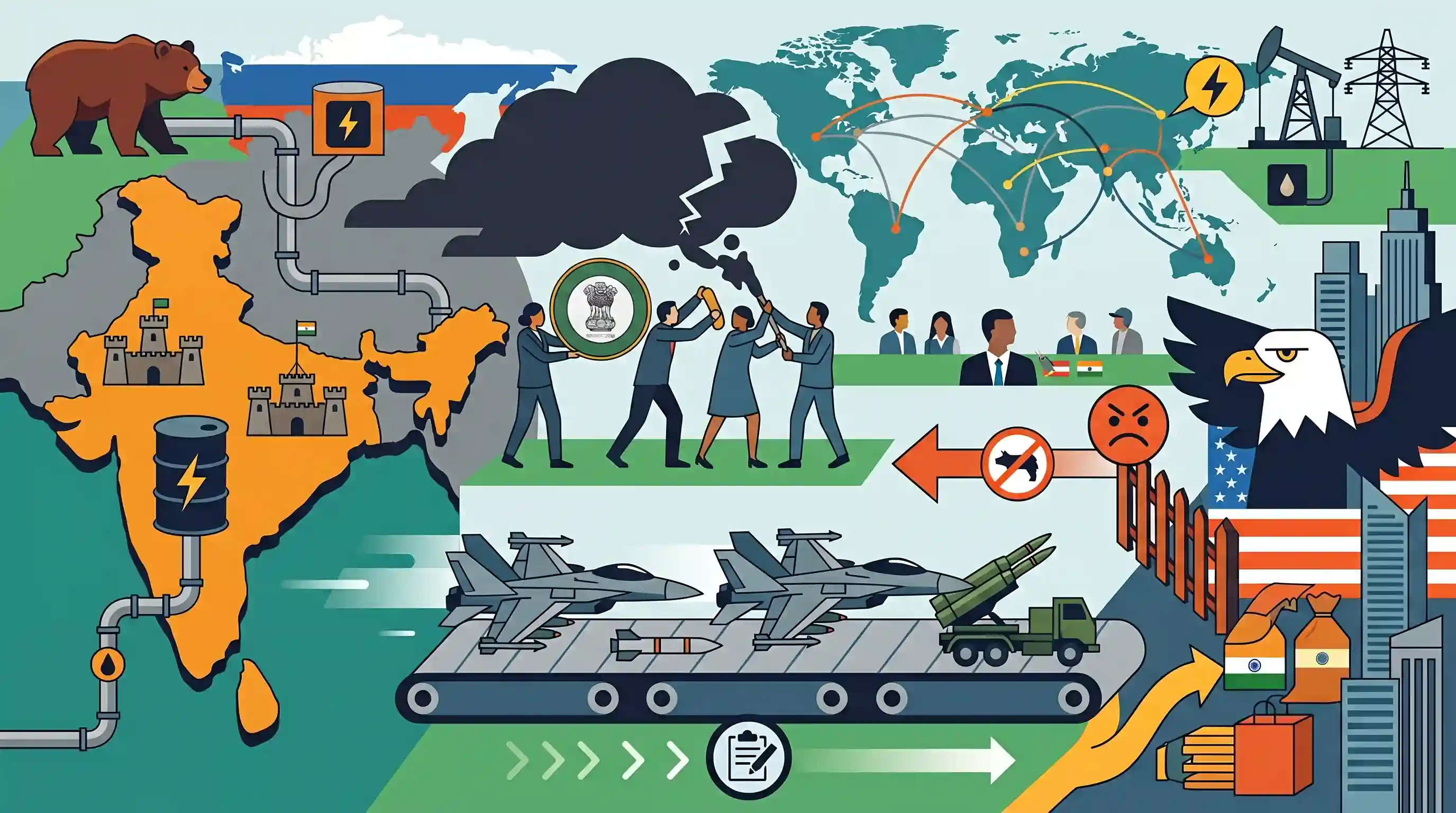
Highlights the complexities of India's strategic autonomy, balancing defence and trade ties with the US while maintaining energy imports from Russia amidst global geopolitical friction.
Summary
The Indian Ministry of Defence has firmly denied reports claiming that India has put purchases of new U.S. weapons and aircraft on hold. The refuted reports suggested that India suspended defence deals in retaliation for U.S. President Donald Trump's imposition of additional tariffs on Indian goods, allegedly punishing New Delhi for buying Russian oil amidst the Ukraine war. The MoD dismissed these claims as "false and fabricated," asserting that all defence procurement cases are progressing as per established procedures.
Key Points
- The Indian Ministry of Defence denied reports that India has paused the procurement of new U.S. weapons and aircraft.
- Earlier reports claimed the pause was due to India's discontent over an additional 25% tariff imposed on Indian exports by U.S. President Donald Trump.
- The U.S. allegedly imposed the tariffs to penalize India for its continued purchase of Russian oil amid the Russia-Ukraine conflict.
- The MoD labeled the claims as "false and fabricated," confirming that defence procurements are progressing under existing procedures.
Important Terms
Ministry of Defence (MoD)

India's central ministry responsible for national security, policy-making for the Indian Armed Forces, and coordinating civilian-military relations to ensure territorial integrity.
UPSC context
GS Paper II (Executive) and Paper III (Security): Crucial for understanding national security architecture and civilian control over the military.
Strategic Autonomy
India’s core foreign policy principle of making independent decisions based on national interest without being coerced by external alliances or structural dependence on foreign powers.
UPSC context
GS Paper II (International Relations): Essential for discussing India's 'Multi-alignment' strategy and balancing relations between the US and Russia.
Defence Acquisition Procedure (DAP)
The primary framework governing capital procurement for India's military, prioritizing indigenization ('Atmanirbhar Bharat') and streamlining transparent acquisition from domestic and foreign vendors.
UPSC context
GS Paper III (Internal Security & Indigenization): Key to questions on military modernization and the 'Make in India' initiative.
CAATSA
A 2017 US federal law imposing sanctions on nations engaging in 'significant transactions' with the Russian, Iranian, or North Korean defense and intelligence sectors.
UPSC context
GS Paper II (Bilateral Relations): Central to India-US-Russia diplomatic triangles and defense procurement challenges like the S-400 deal.
Protectionism
Economic policies that restrict international trade through tariffs, quotas, or regulations to favor domestic industries over foreign competition.
UPSC context
GS Paper III (Economy): Relevant for examining trade wars, deglobalization, and their impact on India’s export competitiveness.
Reciprocity (Trade)
A trade principle where countries grant each other similar tariff concessions or trade privileges, often used as a justification for retaliatory trade measures.
UPSC context
GS Paper III (Economy): Frequently cited in US-India trade disputes regarding 'excessive' tariffs on Harley-Davidson motorcycles or ICT products.
Prelims Trap
India formally suspended US weapon procurements in retaliation against the imposition of bilateral trade tariffs.
Aspirants often mistake media rumors for official government policy. The MoD categorically denied any suspension of US defense deals, maintaining that standard procurement protocols are ongoing.
Static Concepts Connected
What are the key features of the Defence Acquisition Procedure (DAP) 2020?
- Buy (Indian-IDDM): Prioritizes Indigenously Designed, Developed and Manufactured (IDDM) equipment to boost domestic self-reliance.
- FDI Limits: Allows up to 74% Foreign Direct Investment under the automatic route for defence manufacturing.
- Offset Clause: Removed offset requirements for Inter-Governmental Agreements (IGA) and single-vendor deals to expedite procurement processes.
How does the US CAATSA law impact India's strategic autonomy?
- Secondary Sanctions: A US domestic law mandating secondary sanctions on countries engaging in significant defense or intelligence transactions with Russia, Iran, or North Korea.
- Presidential Waiver: The US President can grant a conditional waiver, which has been the center of debate regarding India's procurement of the Russian S-400 missile system.
Cross-Topic Patterns
Energy Security vs. Defence Diversification
India maintains a delicate balance, securing discounted Russian oil for macroeconomic stability while simultaneously reducing its historical Russian arms dependence in favor of US and French defence technology.
Geopolitical Weaponization of Trade Tariffs
The alleged use of US tariffs to coerce alignment on the Russia-Ukraine conflict highlights how trade protectionism is increasingly leveraged to achieve geopolitical and strategic objectives.

Expect a 2026 Mains question analyzing the friction between India's energy security imperatives (Russia) and defence ties (US).
Linked PYQs · 5
Linked PYQs · 5
- 2020MainsGS2
What is the significance of Indo-US defence deals over Indo-Russian defence deals? Discuss with reference to stability in the Indo-Pacific region.
- 2019MainsGS2
‘What introduces friction into the ties between India and the United States is that Washington is still unable to find for India a position in its global strategy, which would satisfy India's national self-esteem and ambitions.’ Explain with suitable examples.
- 2025MainsGS3
What are the challenges before the Indian economy when the world is moving away from free trade and multilateralism to protectionism and bilateralism? How can these challenges be met?
- 2018MainsGS3
How would the recent phenomena of protectionism and currency manipulations in world trade affect macroeconomic stability of India?
- 2025MainsGS2
"Energy security constitutes the dominant kingpin of India's foreign policy, and is linked with India's overarching influence in Middle Eastern countries.” How would you integrate energy security with India's foreign policy trajectories in the coming years?
