National Social Security Board and Welfare of Gig Workers
Source:Indian Express ↗
Why It Matters
Crucial for understanding the evolving framework of social security and labour reforms for gig and platform workers under the Code on Social Security.
Summary
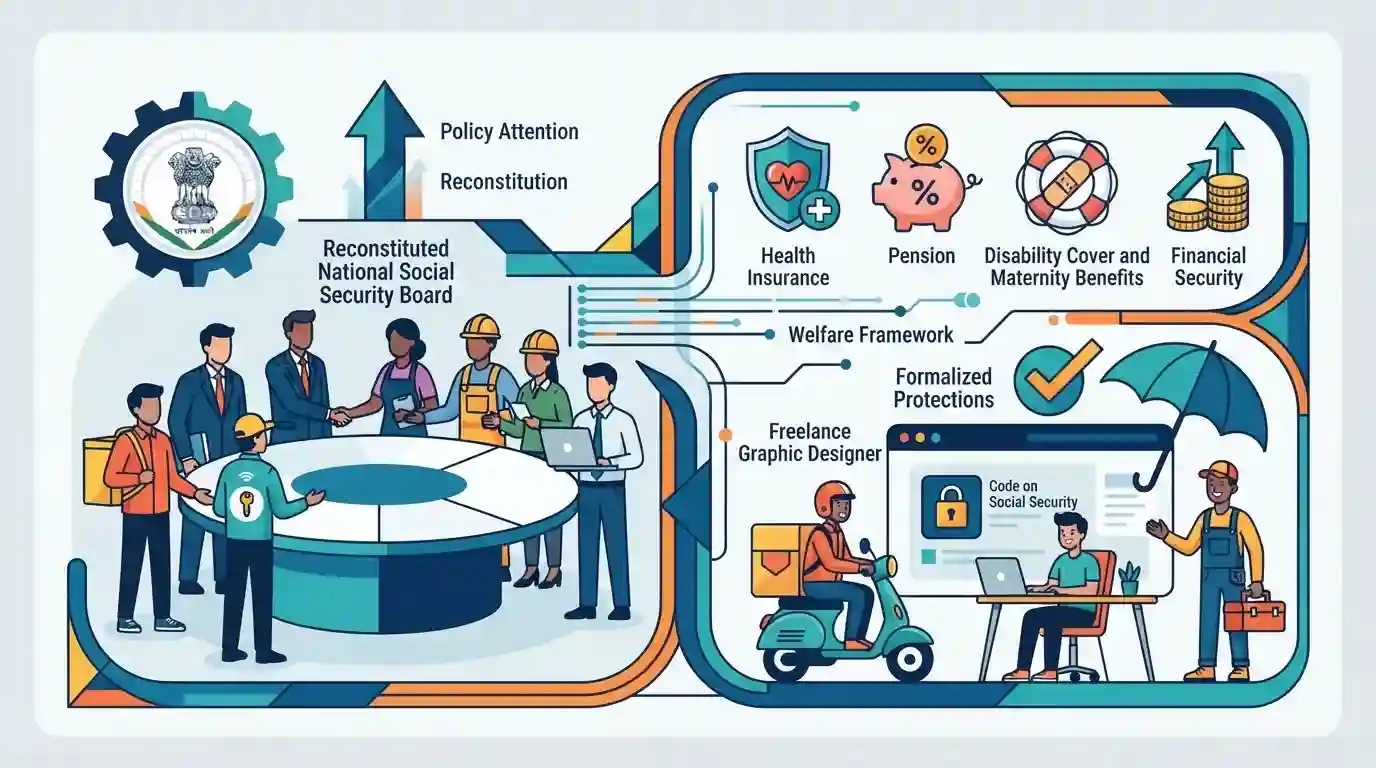
The Ministry of Labour and Employment has reconstituted the National Social Security Board to focus on social security schemes for gig and platform workers. Including various union representatives, the move underscores policy attention towards formalizing protections and welfare frameworks for the expanding gig workforce under the Code on Social Security.
Key Points
- The Ministry of Labour and Employment reconstituted the National Social Security Board to advise on social security schemes for gig and platform workers.
- The board includes representatives from trade unions, including RSS-affiliated Bharatiya Mazdoor Sangh (BMS) and Left-affiliated CITU.
- The inclusion highlights the growing political and economic significance of the gig and platform economy workforce in India's labour landscape.
- The board plays a crucial advisory role under the Code on Social Security for formulating welfare policies for unorganised, gig, and platform workers.
Important Terms
Code on Social Security

An umbrella legislation in India that consolidates existing central labour laws relating to social security, notably extending statutory welfare frameworks and social security benefits to gig and platform workers.
UPSC context
UPSC Paper II/III: Tests understanding of labour reforms, social security schemes, and statutory protections for the growing gig economy workforce.
National Social Security Board
A statutory body constituted under the Code on Social Security to advise the government on designing and administering welfare schemes and social security measures for unorganised, gig, and platform workers.
UPSC context
UPSC Paper II/III: Important for questions on institutional mechanisms, welfare governance, and policy implementation for vulnerable workforce segments.
Ministry of Labour and Employment
The central government ministry responsible for formulating labour policies, regulating industrial relations, ensuring occupational safety, and administering social security legislations for organized and unorganized workers in India.
UPSC context
UPSC Paper II: Important for governance, institutional framework, and administration of central welfare schemes and labour laws.
Prelims Trap
The Code on Social Security automatically enforces aggregator contributions across all states without requiring state-level framing or notification.
Aspirants often assume central labour codes are fully enforced across all states simultaneously, ignoring that state-level rules and framing are required for implementation.
Static Concepts Connected
What are the key provisions of the Code on Social Security, 2020 regarding gig and platform workers?
- New Definitions: Statutory definition explicitly recognizes gig workers and platform workers outside traditional employer-employee relationships.
- Welfare Fund: Aggregators operating in specified sectors are mandated to contribute 1-2% of annual turnover towards social security.
- Advisory Board: National Social Security Board established to advise the central government on schemes for unorganised, gig, and platform workers.
Cross-Topic Patterns
Gig Economy and Fiscal Federalism
The growth of platform work intersects directly with fiscal federalism as states like Rajasthan pioneer separate welfare funds and legislations alongside central codes.
Labour Jurisprudence and Digital Workspaces
Algorithmic management and non-standard employment challenge traditional industrial dispute mechanisms, shifting labour activism from factory floors to digital platforms.

Code on Social Security 2020 funding mechanisms for gig workers (1-2% aggregator turnover cap) high-yield for prelims/mains.
Linked PYQs · 1
Linked PYQs · 1
- 2024MainsGS3
Discuss the merits and demerits of the four 'Labour Codes' in the context of labour market reforms in India. What has been the progress so far in this regard?
