Arecanut Cultivation Crisis and Border Smuggling Challenges
Source:The Hindu ↗
Why It Matters
The article provides a highly relevant case study for GS3, connecting agricultural vulnerability (crop diseases, climate disruptions, insurance needs) with internal security challenges (economic impact of trans-border smuggling along the porous India-Myanmar border).
Summary
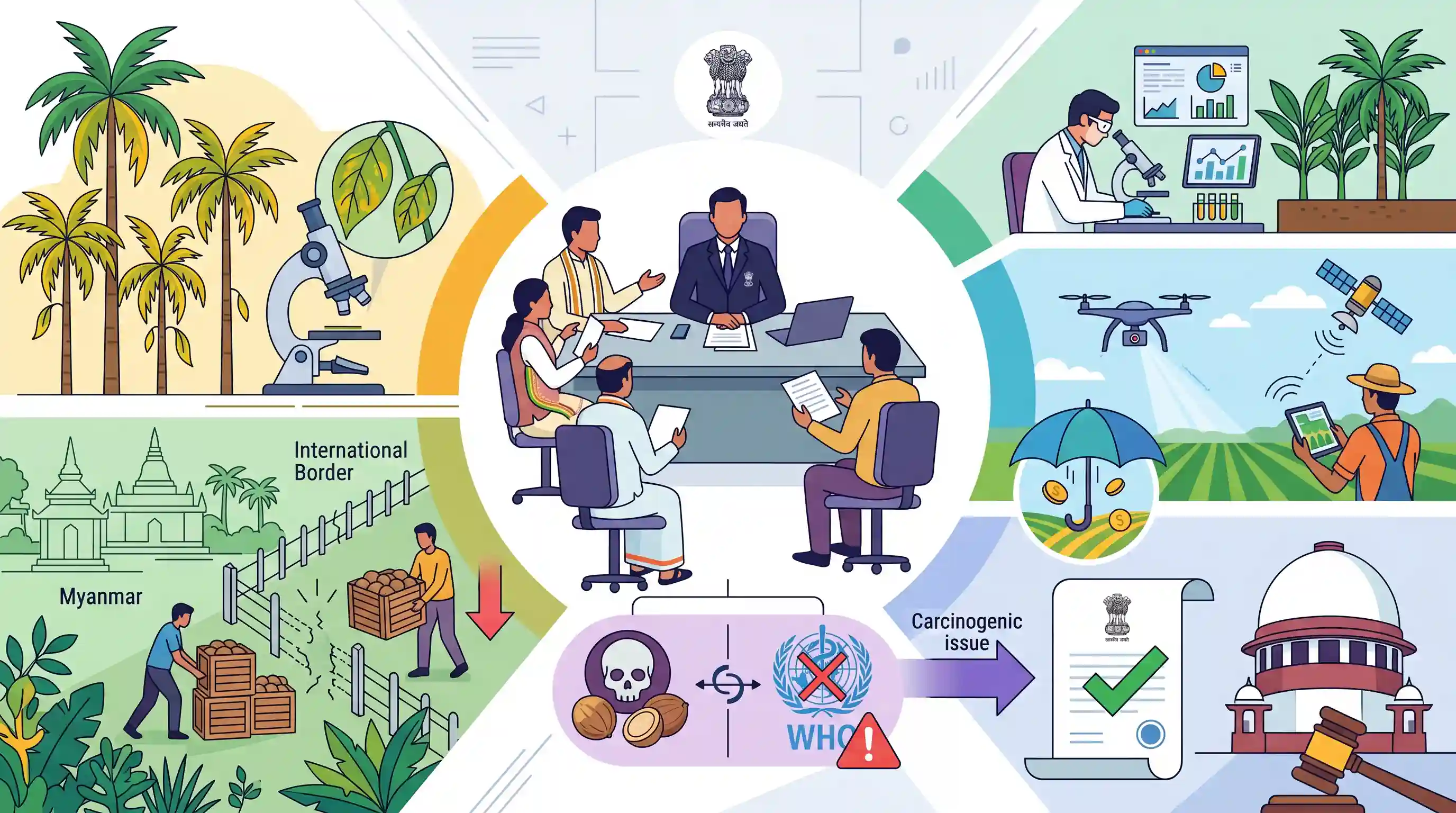
Ministers and MPs from Karnataka met Union Agriculture Minister Shivraj Singh Chouhan to highlight the severe challenges faced by arecanut growers, primarily due to Yellow-Leaf-Disease (YLD) and illegal imports via the Myanmar border. The delegation requested central funds for agricultural research, better crop insurance mechanisms, and technology-based climate and disease monitoring. They also urged the Union Government to finalize an official report refuting the WHO's classification of arecanut as carcinogenic, a matter currently pending before the Supreme Court.
Key Points
- A delegation of Karnataka ministers and MPs met Union Agriculture Minister Shivraj Singh Chouhan to discuss the challenges faced by arecanut growers in Karnataka and Kerala.
- The delegation requested Central funds for research on arecanut diseases, specifically Yellow-Leaf-Disease (YLD), and advanced technologies for monitoring rainfall and disease outbreaks.
- They demanded strict border security measures to halt the illegal import and smuggling of arecanut and pepper through the Myanmar border, which undercuts domestic prices.
- The Centre was urged to finalize an official evidence-based report on arecanut and human health to counter the WHO's classification of the crop as carcinogenic, pending in the Supreme Court.
- Strengthening of crop insurance frameworks was highlighted as essential to protect farmers from climate disruptions and crop failures.
Important Terms
CAMPCO

A multi-state cooperative society established in 1973 to protect arecanut and cocoa farmers in Karnataka and Kerala from market volatility and exploitation by middlemen.
UPSC context
GS Paper 2 & 3: Tests knowledge of cooperatives, agricultural marketing, and price stabilization mechanisms in rural economies.
Yellow Leaf Disease (YLD)
A debilitating disease in areca palms caused by Phytoplasma (spread by plant hoppers), leading to leaf yellowing, reduced vigour, and significant yield losses in South India.
UPSC context
GS Paper 3: Agriculture. Pests and diseases affecting commercial crops and their impact on farmer livelihoods and food security.
Minimum Import Price (MIP)
A trade policy tool used by the Directorate General of Foreign Trade (DGFT) to set a floor price below which imports are prohibited, protecting domestic producers.
UPSC context
GS Paper 3: Economic Development and Trade. Tests understanding of import-export regulations and protectionist measures for domestic agriculture.
Arecanut
The seed of the Areca catechu palm, India's leading commercial plantation crop, primarily grown in Karnataka and Kerala for masticatory and socio-religious purposes.
UPSC context
GS Paper 1 & 3: Geography of crops and agricultural economy. Karnataka’s dominance makes it a key regional geography topic.
WHO Carcinogenic Classification
The classification of arecanut as a Group 1 carcinogen by the WHO's International Agency for Research on Cancer, a major legal hurdle for the industry.
UPSC context
GS Paper 2 & 3: Intersection of public health, international standards (WHO), and their impact on agricultural trade and litigation.
Prelims Trap
Arecanut is classified by the WHO as a carcinogen only when it is consumed in combination with tobacco.
The WHO's IARC classifies arecanut itself as a Group 1 human carcinogen, independent of tobacco use, primarily due to the active alkaloid 'arecoline'.
Static Concepts Connected
What are the geographical requirements for Arecanut cultivation in India?
- Climate: Requires a tropical climate with temperatures between 14ºC and 36ºC, alongside high and well-distributed rainfall.
- Soil: Thrives best in deep, well-drained laterite soils and alluvial soils. Cannot withstand waterlogging.
- Distribution: Karnataka dominates with ~80% of national production, primarily concentrated in the Western Ghats region, followed by Kerala and Assam.
How does a Minimum Import Price (MIP) protect domestic agriculture?
- Definition: It is a trade policy tool that strictly prohibits the import of specific commodities below a government-mandated price floor.
- Objective: Protects domestic farmers from the dumping of artificially cheap or inferior foreign goods (like smuggled Burmese betel nut) that undercut local market prices.
Cross-Topic Patterns
Myanmar border security & crop smuggling
The porous 1,643 km India-Myanmar border facilitates illicit smuggling of 'Burmese betel nut', linking domestic agricultural distress directly to border security vulnerabilities and the suspension of the Free Movement Regime (FMR).
Livelihoods vs. Public Health ethics
The battle over WHO's classification of arecanut as a carcinogen mirrors the tobacco industry dilemma—forcing policymakers to balance mass farmer livelihoods against severe national health burdens.

A multi-statement Prelims question merging arecanut’s agro-climatic needs, Minimum Import Price (MIP), and WHO carcinogen status is likely.
Linked PYQs · 5
Linked PYQs · 5
- 2023MainsGS3
How does e-Technology help farmers in production and marketing of agricultural produce? Explain it.
- 2021MainsGS3
What are the present challenges before crop diversification? How do emerging technologies provide an opportunity for crop diversification?
- 2018PrelimsGS1
Consider the following: 1. Birds 2. Dust blowing 3. Rain 4. Wind blowing Which of the above spread plant diseases ?
- 2020MainsGS3
Analyze internal security threats and transborder crimes along Myanmar, Bangladesh and Pakistan borders including Line of Control (LoC). Also discuss the role played by various security forces in this regard.
- 2019MainsGS3
Cross-border movement of insurgents is only one of the several security challenges facing the policing of the border in North-East India. Examine the various challenges currently emanating across the India-Myanmar border. Also, discuss the steps to counter the challenges.
