Measures Proposed to Revamp Medical Education at NTRUHS
Source:The Hindu ↗
Why It Matters
The article sheds light on the critical need for governance and quality control in India's medical education system. It highlights the intersection of higher education administration and public health, underscoring how robust academic standards and localized medical research are essential for developing a competent healthcare workforce.
Summary
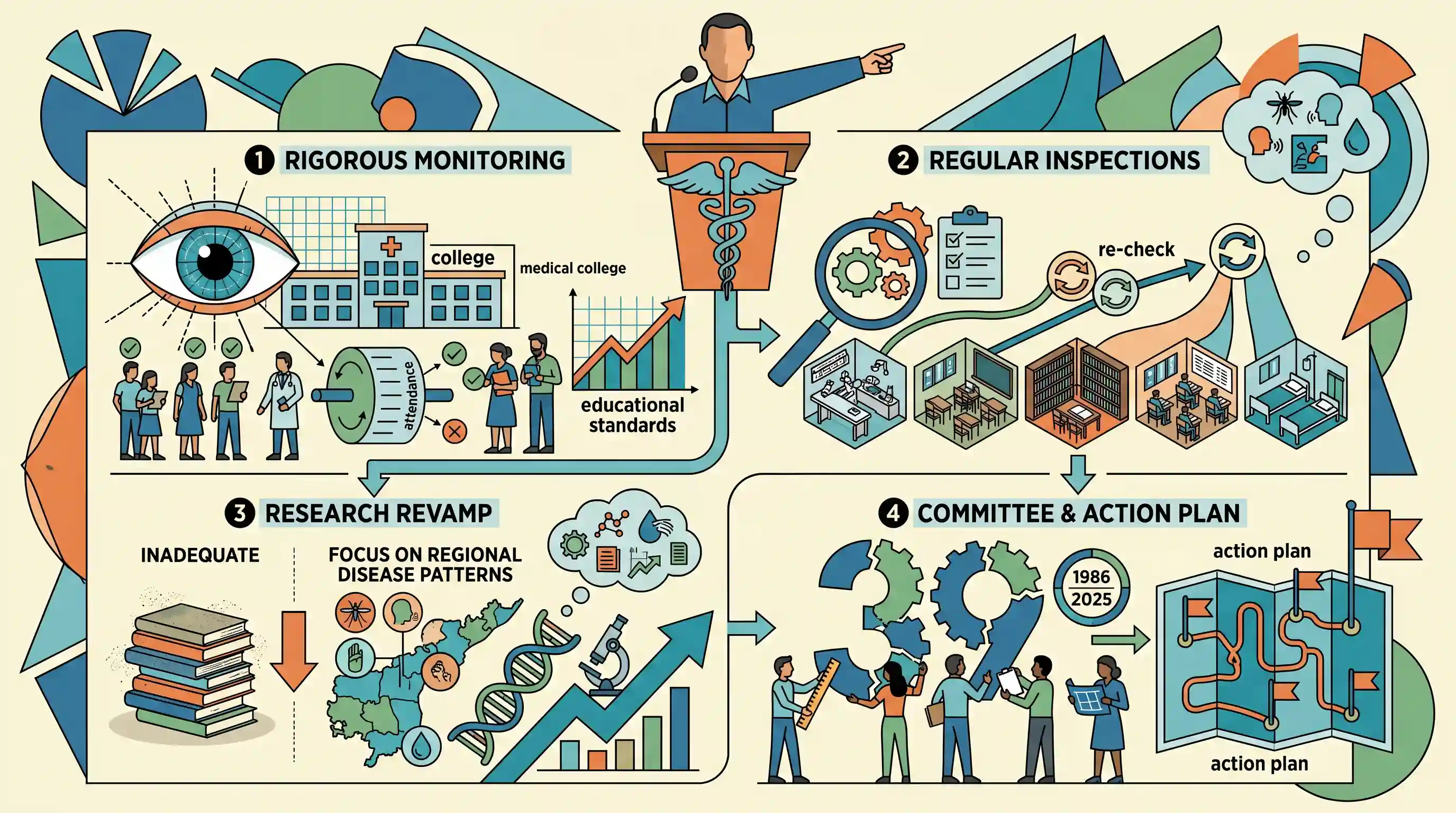
Andhra Pradesh's Health Minister has outlined measures to revamp medical education at Dr. NTR University of Health Sciences (Dr. NTRUHS). Addressing officials in Vijayawada, he stressed the need for rigorous monitoring of attendance and regular inspections to uphold academic standards. The Minister also raised concerns over inadequate research output, urging the institution to focus on analyzing regional disease patterns to advance medical science. To ensure accountability, a committee has been established to review the university's 39-year track record and formulate an action plan for comprehensive improvement.
Key Points
- Andhra Pradesh Health Minister Satya Kumar Yadav called for a robust monitoring system to improve medical education, pedagogy, and attendance at Dr. NTRUHS.
- The Minister expressed dissatisfaction over the lack of regular inspections to maintain and elevate medical education standards at the university.
- He urged the formulation of strong research policies, specifically emphasizing the need for studies on disease patterns in the State to contribute to medical science.
- A committee has been formed to review the university's performance over the past 39 years, identify shortcomings, and draft an action plan for better administration.
Important Terms
Dr. NTR University of Health Sciences (Dr. NTRUHS)

Established in 1986 as India's first health university, it functions as the central regulatory and affiliating body for medical, dental, and nursing education in Andhra Pradesh.
UPSC context
GS-II (Social Sector-Health); relevant for understanding state-level institutional frameworks that govern specialized professional education and healthcare quality.
Andhra Pradesh Health Department
The state-level executive body responsible for public health, medical services, and family welfare, implementing policies across primary, secondary, and tertiary healthcare levels.
UPSC context
GS-II (Governance); exemplifies the constitutional role of States in managing health (State List) and implementing welfare schemes.
National Medical Commission (NMC)
The statutory body that regulates medical education and professionals in India, replacing the Medical Council of India (MCI) to ensure transparency and meritocracy.
UPSC context
GS-II (Statutory/Regulatory Bodies); critical for questions on health sector reforms and the regulatory landscape of medical professionals.
Medical Education
The systematic training of healthcare professionals through undergraduate, postgraduate, and super-specialty courses, aiming to build a competent and ethical health workforce.
UPSC context
GS-II (Health and Education); essential for discussing human resource gaps in India’s healthcare system and universal health coverage.
Higher Education Governance
The regulatory and administrative framework involving bodies like the UGC and NMC to ensure academic standards, institutional accountability, and quality in universities.
UPSC context
GS-II (Governance/Education); covers institutional autonomy, regulatory overlaps, and reforms under the National Education Policy (NEP) 2020.
Research and Development (R&D) in Medicine
Investigation and clinical study aimed at developing new diagnostic tools, treatments, and vaccines, focusing on disease patterns to improve clinical outcomes.
UPSC context
GS-III (Science & Technology); focuses on innovation, indigenous healthcare solutions, and the link between research and public health surveillance.
Prelims Trap
State health universities have the sole authority to de-recognize medical colleges for failing academic standards.
The National Medical Commission (NMC), through its Medical Assessment and Rating Board (MARB), holds the primary authority to recognize, rate, or de-recognize medical colleges across India.
Static Concepts Connected
What is the governance structure under the National Medical Commission (NMC) Act 2019?
- Apex Regulator: It replaced the corruption-plagued Medical Council of India (MCI) to ensure transparency in medical education.
- Four Autonomous Boards: Functions through four autonomous boards: Under-Graduate, Post-Graduate, Medical Assessment and Rating, and Ethics and Medical Registration.
- NExT Exam: Introduced a uniform National Exit Test (NExT) serving as a licentiate exam and PG entrance test.
Why is regional disease surveillance critical in India?
- Epidemiological Diversity: India faces a high variation in the dual burden of communicable and non-communicable diseases across different climatic and socioeconomic zones.
- Targeted Policy: Enables localized policy interventions rather than one-size-fits-all national schemes, optimizing state health budgets.
- IDSP Framework: Relies on the Integrated Disease Surveillance Programme (IDSP) to detect and respond to early outbreak warning signals.
Cross-Topic Patterns
State Universities vs. Central Regulation
The friction between state-level university administration and centralized quality mandates (NMC/UGC) frequently features in mains questions concerning federalism and higher education governance.
Clinical Practice vs. Academic Research
India's deficit in primary medical research links directly to its reliance on imported medical devices and preference for generic manufacturing over novel drug discovery.

Expect a GS2 mains question evaluating the NMC's efficacy in balancing centralized medical standards with localized state health deficits.
Linked PYQs · 3
Linked PYQs · 3
- 2015MainsGS2
The quality of higher education in India requires major improvements to make it internationally competitive. Do you think that the entry of foreign educational institutions would help improve the quality of higher and technical education in the country? Discuss.
- 2020MainsGS2
In order to enhance the prospects of social development, sound and adequate health care policies are needed particularly in the fields of geriatric and maternal health care. Discuss.
- 2021MainsGS2
“Besides being a moral imperative of a Welfare State, primary health structure is a necessary precondition for sustainable development.” Analyze.
