NEET Examination Irregularities and Federal Governance Issues
Source:The Hindu ↗
Why It Matters
The controversy surrounding NEET irregularities highlights critical governance deficits in conducting fair national-level examinations. It raises important questions about the Public Examination (Prevention of Unfair Means) Act, 2024, and Centre-State dynamics in managing concurrent subjects like education. Simultaneously, the direct transfer of drought and crop insurance relief demonstrates the practical utility of DBT in agricultural crisis management.
Summary
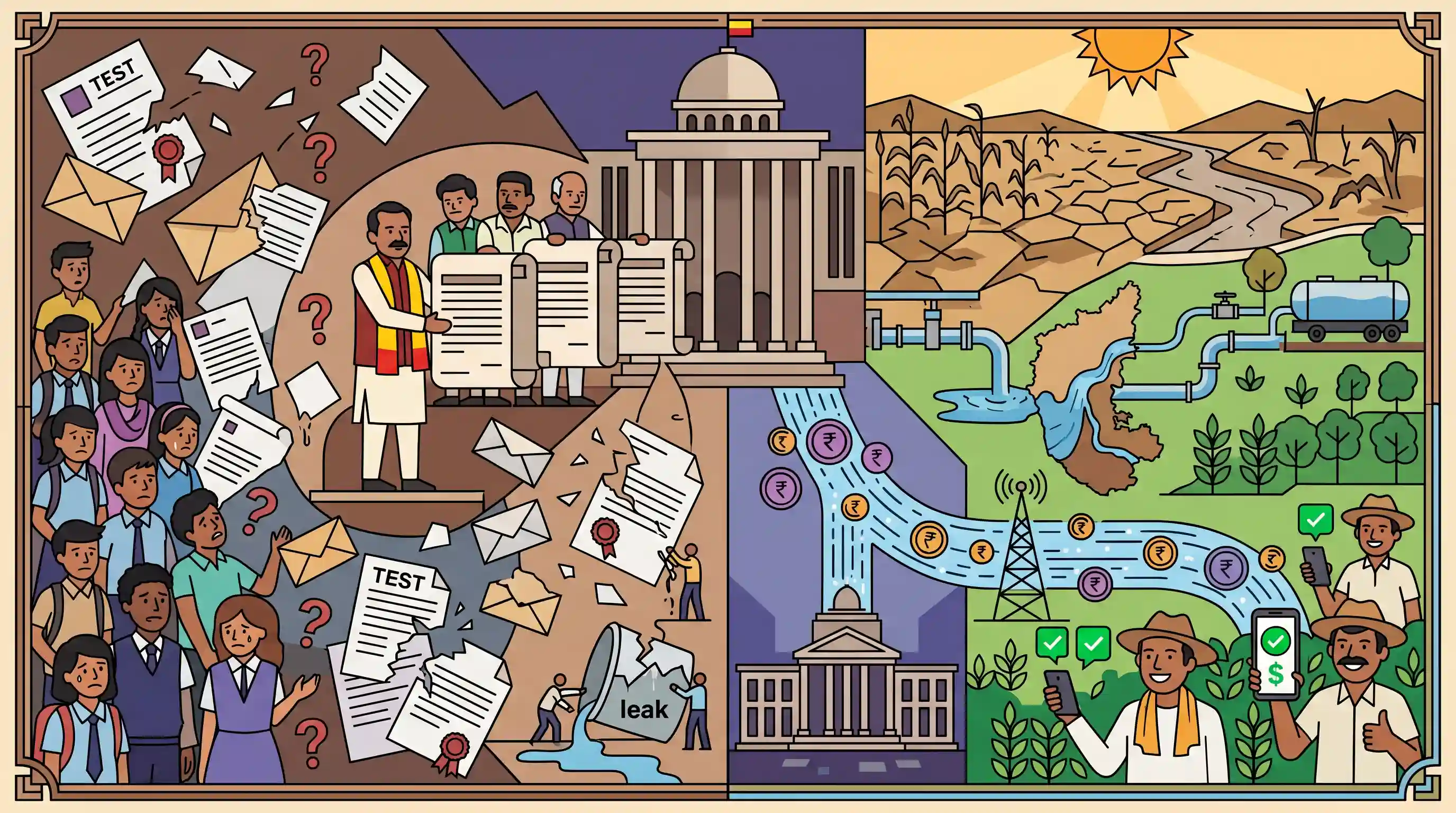
Karnataka's Medical Education Minister, Sharan Prakash Patil, has strongly criticized the Central government's handling of the NEET controversies, including alleged paper leaks and systemic irregularities affecting 23 lakh students. He plans to bring together Medical Education Ministers from multiple States to submit collective recommendations for overhauling the examination process. Furthermore, the minister highlighted the state government's success in managing severe drought and water scarcity in the Bhima river region, alongside the direct transfer of significant crop insurance and drought compensation funds to farmers.
Key Points
- Karnataka Minister Sharan Prakash Patil criticized the Central government over alleged irregularities and paper leaks in the NEET examination, which impacted nearly 23 lakh students.
- He announced plans to convene a meeting of Medical Education Ministers from various States to formulate recommendations for improving the national medical entrance examination system.
- On the local front, he stated that despite severe drought conditions and the Bhima river drying up, the drinking water crisis in the district was successfully managed.
- He highlighted agricultural relief efforts, noting that ₹183 crore in crop insurance and ₹203 crore in drought compensation were credited directly to farmers' bank accounts.
Important Terms
National Testing Agency (NTA)

An autonomous organization under the Ministry of Education established to conduct transparent and standardized entrance examinations (like NEET, JEE) for higher educational institutions in India.
UPSC context
GS-II: Statutory, regulatory and various quasi-judicial bodies; tests understanding of governance and transparency in competitive examinations.
National Eligibility-cum-Entrance Test (NEET)
The single mandatory nationwide entrance examination for admission to undergraduate medical (MBBS), dental (BDS), and AYUSH courses in all medical institutions across India.
UPSC context
GS-II: Issues relating to development and management of Social Sector/Services relating to Education.
Direct Benefit Transfer (DBT)
A mechanism to transfer subsidies and welfare payments directly into beneficiaries' bank accounts using the JAM (Jan Dhan-Aadhaar-Mobile) trinity to eliminate leakages and intermediaries.
UPSC context
GS-II: Welfare schemes; GS-III: E-technology in the aid of farmers and issues related to direct and indirect farm subsidies.
Pradhan Mantri Fasal Bima Yojana (PMFBY)
A flagship crop insurance scheme providing comprehensive financial support to farmers for crop losses due to natural calamities, pests, or diseases at capped premium rates.
UPSC context
GS-III: Issues related to direct and indirect farm subsidies and minimum support prices; Public Distribution System; Food Security.
Cooperative Federalism
A constitutional concept where Central and State governments collaborate and interact to solve common problems and implement national policies for public interest.
UPSC context
GS-II: Functions and responsibilities of the Union and the States, issues and challenges pertaining to the federal structure.
Prelims Trap
Education is a Union subject under the Seventh Schedule, giving the Centre exclusive control.
Education was moved from the State List to the Concurrent List by the 42nd Amendment (1976), giving both the Centre and States jurisdiction.
Static Concepts Connected
How is jurisdiction over 'Education' divided in the Constitution?
- Concurrent List: Transferred from the State List to the Concurrent List (List III) by the 42nd Constitutional Amendment Act, 1976.
- Article 254 Doctrine: Under Article 254, if a conflict arises between State and Union legislation on a concurrent subject, the Union law generally prevails.
- Union List Entry 66: Empowers the Union to coordinate and determine standards in institutions for higher education or research and scientific and technical institutions.
What are the key geographical features of the Bhima River?
- Tributary status: It is a major left-bank tributary of the Krishna River.
- Origin: Originates in the Bhimashankar hills of the Western Ghats in Maharashtra.
- Basin states: Flows southeast through the states of Maharashtra, Karnataka, and Telangana before merging with the Krishna River.
Cross-Topic Patterns
Federal friction in Concurrent subjects
NEET controversies highlight growing friction in Concurrent List subjects, mirroring recent State-Centre disputes over the agricultural laws, GST compensation, and general consent to the CBI.
Climate shocks and DBT efficiency
Severe droughts in the Krishna basin (Bhima river) emphasize DBT's crucial role in immediate disaster relief and the effectiveness of PMFBY in mitigating climate-induced agricultural shocks.

Expect a Mains question linking the 2024 Public Examination Act, NEET controversies, and cooperative federalism in Concurrent List domains.
Linked PYQs · 3
Linked PYQs · 3
- 2024MainsGS2
What are the aims and objects of recently passed and enforced, The Public Examination (Prevention of Unfair Means) Act, 2024? Whether University/State Education Board examinations, too, are covered under the Act ?
- 2015MainsGS3
In what way could replacement of price subsidy with Direct Benefit Transfer (DBT) change the scenario of subsidies in India ? Discuss.
- 2016PrelimsGS1
With reference to 'Pradhan Mantri Fasal Bima Yojana', consider the following statements: 1. Under this scheme, farmers will have to pay a uniform premium of two percent for any crop they cultivate in any season of the year. 2. This scheme covers post-harvest losses arising out of cyclones and unseasonal rains. Which of the statements given above is/are correct?
