Telangana urges parties to support backward class reservation quota
Source:The Hindu ↗
Why It Matters
The 50% reservation ceiling established in the Indira Sawhney case is a defining feature of Indian affirmative action. States attempting to breach it using caste survey data, EWS precedents, or local body carve-outs (under the Krishnamurthy case) raise critical federal and constitutional questions relevant to GS2 (Polity and Social Justice).
Summary
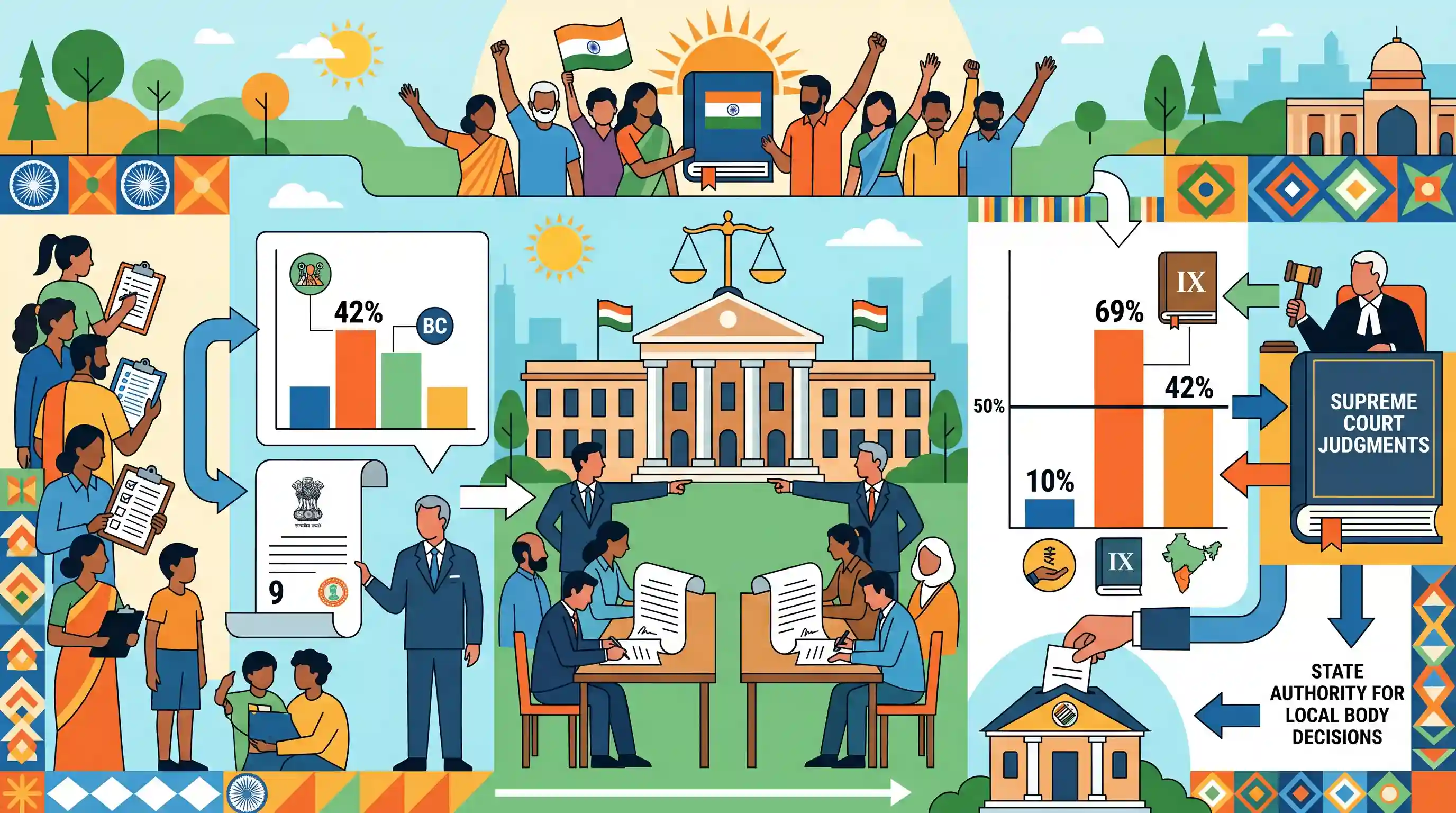
Telangana Ministers have urged political parties to file affidavits in the High Court supporting the State's decision to provide 42% reservation to Backward Classes (BCs) in local body polls. The government recently issued G.O. No. 9 following a comprehensive caste survey. To defend breaching the traditional 50% reservation ceiling, officials cited precedents such as the 10% EWS quota and Tamil Nadu's 69% reservation under the Ninth Schedule. They also referenced the Supreme Court's Krishnamurthy and Indira Sawhney judgments, which clarify that the quantum of local body reservations falls under the purview of State governments.
Key Points
- The Telangana government passed a bill and issued G.O. No. 9 to increase Backward Class (BC) reservations in local bodies to 42%.
- The decision was backed by a comprehensive state-level caste survey to provide empirical, verified data.
- Ministers cited the Supreme Court's rulings in the Indira Sawhney and Krishnamurthy cases to argue that local body reservations fall under the purview of State governments.
- The state justifies breaching the 50% reservation ceiling by citing the 10% EWS quota and Tamil Nadu's 69% reservation protected under the Ninth Schedule.
- With the High Court set to hear the matter, the government has urged all political parties to file supporting affidavits.
Important Terms
Indira Sawhney Case

A landmark 1992 Supreme Court judgment that upheld 27% OBC reservations while capping total reservations at 50% and introducing the "creamy layer" concept to exclude affluent members from benefits.
UPSC context
GS Paper II: Polity/Social Justice. Essential for understanding judicial limits on reservation and the evolution of affirmative action.
Ninth Schedule
Article 31B of the Constitution that shields specific laws from judicial review. It is often invoked by States to protect reservation laws that breach the 50% ceiling.
UPSC context
GS Paper II: Constitution. Tests knowledge of judicial review, the Basic Structure doctrine, and legislative protections for social reforms.
K. Krishna Murthy Case
A 2010 Supreme Court ruling distinguishing 'political' reservations in local bodies from 'social' reservations, establishing that while distinct, aggregate quotas should generally remain within 50%.
UPSC context
GS Paper II: Local Governance. Vital for understanding Articles 243D/243T and the legal framework for local body quotas.
103rd Constitutional Amendment Act
The 2019 amendment that introduced 10% reservation for Economically Weaker Sections (EWS), marking the first formal breach of the 50% reservation ceiling established in 1992.
UPSC context
GS Paper II: Governance. Tests understanding of Articles 15(6) and 16(6) and the shift toward economic criteria for reservations.
Triple Test (Local Bodies)
A mandatory three-pronged legal standard (empirical inquiry, specifying proportion, and 50% aggregate cap) that States must satisfy before providing OBC reservations in local body elections.
UPSC context
GS Paper II: Social Justice/Governance. Crucial for assessing the validity of state-led political reservations for backward classes.
G.O. No. 9 (Telangana)
The Telangana Government Order (2025) that enhanced Backward Class (BC) reservations to 42% for local body polls, currently under judicial scrutiny for exceeding the 50% cap.
UPSC context
GS Paper II: State Administration. A contemporary case study of regional reservation politics and conflict between state policy and judicial precedents.
Prelims Trap
The Constitution mandates reservation for Backward Classes in Panchayats in proportion to their population.
The Constitution specifically mandates reservations for SCs, STs, and women in local bodies. However, reservation for Backward Classes is completely discretionary and left to State Legislatures.
Static Concepts Connected
What is the 'Triple Test' established by the SC for local body OBC quotas?
- Empirical Commission: State must set up a dedicated commission to conduct an empirical inquiry into the nature and implications of backwardness.
- Proportion Specification: The state must specify the proportion of reservation required local-body-wise based on the commission's recommendations.
- 50% Ceiling: The aggregate of reservations in favor of SCs, STs, and OBCs must not exceed 50% of the total seats.
How does the Ninth Schedule interact with reservation ceilings?
- Article 31B Protection: Laws placed in the 9th Schedule cannot be challenged for violating Fundamental Rights, famously used for Tamil Nadu's 69% quota.
- Basic Structure Test: Post-I.R. Coelho (2007), laws added after April 24, 1973, can be reviewed if they violate the Constitution's basic structure.
Cross-Topic Patterns
State-led empirical data generation
With the Union avoiding a socio-economic caste census, states (Bihar, Telangana) are conducting their own surveys to satisfy the Supreme Court's 'empirical data' requirement for expanding quotas.
Political vs. Public Employment Quotas
UPSC frequently tests the conceptual difference between political backwardness (Article 243D/T for local bodies) and social/educational backwardness (Articles 15/16 for public employment/education).

Expect a multi-statement Prelims question testing the 'Triple Test' criteria and the discretionary nature of OBC quotas in local bodies.
Linked PYQs · 4
Linked PYQs · 4
- 2022MainsGS2
Discuss the role of the National Commission for Backward Classes in the wake of its transformation from a statutory body to a constitutional body.
- 2021MainsGS2
Analyze the distinguishing features of the notion of Right to Equality in the Constitutions of the USA and India.
- 2024MainsGS1
Despite comprehensive policies for equity and social justice, underprivileged sections are not yet getting the full benefits of affirmative action envisaged by the Constitution. Comment.
- 2022MainsGS1
Analyse the salience of 'sect' in Indian society vis-a-vis caste, region and religion.
