Telangana Seeks Rapid Environmental Clearance For Irrigation Projects
Source:The Hindu ↗
Why It Matters
Highlights the persistent tension between executing developmental infrastructure (like irrigation projects for water security) and adhering to environmental regulatory frameworks, a classic theme in environmental governance and EIA.
Summary
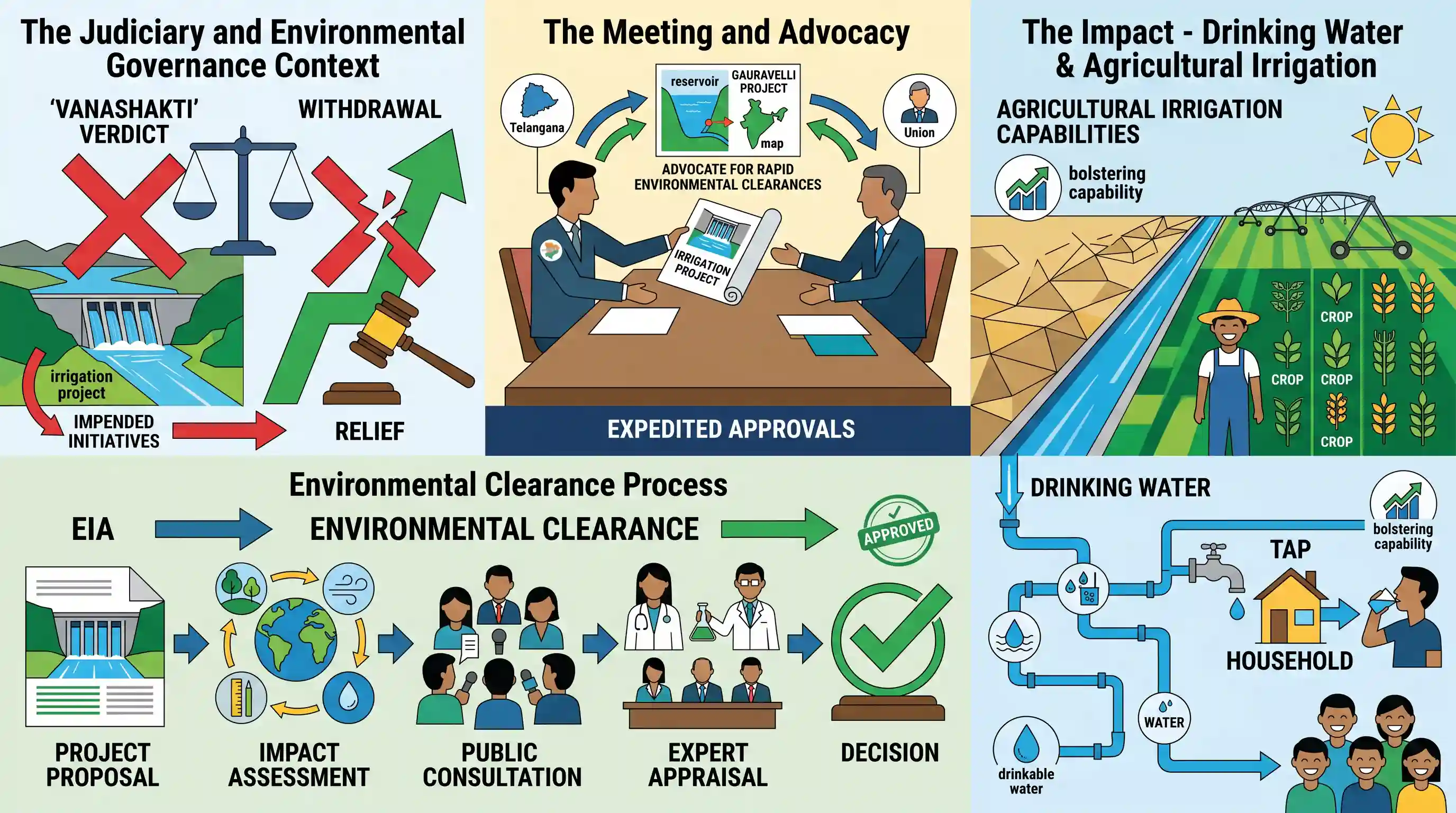
Telangana Minister Ponnam Prabhakar met Union Forest and Environment Secretary Tanmay Kumar to advocate for rapid environmental clearances for state irrigation projects, notably the Gauravelli project. This appeal comes in the wake of the Supreme Court withdrawing its 'Vanashakti' verdict, which had previously impeded such initiatives. Expedited approvals are critical for bolstering the state's drinking water and agricultural irrigation capabilities.
Key Points
- Telangana Transport and BC Welfare Minister Ponnam Prabhakar urged the Union government to expedite environmental clearances for key irrigation projects like the Gauravelli project.
- Faster approvals are expected to significantly enhance drinking water supply and irrigation facilities for farmers in the State.
- The request follows the Supreme Court\'s withdrawal of its \'Vanashakti\' verdict, which had previously created hurdles for several infrastructure projects.
- The Union Forest and Environment Secretary assured that legal counsel would be sought to speed up the clearance process.
Important Terms
Gauravelli project

A reservoir project in Telangana's Siddipet district, part of the Kaleshwaram Lift Irrigation Scheme, aimed at providing irrigation to over 1 lakh acres and drinking water.
UPSC context
Relevant for GS Paper III (Irrigation) and GS Paper I (Geography of India: River systems and projects).
Vanashakti verdict
A Supreme Court judgment (recalled in 2025) that initially barred the government from granting retrospective environmental clearances for projects that began without prior approval.
UPSC context
Significant for GS Paper II (Judiciary) and GS Paper III (Environmental Governance and post-facto approvals).
Environmental Impact Assessment (EIA)
A statutory process under the Environment (Protection) Act, 1986, used to evaluate the potential environmental impacts of proposed projects before granting developmental permission.
UPSC context
A core topic for GS Paper III (Environment) and Prelims (Environmental legislation).
Ex-post facto Environmental Clearance
The administrative grant of environmental approval for projects that have already commenced or completed construction, typically requiring the payment of heavy penalties.
UPSC context
Tests understanding of GS Paper III (Environmental Law) and the balance between development and conservation.
Union Ministry of Environment, Forest and Climate Change (MoEFCC)
The nodal agency in India responsible for planning, promoting, and coordinating environmental and forestry programs, including granting environmental clearances for major projects.
UPSC context
Crucial for GS Paper II (Government Policies) and GS Paper III (Environmental conservation).
Kaleshwaram Lift Irrigation Scheme (KLIS)
A massive multi-purpose lift irrigation project on the Godavari River in Telangana, designed to provide water for irrigation, drinking, and industrial use.
UPSC context
Frequently tested in GS Paper III (Infrastructure and Water Resources) and state-specific exams.
Prelims Trap
"Ex post facto (retrospective) environmental clearances are strictly prohibited and unconstitutional in India."
While initially struck down, the Supreme Court recently recalled its Vanashakti verdict, thereby restoring the mechanism of granting ex post facto environmental clearances for "permissible activities".
Static Concepts Connected
How are projects classified for clearance under the EIA Notification 2006?
- Category A: Appraised at the Central level by the MoEFCC based on the Expert Appraisal Committee (EAC) recommendations. Requires mandatory prior clearance.
- Category B: Appraised at the State level by the SEIAA. It is further divided into B1 (requires an EIA report) and B2 (exempted from an EIA report).
- Public Hearing Exemptions: Projects like the modernization of existing irrigation systems are explicitly exempted from the mandatory public consultation process.
What are the core principles of Indian environmental jurisprudence?
- Precautionary Principle: Anticipating and preventing environmental harm even in the absence of absolute scientific certainty. Recognized as part of Article 21 (Vellore Citizens case).
- Polluter Pays Principle: The entity responsible for pollution must bear the costs of managing it and compensating victims, rather than the public or government.
- Principle of Proportionality: Balancing environmental protection with economic realities, ensuring that regulatory actions (like demolishing ongoing projects) do not cause disproportionate economic ruin.
Cross-Topic Patterns
Infrastructure push vs EIA mandates
The tension between completing massive capital-intensive irrigation projects and adhering to strict prior environmental clearances frequently invites judicial intervention, reflecting the ongoing debate over sustainable development versus economic necessity.
Judicial Review & Article 137
The Supreme Court recalling the Vanashakti verdict highlights its powers under Article 137 to review and rectify its own orders when economic externalities and public investments outweigh procedural lapses.

Expect a GS-III Mains question on the balancing act between the 'precautionary principle' and 'principle of proportionality' in EIA norms.
Linked PYQs · 3
Linked PYQs · 3
- 2024MainsGS3
What role do environmental NGOs and activists play in influencing Environmental Impact Assessment (EIA) outcomes for major projects in India? Cite four examples with all important details.
- 2024MainsGS3
What are the major challenges faced by Indian irrigation system in recent times? State the measures taken by the government for efficient irrigation management.
- 2020MainsGS3
Suggest measures to improve water storage and irrigation system to make its judicious use under depleting scenario.
