Monsoon Safety Measures in Welfare Residential Schools
Source:The Hindu ↗
Why It Matters
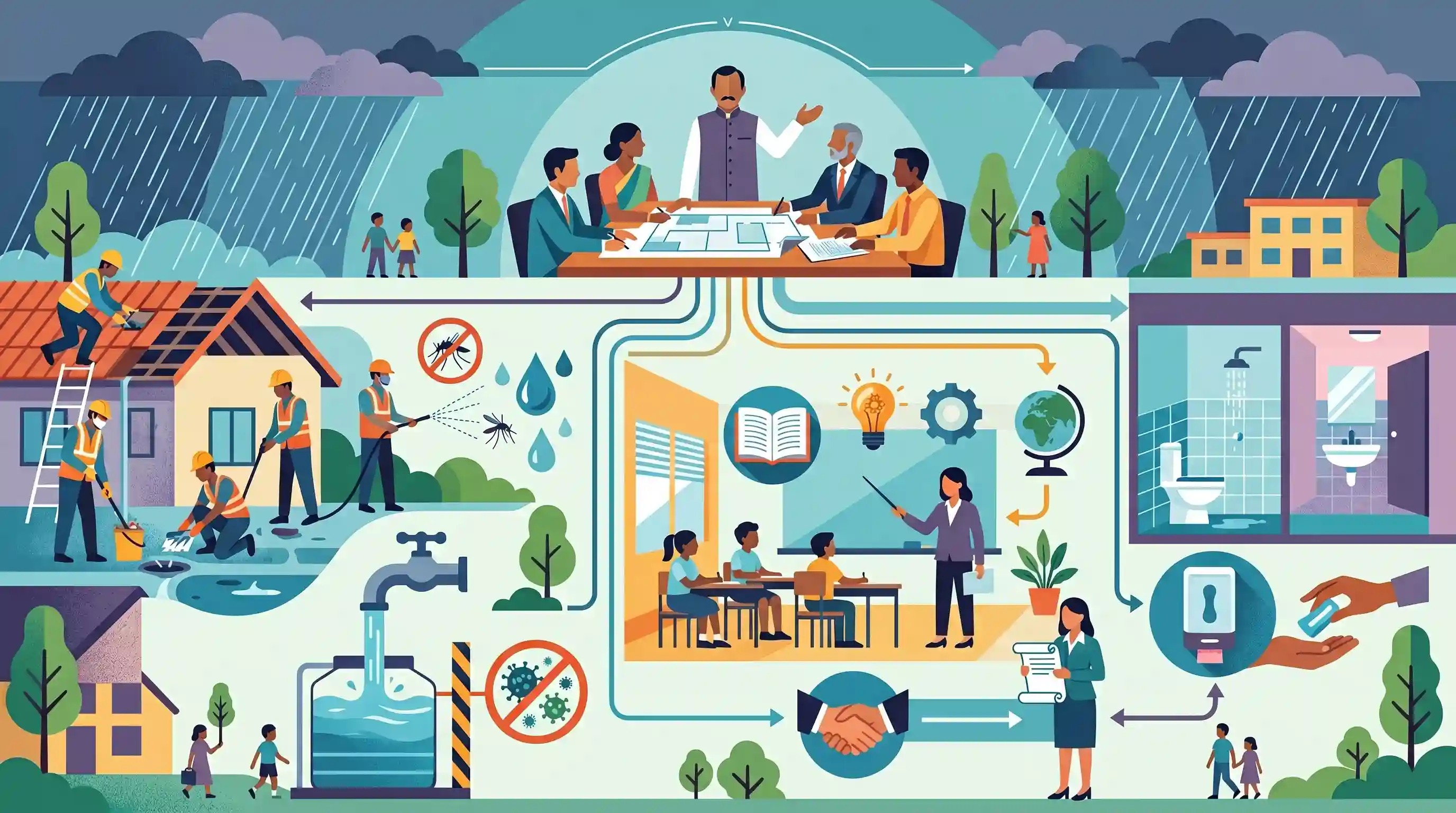
This article highlights practical, decentralized governance measures addressing the convergence of tribal/marginalized welfare, preventative public healthcare, gender-responsive sanitation (WASH), and educational administration in residential institutions during seasonal environmental challenges like the Indian monsoon.
Summary
Telangana Minister for Welfare Adluri Laxman Kumar has directed officials to carry out comprehensive monsoon safety and health preparedness across Telangana's Social Welfare and Tribal Welfare residential schools (TSWREIS and TTWREIS). The directive emphasizes robust infrastructure maintenance, seasonal epidemic prevention (dengue, malaria, and water-borne diseases), temporary teacher recruitment to combat staff shortages, and specialized menstrual hygiene facilities in girls' hostels. This governance measure highlights the intersection of public health, education continuity, and welfare management for vulnerable socio-economic groups.
Key Points
- Telangana Minister for Welfare, Adluri Laxman Kumar, directed state officials to implement comprehensive monsoon preparedness across TSWREIS and TTWREIS residential schools.
- The initiative focuses heavily on strengthening school infrastructure, including hostels, classrooms, kitchens, and addressing teacher shortages through temporary appointments to prevent academic disruption.
- Preventative healthcare measures are prioritized to control the spread of monsoon-related ailments such as dengue, malaria, viral fevers, and water-borne diseases within educational institutions.
- The order mandates essential amenities, including safe drinking water, regular sanitation, and hot water facilities, along with adequate medical support systems.
- A special emphasis has been placed on improving sanitation, hygiene, and menstrual health facilities in girls' hostels to ensure dignity and health safety.
Important Terms
Telangana Social Welfare Residential Educational Institutions Society (TSWREIS)

A government-run autonomous society in Telangana (now TGSWREIS) that manages residential schools and colleges, providing free, quality English-medium education to marginalized Scheduled Caste (SC) students.
UPSC context
GS Paper II: Governance, Social Justice, and Welfare Schemes for Vulnerable Sections.
Telangana Tribal Welfare Residential Educational Institutions Society (TTWREIS)
An autonomous society under Telangana’s Tribal Welfare Department (now TGTWREIS) that operates residential schools and colleges to provide high-quality English-medium education to Scheduled Tribe (ST) students.
UPSC context
GS Paper II: Welfare schemes for STs, education, and human resource development.
Water, Sanitation, and Hygiene (WASH)
A developmental concept grouping water, sanitation, and hygiene, critical for public health, gender equality, and sustainable development, central to WHO standards and SDG 6.
UPSC context
GS Paper II: Issues relating to development and management of Social Sector/Services relating to Health.
Menstrual Hygiene Scheme (MHS)
A scheme launched by India's Ministry of Health and Family Welfare to promote menstrual hygiene and distribute subsidized sanitary napkins to rural adolescent girls aged 10-19.
UPSC context
GS Paper II: Social empowerment, gender justice, and adolescent health schemes.
Eklavya Model Residential Schools (EMRS)
A central scheme launched in 1997-98 under the Ministry of Tribal Affairs to provide free, high-quality residential education to Scheduled Tribe (ST) students in remote areas.
UPSC context
GS Paper II: Welfare schemes for STs, education, and social sector management.
Prelims Trap
Article 46, which mandates state promotion of SC/ST educational interests, is a justiciable fundamental right under Part III.
While the Supreme Court has read menstrual hygiene into justiciable rights (Article 21/21A), Article 46 remains a non-justiciable DPSP (Part IV) that cannot be enforced directly via writ petitions.
Static Concepts Connected
What constitutional provisions secure educational advancement for SCs and STs?
- Article 15(4): Empowers the State to make special provisions for the advancement of socially and educationally backward classes, Scheduled Castes, and Scheduled Tribes.
- Article 46: Mandates the State to promote with special care the educational and economic interests of weaker sections, particularly SCs and STs, protecting them from injustice.
- Article 21A: Guarantees free and compulsory education to all children aged six to fourteen, which courts have ruled includes safe and hygienic school environments.
How do vector-borne and water-borne transmission pathways differ in monsoon crises?
- Vector transmission: Living hosts like mosquitoes or ticks carry and transmit pathogens (e.g., Malaria, Dengue) from one host to another.
- Water-borne transmission: Ingestion route where drinking water or food is contaminated directly by pathogenic microorganisms, bacteria, or viruses (e.g., Cholera, Typhoid).
- WASH interventions: Targeted sanitation specifically blocks water-borne fecal-oral transmission, whereas vector control requires biological or chemical source reduction of breeding sites.
Cross-Topic Patterns
WASH Infrastructure and Female Literacy
Infrastructural deficits in menstrual hygiene directly violate Article 21A, illustrating how physical school sanitation dictates gender-parity metrics and adolescent drop-out rates in rural India.
Climate Monsoons and Epidemic Resilience
Monsoon waterlogging bridges disaster management and epidemiology, proving that climate-resilient school infrastructure is vital to prevent seasonal vector and water-borne disease outbreaks.

SC mandates on menstrual hygiene under Articles 21/21A combined with WASH deficiencies in tribal schools will likely frame a GS-2 question.
Linked PYQs · 3
Linked PYQs · 3
- 2017MainsGS2
To ensure effective implementation of policies addressing water, sanitation and hygiene needs the identification of the beneficiary segments is to be synchronized with the anticipated outcomes." Examine the statement in the context of the WASH scheme.
- 2024MainsGS2
In a crucial domain like the public healthcare system the Indian State should play a vital role to contain the adverse impact of marketisation of the system. Suggest some measures through which the State can enhance the reach of public healthcare at the grassroots level.
- 2019MainsGS3
Disaster preparedness is the first step in any disaster management process. Explain how hazard zonation mapping will help disaster mitigation in the case of landslides.
