Nellore government school student bicycle distribution welfare drive
Source:The Hindu ↗
ఇది ఎందుకు ముఖ్యం
Provides a practical example of how Corporate Social Responsibility (CSR) and private resources are being mobilized to augment public education infrastructure in Andhra Pradesh, closely tying into the state's P-4 governance framework for poverty alleviation.
సారాంశం
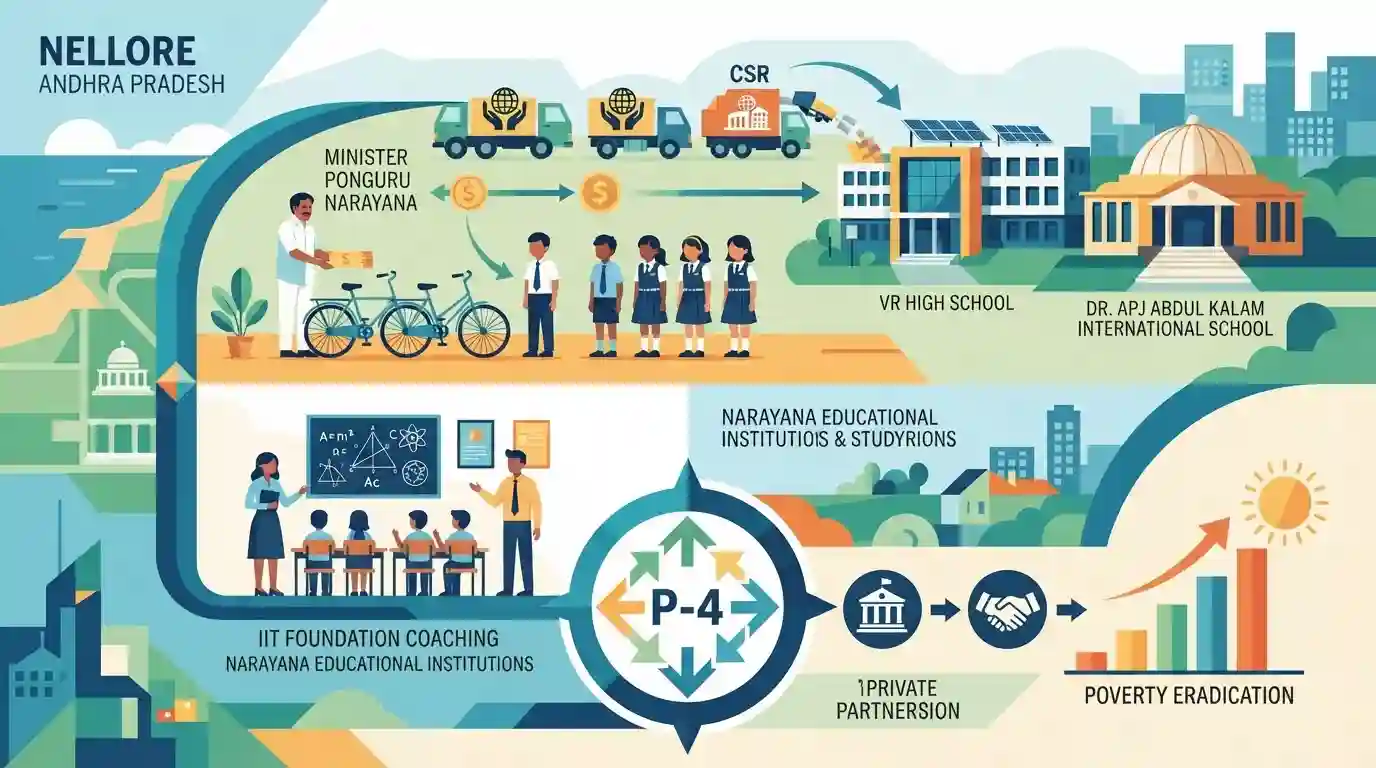
Andhra Pradesh Municipal Administration and Urban Development (MA&UD) Minister Ponguru Narayana has launched an extensive educational welfare initiative in Nellore, distributing 7,000 free bicycles to government school students using his family's own funds. As part of a broader corporate social responsibility (CSR) push, the Narayana family is also funding the ₹17 crore upgrade of VR High School and the ₹20 crore construction of the Dr. APJ Abdul Kalam International School on Waqf Board land. Additionally, Narayana Educational Institutions will provide free IIT Foundation coaching and study materials. The minister emphasized that these efforts align directly with Chief Minister N. Chandrababu Naidu’s 'P-4' programme, which seeks to leverage public and private partnerships to achieve zero poverty in the state.
ముఖ్య అంశాలు
- Andhra Pradesh MA&UD Minister Ponguru Narayana distributed 7,000 bicycles to government school students in Nellore using his family's personal funds, as part of a ₹6 crore initiative.
- The Narayana family is investing ₹17 crore via CSR to upgrade VR High School to international standards.
- An estimated ₹20 crore from CSR funds is being used to construct the Dr. APJ Abdul Kalam International School on Waqf Board land.
- Narayana Educational Institutions will begin offering free study materials and IIT Foundation classes for government school students on August 1, 2026.
- These initiatives are positioned to support Chief Minister N. Chandrababu Naidu's 'P-4' programme, which focuses on public-private collaboration for poverty eradication.
ముఖ్యమైన పదాలు
P-4 programme

An Andhra Pradesh government initiative (Public-Private-People Partnership) aiming to eradicate poverty by 2029. It connects affluent individuals ("Margadarsis") with underprivileged families ("Bangaru Kutumbams") to provide financial support and mentorship.
UPSC context
Covers GS Paper 2 (Governance & Welfare Schemes). Highlights participatory governance, wealth redistribution, and innovative poverty eradication frameworks.
Waqf Board
A statutory body established under the Waqf Act of 1995 to manage, protect, and regulate properties permanently dedicated for religious, pious, or charitable purposes under Islamic law.
UPSC context
Crucial for GS Paper 2 (Polity, Statutory Bodies). Focuses on minority affairs, property rights, governance transparency, and recent legislative amendments.
Narayana Educational Institutions
One of Asia's largest educational conglomerates, founded in 1979 by AP Minister Ponguru Narayana. It operates schools and coaching centers across India and participates in substantial CSR-driven educational welfare projects.
UPSC context
Connects to GS Paper 2 (Education, Social Sectors) and GS Paper 4 (Corporate Social Responsibility, ethical governance by public officials).
ప్రిలిమ్స్ ఉచ్చు
"The 'P-4' model is a standard infrastructure procurement scheme launched by the Central Government."
P-4 (Public-Private-People Partnership) in this context is an Andhra Pradesh welfare and poverty-eradication model integrating community contributions, not a standard central infrastructure procurement method.
అనుసంధానమైన స్థిర భావనలు
What are the statutory requirements for Corporate Social Responsibility (CSR) in India?
- Applicability: Applies to companies with net worth ₹500cr+, turnover ₹1000cr+, or net profit ₹5cr+ under Section 135 of the Companies Act, 2013.
- Spending Mandate: Mandates spending at least 2% of the average net profits of the immediately preceding three financial years.
- Eligible Activities: Must align with Schedule VII, which includes promoting education, eradicating extreme hunger and poverty, and rural development.
What is the legal status and usage of Waqf properties in India?
- Definition: An irrevocable dedication of property for purposes recognized by Muslim law as pious, religious, or charitable.
- Regulation: Governed by the Waqf Act, 1995, and managed by statutory State Waqf Boards.
- Charitable Usage: Can be leased or utilized for secular, public-welfare infrastructure, such as building schools, hospitals, and community centers.
అంతర-అంశ నమూనాలు
In-kind Transfers & Education Economics
Bicycle distribution schemes (like Bihar's historic Cycle Yojna) are proven conditional in-kind transfers in development economics, heavily cited for significantly boosting secondary school retention rates.
Evolution of PPP to P-4 Models
The shift from traditional Public-Private Partnerships (PPP) to Public-Private-People Partnerships (P-4) integrates direct citizen participation, reflecting a bottom-up, community-driven approach to state poverty alleviation.

Expect a multi-statement Prelims question linking Schedule VII CSR eligibilities with the legal framework of Waqf properties and trusts.
అనుసంధాన PYQలు · 3
అనుసంధాన PYQలు · 3
- 2023APPSC_PRELIMSGS1
Government of Andhra Pradesh is implementing YSR Rythu Bharosa - PM Kisan Scheme for the benefit of farmers of Andhra Pradesh. Which of the following statements are correct about the above scheme ?
- 2024APPSC_PRELIMSGS1
Which of the following statements are valid regarding the interventions of the Government of Andhra Pradesh in the context of Healthcare ? I. Telemedicine facility is available in all Ayushman Bharat Health and Wellness Centres (AB-HWCs) to avail specialist services through district hub. II. The Family Doctor Programme has been planned to be implemented as a standalone project without the need to be integrated with Primary Health Centres (PHCs). III. Dr. YSR Aarogyasri Scheme has been revamped, by increasing the income limit from ₹ 2.5 lakh to ₹ 5 lakh per annum per family. IV. 'Aarogya Aasara' Scheme is intended to provide post-operative sustenance allowance with certain eligible conditions complied with. Select the correct answer using the codes given below :
- 2023APPSC_PRELIMSGS1
One of the following welfare programmes implemented by Government of Andhra Pradesh is not part of Navaratnalu.
