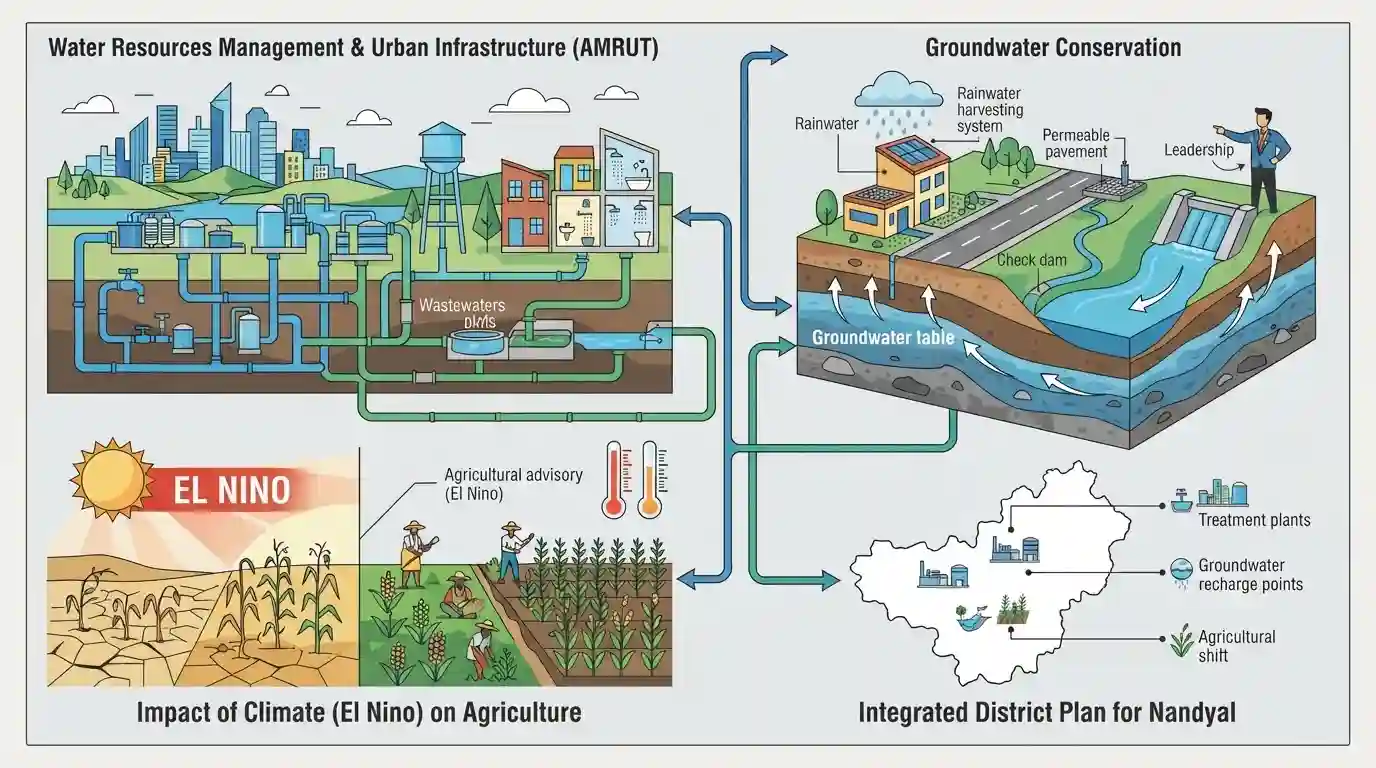
Nandyal AMRUT 2.0 water treatment and sewage infrastructure works
Source:The Hindu ↗
Why It Matters
The article highlights practical applications of urban infrastructure schemes (AMRUT) and the direct impacts of global climatic phenomena (El Nino) on local agricultural planning and water management, which are key components of Geography and Governance syllabi.
Summary
Andhra Pradesh's Nandyal district has launched significant water infrastructure projects under the AMRUT 2.0 scheme, including comprehensive water and sewage treatment plants, to address drinking water scarcity. The district was recently lauded by the Prime Minister for its groundwater conservation efforts. Additionally, authorities have advised farmers to adapt to potential El Nino impacts by cultivating crops with lower water requirements.
Key Points
- Foundation stones were laid for critical water and sewage treatment projects in Nandyal under the AMRUT 2.0 scheme to resolve local drinking water problems.
- The projects include a 16 MLD Comprehensive Water Treatment Plant, a 32 MLD Sewage Treatment Plant, and a minor tank rejuvenation initiative.
- Prime Minister Narendra Modi previously praised Nandyal district during his 'Mann Ki Baat' address for its exemplary groundwater conservation and tank restoration efforts.
- In light of the El Nino phenomenon impacting rainfall, farmers were advised to transition from water-intensive paddy cultivation to crops that require less water.
Important Terms
AMRUT 2.0

A centrally sponsored scheme launched in 2021 by the Ministry of Housing and Urban Affairs to make Indian cities "water secure" by ensuring universal household water tap connections across all statutory towns by 2025–26.
UPSC context
GS Paper II (Government Schemes) and GS Paper III (Infrastructure); tests understanding of urban planning, fiscal federalism, and water governance.
El Niño
A climatic phenomenon characterized by abnormal warming of sea surface temperatures in the equatorial Pacific, often weakening the southwest monsoon and causing agricultural droughts in India.
UPSC context
GS Paper I (Physical Geography) and GS Paper III (Agriculture); tests knowledge of global weather systems and their socio-economic impact on India.
Water Resources Management
The strategic planning, development, and distribution of water assets to meet ecological, domestic, and agricultural needs sustainably while mitigating conflicts, pollution, and resource depletion.
UPSC context
GS Paper I (Distribution of Key Resources) and GS Paper III (Conservation); tests understanding of water scarcity and integrated water policy models.
Groundwater Conservation
The practice of managing and protecting underground aquifers from depletion and contamination through rainwater harvesting, watershed development, artificial recharge structures, and efficient micro-irrigation.
UPSC context
GS Paper I (Water Bodies) and GS Paper III (Environment); tests understanding of depletion factors, aquifer mapping, and community-led water schemes.
Circular Economy of Water
An eco-friendly model focusing on recycling and reusing treated sewage and industrial wastewater, thereby reducing freshwater demand and augmenting city-level water security.
UPSC context
GS Paper III (Urbanization & Environmental Conservation); tests concepts of waste-to-resource management and Sustainable Development Goal 6.
Prelims Trap
The Shallow Aquifer Management (SAM) program is implemented by the Ministry of Jal Shakti.
SAM is a sub-initiative of AMRUT 2.0, which falls under the Ministry of Housing and Urban Affairs (MoHUA), not the Ministry of Jal Shakti.
Static Concepts Connected
What is the mechanism of El Niño and its impact on Indian monsoons?
- Humboldt Current: Warm equatorial water replaces the cold Humboldt current off Peru, weakening the Pacific trade winds.
- Walker Circulation: The atmospheric pressure shift weakens convection over the Indian Ocean, causing deficit Southwest monsoon rains.
- Agricultural Impact: It frequently triggers agricultural droughts, forcing a shift away from high water-intensity crops like paddy.
What constitutes the 'circular economy of water' in urban planning?
- Wastewater Recycling: Treating municipal sewage systematically to supply industrial zones, urban forestry, and non-potable municipal utilities.
- Aquifer Recharge: Systematic replenishing of shallow urban aquifers using treated stormwater runoff and integrated rainwater harvesting.
- Resource Recovery: Extracting valuable nutrients like phosphorus and organic solids from sewage sludge for agricultural fertilizers.
Cross-Topic Patterns
El Niño and crop-diversification economics
Advising farmers to abandon paddy during El Niño fails without viable minimum support price (MSP) mechanisms for climate-resilient alternatives.
Urban groundwater governance
AMRUT 2.0's urban focus on shallow aquifers highlights the emerging legal and environmental separation of urban land ownership from groundwater extraction rights.

AMRUT 2.0's Shallow Aquifer Management (SAM) is highly likely to be tested alongside Jal Jeevan Mission to confuse MoHUA vs Jal Shakti roles.
Linked PYQs · 3
Linked PYQs · 3
- 2019APPSC_PRELIMSGS1
El-Nino is a complex weather system that appears once every three to seven years. Consider the following statements in this regard : A. The appearance of warm currents off the Coast of Peru in the Eastern Pacific. B. The word El-Nino means 'Christ Child' because the current appears around Christmas in December. C. El-Nino was one of the reasons for the deficit rainfall in India (2014). Which of the statements given above is/are correct ?
- 2024APPSC_PRELIMSGS1
Consider the following states of India : I. Punjab II. Odisha III. Haryana IV. Tamil Nadu Which of the above states have relatively high level of groundwater utilization?
- 2023APPSC_PRELIMSGS1
Given below are two statements, one labelled as Assertion (A) and the other labelled as Reason (R). Select your answer from the codes given below. Assertion (A) : National Income growth fluctuates with fluctuations in Agriculture growth in India. Reason (R) : Weather conditions, especially rains, are uncertain in India. Codes :
