Thalli Bidda Express Scheme Expands Maternal Transport in Kurnool
Source:The Hindu ↗
Why It Matters
State-level welfare and health initiatives (such as Aarogyasri, Disha, and 104/108 services) are prominent in the APPSC Group 1 Prelims syllabus. Knowledge of the 'Thalli-Bidda Express', its target beneficiaries, and its role in maternal healthcare is essential for answering questions on Andhra Pradesh's social governance and healthcare interventions.
Summary
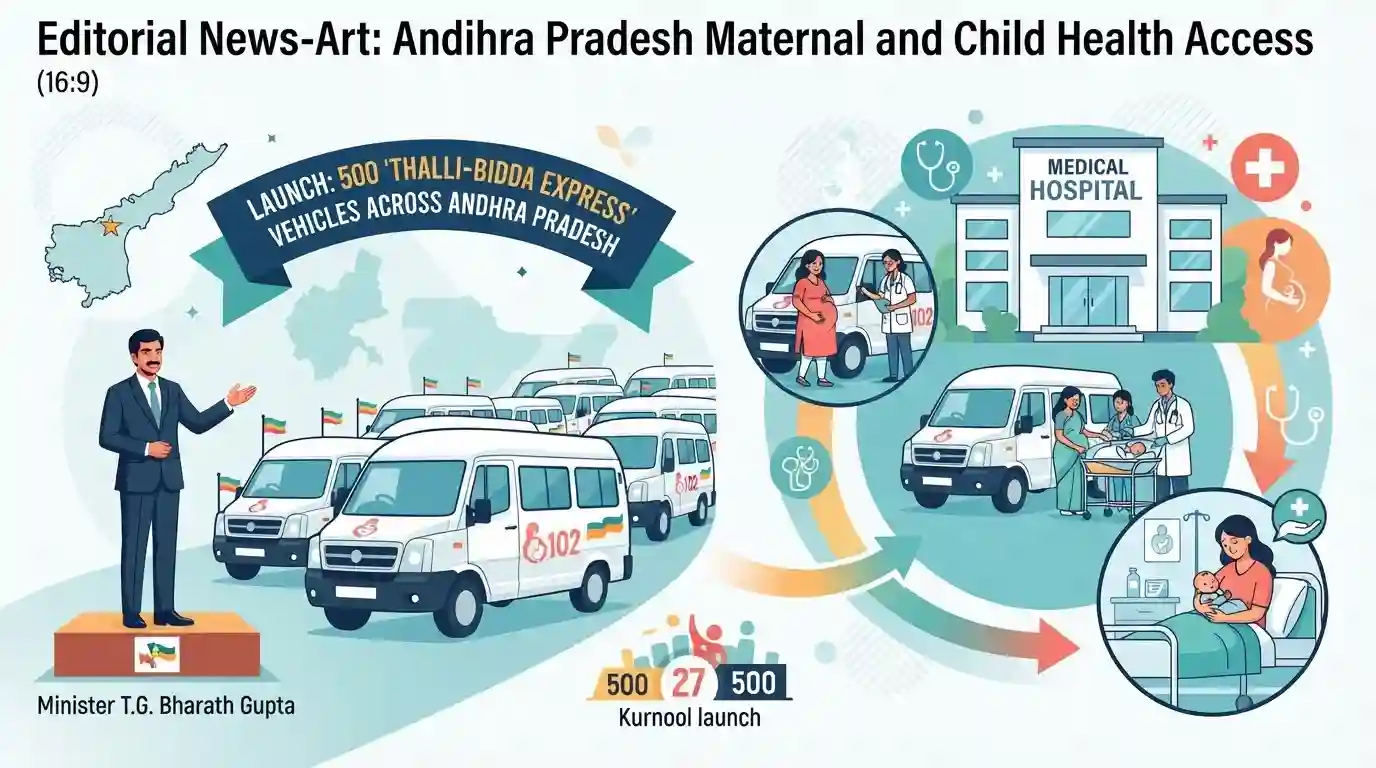
Andhra Pradesh Minister for Industries T.G. Bharath Gupta flagged off 27 new 'Thalli-Bidda Express' vehicles in Kurnool out of the 500 launched statewide. Operating under the 102 services, this state government scheme offers free and safe transportation for pregnant women, postpartum mothers, and newborn babies to hospitals, playing a crucial role in enhancing maternal and neonatal healthcare access in the state.
Key Points
- The Andhra Pradesh state government introduced 500 new 'Thalli-Bidda Express' vehicles, with 27 vehicles flagged off in Kurnool district.
- The scheme provides free and safe transportation to pregnant women, postpartum mothers, and newborn infants to and from hospitals.
- The vehicles operate as part of the state's 102 health services network.
- The initiative is designed to strengthen maternal health infrastructure and improve health outcomes for mothers and infants in the state.
Important Terms
Thalli-Bidda Express

A specialized healthcare transport initiative of the Andhra Pradesh government providing free and safe emergency drop-back and pick-up services for pregnant women, postpartum mothers, and newborns to reduce maternal and infant mortality.
UPSC context
GS Paper II: Governance & Social Justice; tests knowledge of state-level maternal healthcare welfare schemes and public service delivery mechanisms.
102 services
A free, 24/7 national referral transport service in India focused on maternal and child healthcare, facilitating emergency transport for pregnant women and newborns under the National Health Mission (NHM).
UPSC context
GS Paper II: Issues relating to development and management of Social Sector/Services relating to Health; tests knowledge of national healthcare helplines.
District Medical and Health Office (DMHO)
The administrative office headed by the DMHO at the district level, responsible for implementing, supervising, and coordinating public health services, national health programs, and government healthcare facilities.
UPSC context
GS Paper II: Public Health Administration & Decentralization; tests understanding of governance and institutional frameworks at the district level for service delivery.
Kurnool Government General Hospital (GGH)
One of the oldest tertiary teaching hospitals in Andhra Pradesh, established in 1852, providing essential, comprehensive, and emergency healthcare services to the Rayalaseema region and neighboring states.
UPSC context
GS Paper II: Social Sector (Health); tests understanding of regional public health infrastructure and healthcare delivery in tertiary institutions.
Prelims Trap
Janani Suraksha Yojana (JSY) guarantees free transport, drugs, and diagnostics to pregnant women and sick infants.
UPSC often swaps the features of JSY (which is a conditional cash transfer scheme) with JSSK (which is the actual entitlement scheme guaranteeing free transport, diagnostics, and drugs).
Static Concepts Connected
What are the core distinctions between JSY and JSSK under the NHM?
- JSY focus: Conditional cash transfer scheme designed specifically to incentivize institutional deliveries among low-income pregnant women.
- JSSK focus: Entitlement-based initiative providing zero-cost delivery, free drugs, diagnostics, consumables, and two-way transport to eliminate out-of-pocket expenditure.
- Beneficiary scope: JSY targets eligible pregnant women; JSSK extends entitlements to both pregnant women and sick infants up to one year of age.
How do 108 and 102 services differ under the National Health Mission?
- 108 Service: Serves as an emergency response system (ERS) for critical care, accidents, and urgent obstetric emergencies, deploying life-support ambulances.
- 102 Service: Functions as a basic, non-emergency patient transport system primarily dedicated to maternal and child healthcare logistics, including hospital drop-backs.
Cross-Topic Patterns
CSS Customization and Competitive Federalism
States leverage and brand NHM's 102 network to create customized welfare schemes, showcasing how federal funds are adapted to improve local health indices.
SDG 3.1 and Rural Infrastructure Gaps
Maternal mortality reduction depends heavily on the 'three delays' framework; dedicated transport schemes directly address the second delay—reaching a medical facility.

Expect a multi-statement prelims question contrasting JSY, JSSK, and the specific functional divisions of NHM's 108/102 transport networks.
Linked PYQs · 2
Linked PYQs · 2
- 2024APPSC_PRELIMSGS1
Which of the following statements are valid regarding the interventions of the Government of Andhra Pradesh in the context of Healthcare ? I. Telemedicine facility is available in all Ayushman Bharat Health and Wellness Centres (AB-HWCs) to avail specialist services through district hub. II. The Family Doctor Programme has been planned to be implemented as a standalone project without the need to be integrated with Primary Health Centres (PHCs). III. Dr. YSR Aarogyasri Scheme has been revamped, by increasing the income limit from ₹ 2.5 lakh to ₹ 5 lakh per annum per family. IV. 'Aarogya Aasara' Scheme is intended to provide post-operative sustenance allowance with certain eligible conditions complied with. Select the correct answer using the codes given below :
- 2023APPSC_PRELIMSGS1
The following App developed by Government of Andhra Pradesh is an SOS service for women in distress or danger.
