Grassroots Governance: Bihar introduces Sahyog Shivirs in panchayats
Source:times-of-india ↗
Why It Matters
This article links modern administrative decentralization (Sahyog Shivirs) with Bihar's historical social movements. For BPSC Prelims, understanding the 'Triveni Sangh' (formed in Shahabad in 1933) and its role in backward-class mobilization is a crucial aspect of Bihar's modern political history.
Summary
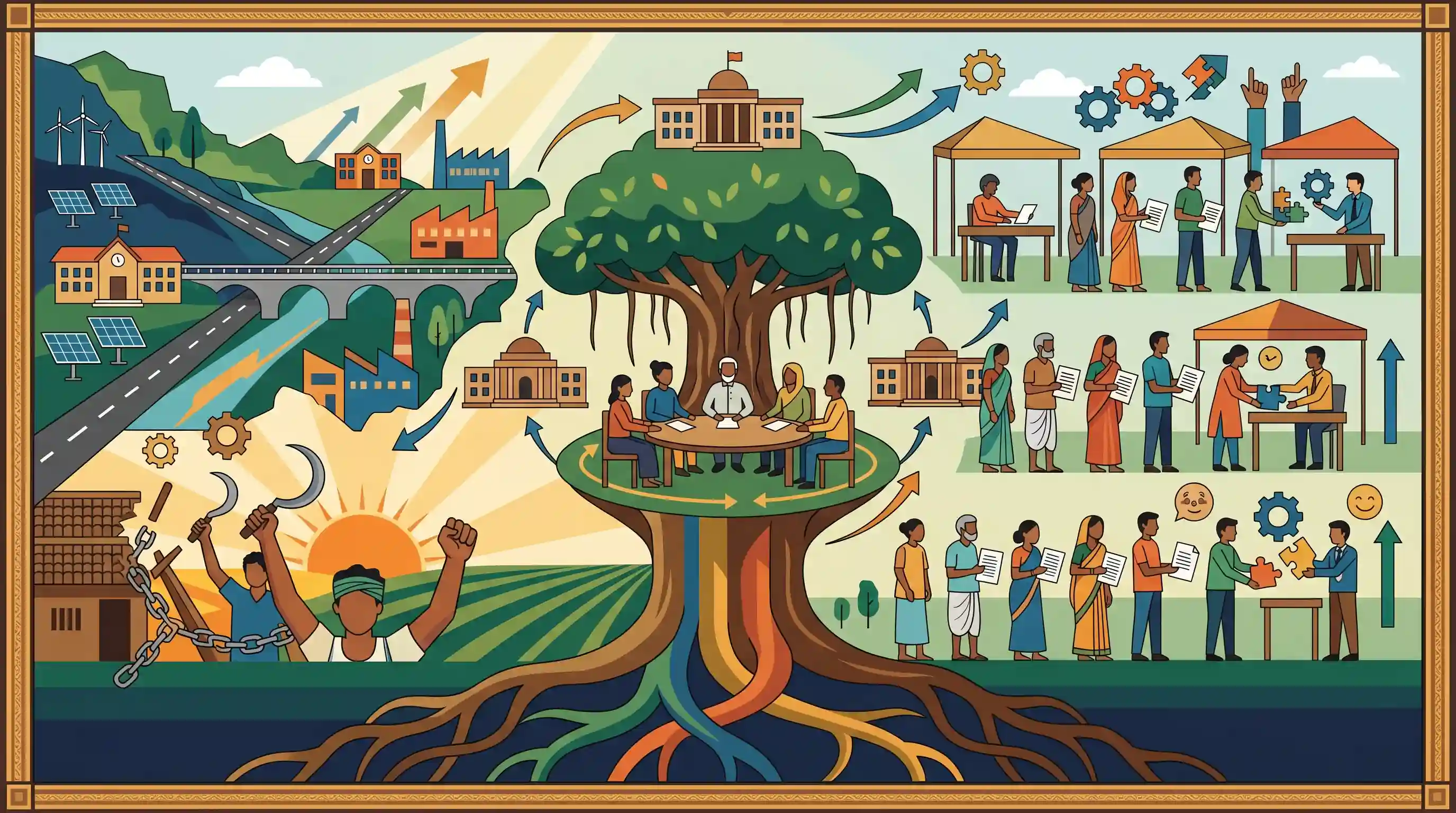
During an event organized by the Nagrik Parishad in Dumraon, Buxar, Bihar's Planning and Development Minister Bhagwan Singh Kushwaha highlighted the state's ongoing development model and the rollout of 'Sahyog Shivirs' for grassroots grievance redressal. The event featured reflections from social scientist Jagnarayan Singh Yadav, who emphasized the legacy of the 'Triveni Sangh' in the Shahabad region, linking Bihar's modern socio-political empowerment and peasant struggles back to this historic 1930s caste-coalition movement.
Key Points
- Planning and Development Minister Bhagwan Singh Kushwaha emphasized Bihar's development vision, crediting the foundation laid by former CM Nitish Kumar and the current administrative drive.
- The state government is actively organizing 'Sahyog Shivirs' at the panchayat level across Bihar to resolve public grievances and deliver social welfare benefits at the grassroots.
- Speaking at a Nagrik Parishad event in Dumraon (Buxar), social scientist Jagnarayan Singh Yadav highlighted the historic significance of the Shahabad region as the birthplace of the 'Triveni Sangh'.
- The 'Triveni Sangh' was an influential caste-based democratic coalition formed in 1933 by three backward communities (Yadavs, Koeris, and Kurmis) in Shahabad, playing a pivotal role in Bihar's socio-political history and peasant empowerment.
- Dumraon MLA Rahul Kumar Singh was also present at the event, which celebrated regional historical contributions to the state's democratic and developmental growth.
Important Terms
Triveni Sangh

A historic caste coalition and political organization formed in Bihar in 1934 by Yadav, Kurmi, and Koeri (Kushwaha) communities to challenge upper-caste hegemony and demand political-economic empowerment for backward peasant castes.
UPSC context
GS Paper I: Modern History; tests knowledge of pre-independence caste mobilization and subaltern peasant struggles in Bihar.
Sahyog Shivirs
A decentralized public grievance redressal initiative launched by the Bihar government in May 2026, organizing sequential local camps at panchayat and urban levels for time-bound resolution of citizen complaints.
UPSC context
GS Paper II: Governance; tests knowledge of citizen-centric administrative reforms, transparency, and public service delivery mechanisms.
Saat Nischay Programme
Bihar's flagship multi-phase development scheme (with 'Saat Nischay-3' running from 2025–2030) focused on youth, employment, agriculture, health, infrastructure, and ease of living to transform the state's socio-economic landscape.
UPSC context
GS Paper III: Economic Development; tests understanding of state-level social sector schemes, planning models, and inclusive growth targets.
Janata Dal (United)
A prominent regional political party in India, based primarily in Bihar, advocating for democratic socialism, developmental politics, and the socio-economic empowerment of backward classes.
UPSC context
GS Paper II: Polity; tests knowledge of regional political parties, electoral dynamics, and their impact on cooperative federalism.
Nagrik Parishad
A regional citizen council or civic forum in Bihar that organizes socio-cultural and public events, fostering grassroots advocacy and community engagement in regional development.
UPSC context
GS Paper II: Civil Society; tests understanding of non-state actors, civic pressure groups, and their role in socio-political mobilization.
Prelims Trap
The Triveni Sangh was founded in 1933 as an official peasant front of the Indian National Congress.
The Triveni Sangh was an autonomous, non-elite caste alliance. Congress actually set up the 'Backward Class Federation' in 1937 to counter and absorb its growing influence.
Static Concepts Connected
What was the Triveni Sangh of 1933?
- Tri-caste alliance: Formed by Yadav, Kurmi, and Koeri communities in Bihar's Shahabad region to fight upper-caste landlord exploitation.
- Sanskritization roots: Emerged from the 1920s Janeu Andolan, where intermediate castes adopted sacred threads as a form of social self-assertion.
- Political backlash: Spurred the Congress to establish the 'Backward Class Federation' in 1937 to neutralize and co-opt its autonomous political clout.
Cross-Topic Patterns
Caste Coalition vs Class Peasantry
Contrasts how the Triveni Sangh (caste-assertion) and Swami Sahajanand’s Bihar Provincial Kisan Sabha (class-struggle) approached peasant grievances in the 1930s.
Grassroots Governance and Sevottam Model
Connects Bihar’s 'Sahyog Shivir' to the 2nd ARC recommendations on decentralized, single-window citizen charters and time-bound grievance redressal.

Pre-independence caste-peasant alliances like the Triveni Sangh (1933) may be targeted to test non-Congress grassroots political history.
Linked PYQs · 3
Linked PYQs · 3
- 2020BPSC_PRELIMSGS1
Swami Sahajananda was related to which of the following?
- 2025BPSC_PRELIMSGS1
Who was the prominent leader of Kisan Sabha movement in Bihar?
- 2022BPSC_PRELIMSGS1
The confluence of the rivers Son and Ganga is located in which district of Bihar?
