Community Certificate Issuance for Tribals in Tamil Nadu
Source:The Hindu ↗
Why It Matters
Provides a concrete state-level example of affirmative action and welfare implementation for Scheduled Tribes, relevant for GS2 answers on social justice and the effectiveness of policies for marginalized communities.
Summary
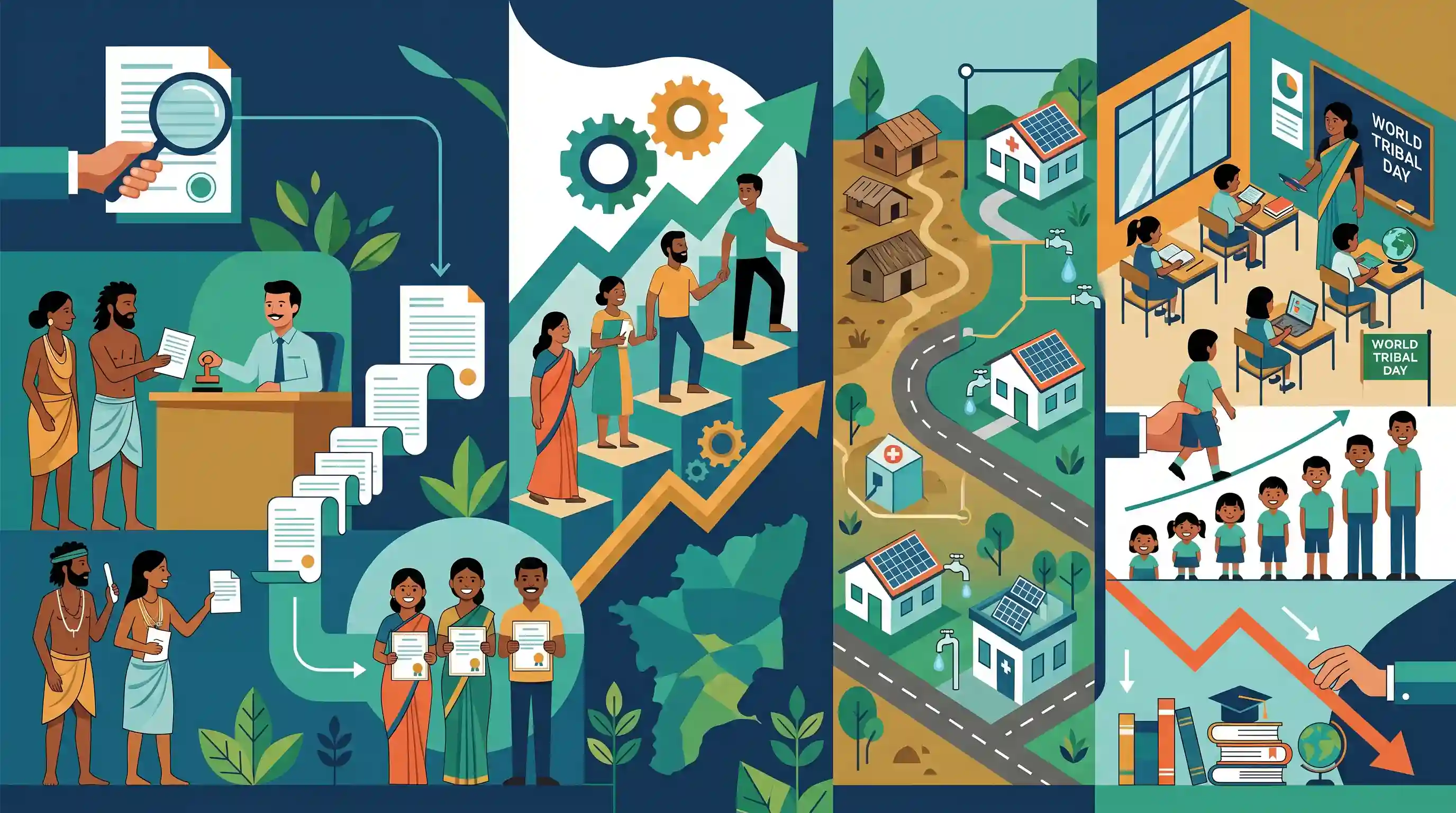
Tamil Nadu's Adi-Dravida Welfare Minister assured that administrative hurdles in issuing community certificates to tribal populations will be resolved, noting that current delays are due to mandatory field inquiries. Speaking at a World Tribal Day event in Dindigul, the Minister emphasized the state's 'Dravidian model' of inclusive growth. Key initiatives include the 'Tholkudi' scheme, aimed at upgrading infrastructure in tribal settlements, and dedicated efforts to counter a 20% dropout rate in Adi-Dravida schools by improving educational facilities.
Key Points
- Tamil Nadu government commits to removing administrative hindrances in issuing ST community certificates.
- Introduction of the 'Tholkudi' scheme targeting the improvement of basic amenities in tribal habitations.
- Strategic focus on improving infrastructure and combating a 20% dropout rate in Adi-Dravida schools.
Important Terms
Tholkudi Scheme

A Tamil Nadu government initiative (₹1,000 crore) focused on upgrading infrastructure, housing, and livelihood opportunities in tribal settlements while preserving tribal culture through digital documentation.
UPSC context
GS Paper II: Welfare schemes for vulnerable sections; important for state-specific interventions in tribal development.
Department of Adi Dravidar and Tribal Welfare
The nodal agency in Tamil Nadu responsible for the socio-economic and educational advancement of Scheduled Castes (Adi Dravidars) and Scheduled Tribes through various welfare schemes.
UPSC context
GS Paper II: Social Justice; tests knowledge of institutional mechanisms for uplifting marginalized communities.
Community Certificate (ST)
A mandatory legal document (issued by RDOs in TN) verifying an individual's Scheduled Tribe status, essential for accessing constitutional reservations and welfare benefits.
UPSC context
GS Paper II: Statutory and regulatory bodies; highlights administrative challenges in delivering rights to tribal populations.
World Tribal Day
Observed annually on August 9 (UN-led) to promote the rights and cultures of indigenous populations; the 2024 theme emphasizes groups in voluntary isolation.
UPSC context
GS Paper I & II: Geography/Social Justice; relevant for international commitments and tribal rights awareness.
Government Tribal Residential (GTR) Schools
Specialized residential boarding schools run by the state to provide tailored education and reduce dropout rates among tribal children in remote habitations.
UPSC context
GS Paper II: Issues relating to Education and Human Resources; tests specific interventions for tribal literacy.
Adi Dravidar
A socio-political term used in Tamil Nadu to denote Scheduled Caste communities, reflecting the state's historical social justice and Dravidian movement context.
UPSC context
GS Paper I: Social Empowerment; important for understanding regional terminology in Indian social history and policy.
Prelims Trap
"ST community certificates are issued and verified by the Central Government to maintain pan-India uniformity."
While the President/Parliament notifies the ST list under Article 342, the issuance and verification of ST community certificates are exclusively handled by State/UT governments.
Static Concepts Connected
How is a community officially added to the Scheduled Tribes list?
- Presidential Order: Initial specification is made via Presidential Order under Article 342, after consulting the Governor of the respective State.
- Parliament's Power: Any subsequent inclusion or exclusion from the published ST list can only be executed through an Act of Parliament.
- State Specificity: The ST list is strictly State/UT specific. A community recognized as a Scheduled Tribe in one State may not be recognized as such in another State.
What are the key constitutional safeguards for tribal education?
- Article 15(4): Empowers the State to make special provisions for the advancement of any socially and educationally backward classes of citizens or for the SCs and STs.
- Article 46: A Directive Principle mandating the State to promote with special care the educational and economic interests of the weaker sections, particularly SCs and STs.
- Article 275(1): Provides regular Union grants-in-aid to States specifically to promote the welfare of Scheduled Tribes and improve the administration of Scheduled Areas.
Cross-Topic Patterns
Tribal education schemes vs dropout paradox
State efforts like 'Tholkudi' and Central schemes like EMRS face a structural paradox: rising dropout rates despite massive infrastructure investments. UPSC often tests this gap between scheme design and ground implementation.
Digital ethnography and PVTG preservation
Tamil Nadu's documentation of tribes like Todas and Irulas under 'Tholkudi' links tribal welfare to cultural preservation. Connect this state-led digital ethnography to the broader Central PM-JANMAN mission targeting PVTGs.

A multi-statement question contrasting the power to notify STs (Parliament) with the power to issue ST certificates (States) is likely.
Linked PYQs · 3
Linked PYQs · 3
- 2016MainsGS1
Why are the tribals in India referred to as 'the Scheduled Tribes'? Indicate the major provisions enshrined in the Constitution of India for their upliftment.
- 2019MainsGS2
Performance of welfare schemes that are implemented for vulnerable sections is not so effective due to absence of their awareness and active involvement at all stages of policy process. Discuss.
- 2024PrelimsGS1
Consider the following statements : 1. It is the Governor of the State who recognizes and declares any community of that State as a Scheduled Tribe. 2. A community declared as a Scheduled Tribe in a State need not be so in another State. Which of the statements given above is/are correct?
