Bauxite mining project near marine national park receives clearance
Source:etvbharat ↗
Why It Matters
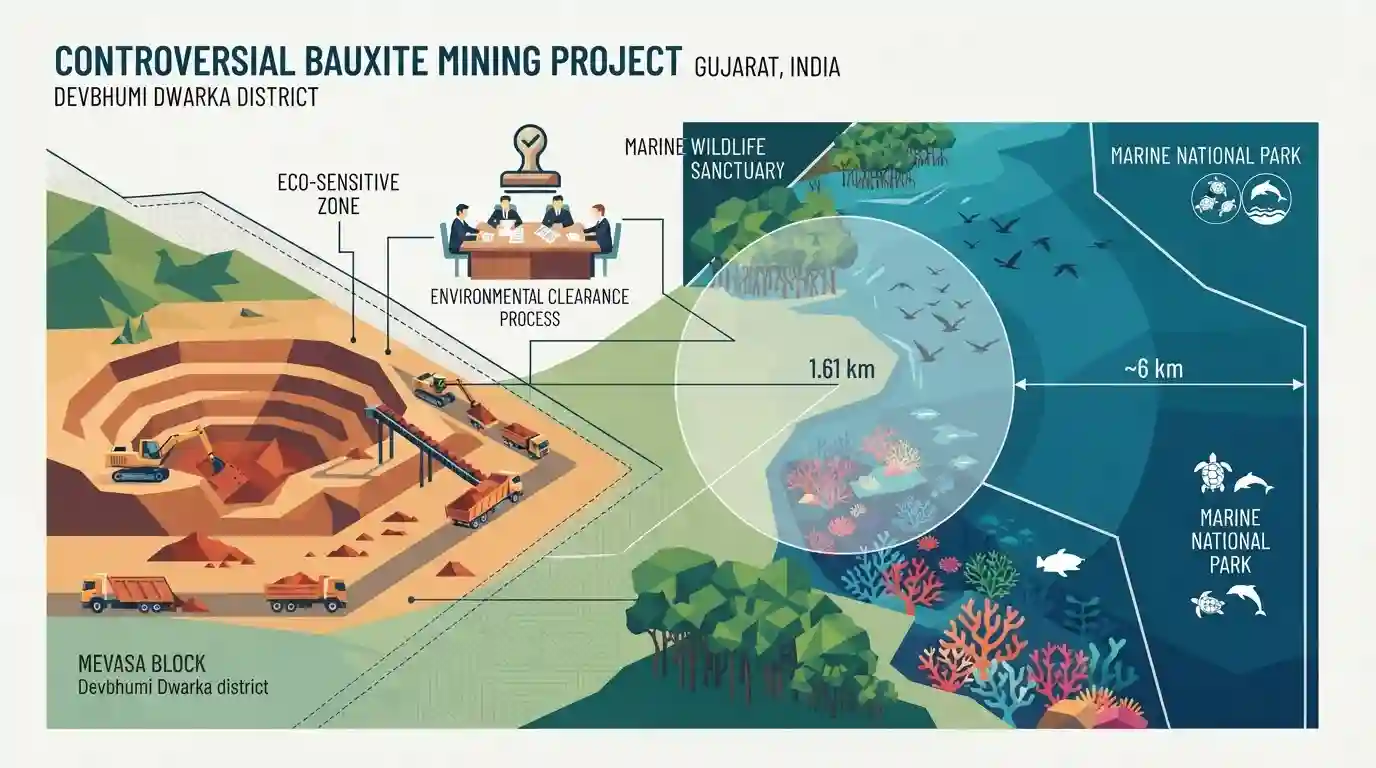
The article highlights the tension between resource extraction (bauxite mining) and environmental conservation, specifically concerning India's first marine national park and wildlife sanctuary. It serves as a prime case study for the Geography of mineral distribution in Gujarat and Environmental Governance (EIA/EAC processes).
Summary
The Union environment ministry's Expert Appraisal Committee (EAC) has granted environmental clearance to a controversial bauxite and marl mining project in the Mevasa Block of Gujarat's Devbhumi Dwarka district. The project has raised significant ecological concerns as it is located just 1.61 kilometers from India's first marine wildlife sanctuary and around 6 kilometers from the marine national park in the Gulf of Kachchh. Although the area boasts rich biodiversity, including coral reefs, mangroves, and critical bird habitats, the clearance was approved because the mining lease formally lies outside the demarcated eco-sensitive zones.
Key Points
- The Expert Appraisal Committee (EAC) of the Union environment ministry approved a bauxite and marl mining project in Devbhumi Dwarka, Gujarat.
- The mining block is situated mere 1.61 km from India's first marine wildlife sanctuary and 6.06 km from the marine national park in the Gulf of Kachchh.
- The approval was granted because the lease area officially falls outside the designated Eco-Sensitive Zones of these protected areas, despite the fragile coral reef and mangrove ecosystems nearby.
- The area is home to rich biodiversity including extensive coral reefs, mangroves, and serves as an important wintering ground for migratory birds.
Important Terms
Environment Impact Assessment (EIA)

A statutory process under the Environment (Protection) Act, 1986, used to identify and evaluate the potential environmental, social, and economic impacts of proposed projects prior to decision-making.
UPSC context
Crucial for GS-3 (Environment) regarding sustainable development, environmental degradation, and balancing ecology with infrastructure.
Environmental Clearance (EC)
Mandatory approval required for specific industrial and developmental projects under the EIA Notification 2006, ensuring they meet stipulated environmental safeguards before physical construction begins.
UPSC context
Important for GS-3 and Prelims. Tests knowledge of regulatory compliance and the implementation of the Environment (Protection) Act, 1986.
Expert Appraisal Committee (EAC)
A multidisciplinary advisory body constituted by the MoEFCC. It screens, scopes, and appraises Category 'A' projects to recommend whether central environmental clearance should be granted or rejected.
UPSC context
Highly relevant for Prelims and GS-3. Tests understanding of statutory advisory bodies and central mechanisms for the EIA process.
Eco-Sensitive Zone (ESZ)
Ecologically fragile areas designated up to 10 kilometers around Protected Areas under the Environment (Protection) Act, 1986, acting as a 'shock absorber' restricting major developmental activities.
UPSC context
Frequent in Prelims and GS-3. Tests understanding of regulatory buffer zones, land-use restrictions, and mitigating man-animal conflict.
Gulf of Kachchh Marine National Park
India's first marine national park established in 1982 in Gujarat. It protects fragile intertidal ecosystems, encompassing 42 islands, coral reefs, mangroves, and diverse marine fauna.
UPSC context
Core Prelims geography/environment topic. Tests knowledge of map locations, critical coastal habitats, and vulnerable marine species.
Union Ministry of Environment, Forest and Climate Change (MoEFCC)
The nodal agency in the Central Government's administrative structure responsible for planning, promoting, and coordinating environmental and forestry programs, including issuing environmental clearances.
UPSC context
Essential for GS-2 (Governance) and GS-3 (Environment) regarding environmental laws, policy implementation, and administrative mandates.
Prelims Trap
"Eco-Sensitive Zones around protected areas are officially notified under the Wildlife (Protection) Act, 1972."
Eco-Sensitive Zones (ESZs) are legally notified under the Environment (Protection) Act, 1986. The WPA 1972 governs the sanctuary itself, but not the buffer.
Static Concepts Connected
What is the legal framework and purpose of Eco-Sensitive Zones (ESZs) in India?
- Legal Backing: Notified by the Union Government under the Environment (Protection) Act, 1986, not the Wildlife (Protection) Act.
- Core Purpose: Designed to act as a 'shock absorber' and transition zone from highly protected ecosystems to lesser-protected areas.
- Prohibited Activities: Commercial mining, highly polluting industries, and major commercial logging are strictly banned within notified ESZ limits.
What are the key geographical features of the Gulf of Kachchh Marine National Park?
- First in India: Designated as India's first Marine Wildlife Sanctuary (1980) and Marine National Park (1982).
- Dual Ecosystem: Unique for harboring both coral reefs and extensive mangrove forests in the same coastal environment.
- Flagship Species: Supports threatened marine life including dugongs (sea cows), green sea turtles, and olive ridley turtles.
Cross-Topic Patterns
Coastal bauxite vs. Marine ecology
Gujarat’s coastal lateritic bauxite belt overlaps heavily with fragile marine ecosystems, creating constant friction between the state's alumina industrial clusters and wildlife conservation mandates.
ESZ demarcations and EIA loopholes
Project approvals often hinge on technical ESZ boundary exclusions, highlighting the ongoing debate about ecological impacts (like mining runoff) extending beyond legally drawn lines into vulnerable habitats.

Expect a multi-statement prelims question mapping India's Marine National Parks against their apex species and ESZ legal frameworks in 2026.
Linked PYQs · 1
Linked PYQs · 1
- 2026GPSC_PRELIMSGS1
Consider the following pairs of mineral resources and their prominent mining districts/regions in Gujarat: Mineral - Associated Region 1. Bauxite - Devbhumi Dwarka 2. Lignite - Panandhro (Kutch) 3. Limestone - Porbandar 4. Chalk (Porbandar Stone) - Junagadh Which of the above pairs are correctly matched?
