Mines and Minerals Regulation and Centre State Jurisdictional Debate
Source:The Hindu ↗
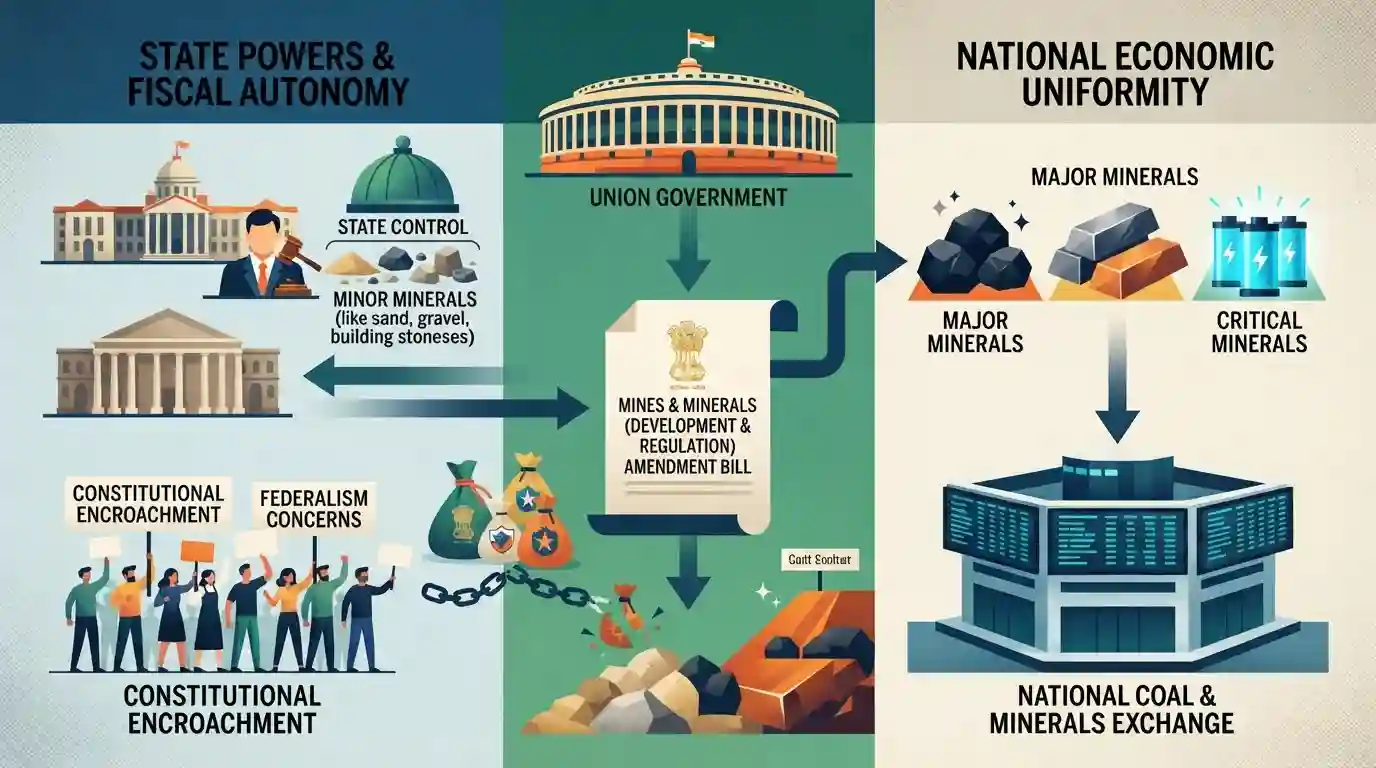
Why It Matters
This legislation is a direct Parliamentary response to the Supreme Court's ruling that affirmed states' rights to tax mineral-bearing lands (Entry 50 of State List). By utilizing its powers under Entry 54 of the Union List, the Centre is capping state taxation on major minerals to ensure a unified market. This makes it a prime case study for Mains GS2 (Fiscal Federalism, Centre-State relations) and Prelims GS1 (distinction between major and minor minerals under the MMDR Act).
Summary
The Union Government defended the proposed Mines and Minerals (Development and Regulation) Amendment Bill in Parliament against claims that it undermines federalism. The Bill aims to standardize taxation on major minerals—such as coal, iron ore, and critical minerals like lithium—by restricting states from levying independent taxes or cesses on mineral-bearing lands. While opposition states like Kerala argue this encroaches on their constitutional powers, the Centre maintains that states retain absolute control over minor minerals. The amendment also paves the way for a national coal and minerals exchange, highlighting the tension between national economic uniformity and state fiscal autonomy.
Key Points
- The MMDR Amendment Bill seeks to standardize taxation rates on major minerals across the country to prevent arbitrary price spikes and ensure global competitiveness.
- The legislation restricts states from levying additional taxes or cesses on mineral-bearing lands, a move Parliament is making to override recent judicial interpretations allowing such state-level levies.
- Union Minister G. Kishan Reddy clarified that the Bill targets only major minerals (like coal, iron ore, lithium, and cobalt) and preserves states' absolute control over minor minerals.
- The Bill faced strong opposition from several states, notably Kerala, which argued that stripping states of their taxing powers on mineral lands violates the federal structure and constitutional rights.
- The legislation also outlines a structural framework for establishing a proposed coal and minerals exchange in India.
Important Terms
MMDR Amendment Bill, 2026

A central legislation barring states from levying independent taxes or cesses on mineral rights and mineral-bearing lands to ensure uniform taxation across the mining sector.
UPSC context
GS-2 & GS-3. Important for analyzing Centre-State financial relations, fiscal federalism, and national resource management.
MMDR Act, 1957
The principal parliamentary act regulating India's mining sector. It distinguishes between centrally regulated major minerals and state-controlled minor minerals for administration and concession grants.
UPSC context
GS-2 & GS-3. Tests knowledge of statutory frameworks governing natural resources and concurrent jurisdiction over development.
Entry 50 of the State List
A constitutional provision (Schedule VII) empowering state legislatures to tax mineral rights, subject to any limitations imposed by Parliament regarding mineral development.
UPSC context
GS-2. Crucial for questions on legislative competence, separation of powers, and the Supreme Court’s interpretation of state taxation rights.
Mineral Royalty
A contractual payment made by a mining leaseholder to the state for extracting minerals. A 2024 Supreme Court Constitution Bench clarified that this royalty is not a tax.
UPSC context
GS-2 & GS-3. Tests the distinction between taxes and royalties, its impact on state revenues, and judicial interpretations.
Major vs. Minor Minerals
A legal classification under the MMDR Act. Major minerals (like coal) are centrally regulated, while states retain absolute regulatory and concession-granting powers over minor minerals.
UPSC context
GS-1 & GS-2. Tests understanding of resource geography, distribution, and decentralized resource management frameworks.
Critical Minerals
Strategically important minerals like lithium and cobalt essential for clean energy and advanced technologies. The Centre aims to shield their supply chains from volatile state taxes.
UPSC context
GS-3. Highly relevant for topics on energy transition, import dependency, and strategic sector reforms in India.
Prelims Trap
The Union Government possesses exclusive constitutional jurisdiction to tax and regulate all minerals across India.
False. States retain absolute control over minor minerals and have constitutional power to tax mineral rights (State List Entry 50), though subject to limitations imposed by Parliament.
Static Concepts Connected
How is jurisdiction over mines and minerals divided between the Centre and States?
- Union List: Entry 54 allows Parliament to regulate mines and mineral development to the extent declared expedient in the public interest.
- State List: Entry 23 covers mining regulation, while Entry 50 permits states to tax mineral rights, both strictly subject to limitations imposed by Parliament.
What is the legal distinction between major and minor minerals under the MMDR Act?
- Definition: Minor minerals include building stones, gravel, clay, and sand. Major minerals encompass coal, iron ore, and critical minerals like lithium and cobalt.
- Regulatory Control: State Governments have absolute administrative and rule-making control over minor minerals, whereas the Union Government dictates policy and standardizes taxation for major minerals.
Cross-Topic Patterns
Parliamentary override of SC judgments
The MMDR Amendment overriding the 2024 SC 9-judge bench ruling mirrors past constitutional patterns, such as retrospective taxation or tribunal reforms, where Parliament alters the legal basis of a judicial decision.
Critical minerals & Net-Zero 2070
Centralizing control over vital elements like lithium and cobalt links constitutional federalism disputes directly to India's geopolitical imperative to secure supply chains for its clean energy transition and Net-Zero targets.

Expect a multi-statement question in 2026 linking 7th Schedule mineral entries, minor vs. major mineral powers, and critical minerals.
Linked PYQs · 5
Linked PYQs · 5
- 2019PrelimsGS1
With reference to the management of minor minerals in India, consider the following statements: 1. Sand is a 'minor mineral' according to the prevailing law in the country. 2. State Governments have the power to grant mining leases of minor minerals, but the powers regarding the formation of rules related to the grant of minor minerals lie with the Central Government. 3. State Governments have the power to frame rules to prevent illegal mining of minor minerals. Which of the statements given above is/are correct?
- 2025PrelimsGS1
Consider the following statements : Statement I: In India, State Governments have no power for making rules for grant of concessions in respect of extraction of minor minerals even though such minerals are located in their territories. Statement II: In India, the Central Government has the power to notify minor minerals under the relevant law. Which one of the following is correct in respect of the above statements?
- 2025PrelimsGS1
Consider the following statements : I. India has joined the Minerals Security Partnership as a member. II. India is a resource-rich country in all the 30 critical minerals that it has identified. III. The Parliament in 2023 has amended the Mines and Minerals (Development and Regulation) Act, 1957 empowering the Central Government to exclusively auction mining lease and composite license for certain critical minerals. Which of the statements given above are correct?
- 2024MainsGS2
What changes has the Union Government recently introduced in the domain of Centre-State relations ? Suggest measures to be adopted to build the trust between the Centre and the States and for strengthening federalism.
- 2025MainsGS2
Examine the evolving pattern of Centre-State financial relations in the context of planned development in India. How far have the recent reforms impacted the fiscal federalism in India?
