Ethics of Civilian Casualties in West Asia Conflicts
Source:Indian Express ↗
Why It Matters
The article brings to the forefront the ethical and legal failures of the international community in conflict zones. For UPSC aspirants, it provides a critical perspective on the limitations of international humanitarian law, the human costs of geopolitical conflicts (Iran-Israel-US dynamics), and the crucial topic of ethics in international relations (GS2 and GS4).
Summary
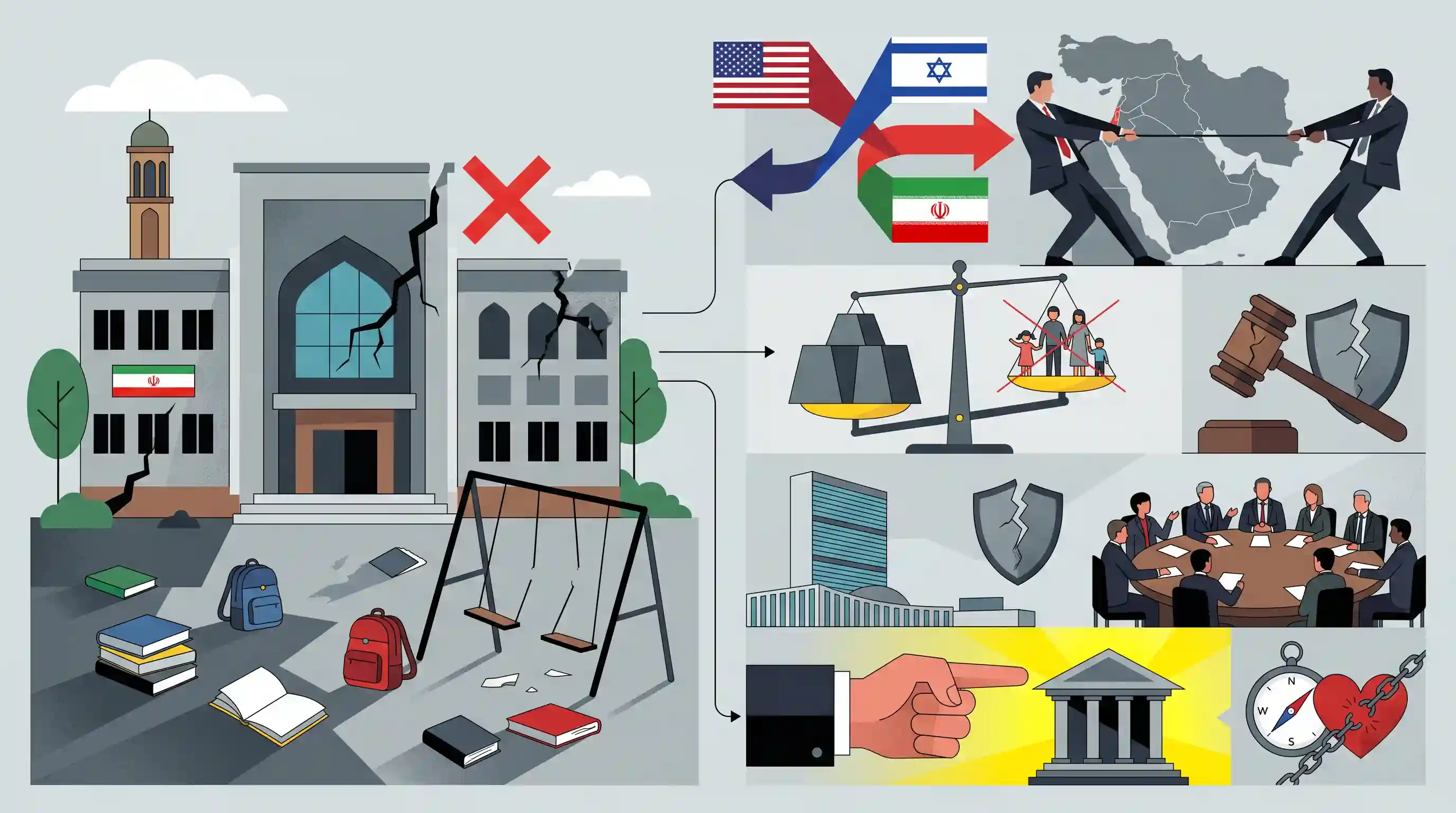
The article examines the tragic bombing of a girls' school in Minab, Iran, to critique the inefficacy of international law in protecting non-combatants during armed conflicts. It highlights how the geopolitical rivalry involving Iran, Israel, and the US has normalized the deaths of children as mere 'collateral damage.' The piece questions the moral foundations of global governance and international humanitarian frameworks, emphasizing the urgent need for accountability and a reevaluation of ethics in international relations.
Key Points
- Highlights the devastating human cost of the Iran-Israel-US geopolitical conflict, focusing on the vulnerability of children and girls as seen in the Minab school bombing.
- Critiques the normalization of civilian casualties as 'collateral damage', raising severe ethical concerns about modern warfare.
- Questions the efficacy and moral standing of international law and humanitarian conventions when they fail to protect non-combatants.
- Emphasizes the urgent need for global accountability and the enforcement of human rights protections over strategic geopolitical objectives.
Important Terms
International Humanitarian Law (IHL)

Set of rules (the 'Law of War') seeking to limit armed conflict effects by protecting non-combatants and restricting warfare methods. It balances military necessity with humanitarian concerns.
UPSC context
GS Paper II: International Relations. Essential for understanding global governance, war crimes, and India's stance on humanitarian crises.
Geneva Conventions
Four 1949 treaties (and 1977 protocols) forming IHL's core. They safeguard wounded soldiers, prisoners of war, and specifically civilians (Fourth Convention) during conflicts.
UPSC context
GS Paper II. Tests knowledge of international treaties, legal obligations of states, and institutional frameworks for human rights.
Principle of Proportionality
IHL principle prohibiting attacks where incidental civilian harm (collateral damage) is excessive compared to the direct military advantage anticipated.
UPSC context
GS Paper IV: Ethics. Tests ethical reasoning in conflict zones and the moral trade-offs between national security and human lives.
Principle of Distinction
IHL principle requiring parties to always differentiate between combatants and civilians, and between military objectives and civilian objects (e.g., schools, hospitals).
UPSC context
GS Paper II & IV. Critical for analyzing "war crimes" and the ethical conduct of modern warfare.
Ethics in International Relations
The study of moral principles (e.g., justice, humanity) that guide state behavior, contrasting Realist power-based paradigms with Value-based global responsibility.
UPSC context
GS Paper IV specific topic. Evaluates the application of core ethical concepts like accountability and justice to global politics.
United Nations (UN)
Intergovernmental organization established in 1945. Its Charter (Jus ad bellum) prohibits the unauthorized use of force, while its agencies (UNESCO, OHCHR) monitor human rights.
UPSC context
GS Paper II: Important International Institutions. Focuses on the mandate and effectiveness of global governance bodies.
Jus in Bello
Branch of international law ('justice in war') regulating how war is conducted, regardless of why it began. It includes the Geneva Conventions.
UPSC context
GS Paper II. Advanced concept for Law optional and IR answers regarding the legality of military operations.
Prelims Trap
"International Humanitarian Law absolutely prohibits all civilian casualties during armed conflicts."
IHL relies on the 'Principle of Proportionality'. It forbids intentional targeting of civilians but legally tolerates incidental harm (collateral damage) if military advantage is deemed proportionate.
Static Concepts Connected
What are the core ethical principles of 'Jus in Bello' (conduct during war)?
- Principle of Distinction: Militaries must differentiate between combatants and non-combatants, strictly forbidding the intentional targeting of civilians or civil infrastructure like schools.
- Principle of Proportionality: The anticipated military advantage from a direct attack must strictly outweigh the expected incidental loss of civilian life (collateral damage).
- Military Necessity: Armed force must only be deployed to achieve legitimate, specific military objectives, avoiding gratuitous violence and unnecessary suffering.
How does the ICC differ from the ICJ regarding international justice?
- Subject Matter: The ICC prosecutes individuals for specific war crimes and genocide, whereas the ICJ settles broader legal disputes between sovereign states.
- Foundational Origin: The ICC is an independent body established by the Rome Statute, while the ICJ is the principal judicial organ of the United Nations.
Cross-Topic Patterns
Veto Power vs. Humanitarian Ethics
UNSC paralysis due to P5 vetoes frequently shields allies from IHL accountability, linking structural global governance reform (GS2) directly to failures in international ethics (GS4).
The Weaponization of Proportionality
State actors increasingly use IHL's 'proportionality' loophole to justify mass casualties as 'collateral damage', creating a recurring GS4 case study on the limits of legal versus moral ethics.

Expect a GS4 Mains question on the ethical failure of 'Just War' theory and 'collateral damage' in contemporary geopolitical conflicts.
Linked PYQs · 3
Linked PYQs · 3
- 2025MainsGS2
"The reform process in the United Nations remains unresolved, because of the delicate imbalance of East and West and entanglement of the USA vs. Russo-Chinese alliance.” Examine and critically evaluate the East-West policy confrontations in this regard.
- 2023MainsGS4
International aid' is an accepted form of helping 'resource-challenged' nations. Comment on 'ethics in contemporary international aid'. Support your answer with suitable examples.
- 2018MainsGS2
“India’s relations with Israel have, of late, acquired a depth and diversity, which cannot be rolled back.” Discuss.
