India Dairy Sector Procurement Costs and Retail Milk Pricing
Source:The Hindu ↗
Why It Matters
The dairy sector is a crucial component of India's agricultural economy, providing supplementary income and employment to millions of small and marginal farmers. Understanding pricing dynamics, supply chain efficiencies (like cooperatives passing high realizations to farmers), and the impact of the monsoon on fodder sheds light on rural incomes and food inflation.
Summary
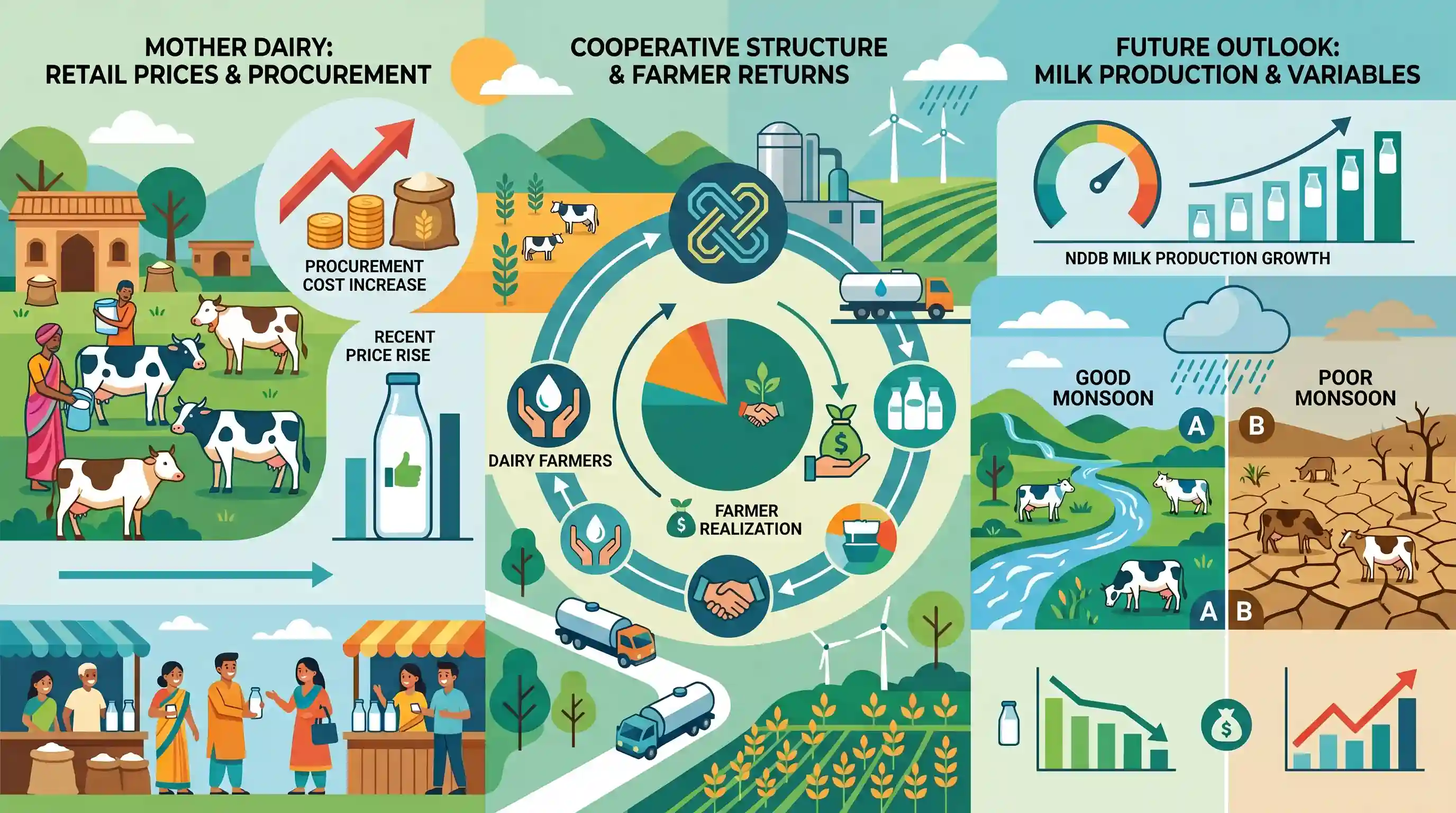
Mother Dairy, a leading milk supplier in India, has stated that it does not intend to hike retail milk prices in the near future owing to a comfortable supply situation. Chairman Meenesh Shah noted that while the company recently raised prices by ₹2 per litre due to a 6% increase in procurement costs, the focus remains on ensuring fair returns for farmers, who receive 75-80% of the sales realization. Looking ahead, the National Dairy Development Board (NDDB) expects India's milk production to grow by 4-6% this fiscal year. However, fodder availability and overall dairy inflation will remain closely tied to the performance of the upcoming monsoon.
Key Points
- Mother Dairy has no immediate plans to hike retail milk prices due to a comfortable supply situation.
- The dairy major recently increased prices by ₹2 per litre to offset a 6% rise in procurement costs.
- Approximately 75-80% of Mother Dairy's sales realization is passed back to the dairy farmers.
- India's milk production is expected to rise by 4-6% this fiscal year, meeting the growing consumer demand.
- Future milk production and fodder availability will heavily depend on the upcoming monsoon season.
Important Terms
National Dairy Development Board (NDDB)

Statutory body and 'Institution of National Importance' established in 1965 to support producer-owned dairy cooperatives. It spearheads India's dairy development and was founded by Dr. Verghese Kurien to replicate the Anand model nationwide.
UPSC context
GS Paper 2 (Statutory bodies) and Paper 3 (Agriculture). Tests dairy governance, rural development, and the legacy of the White Revolution.
Dairy Cooperatives
Producer-owned organizations where farmers collectively process and market milk. This model ensures fair pricing for producers—often 75-80% of sales—and eliminates intermediaries in the dairy supply chain.
UPSC context
GS Paper 3 (Agriculture/Cooperatives). Crucial for questions on rural entrepreneurship, doubling farmers' income, and inclusive economic growth.
Mother Dairy
A wholly-owned subsidiary of NDDB, established in 1974 under Operation Flood. It serves as a major milk supplier in India, particularly in Delhi-NCR, balancing consumer prices with fair returns to farmers.
UPSC context
GS Paper 3 (Food Processing/Supply Chain). Relevant for cooperative-led marketing models and managing urban food inflation and security.
India Meteorological Department (IMD)
The premier agency under the Ministry of Earth Sciences for weather forecasting and monsoon monitoring. Its forecasts are vital for agricultural planning, fodder management, and managing climate-related risks to the economy.
UPSC context
GS Paper 1 (Geography) and Paper 3 (Agriculture). Essential for understanding monsoon dependencies in Indian agriculture and food inflation.
Operation Flood
Launched in 1970 by NDDB, this world-largest dairy development program transformed India from a milk-deficient nation into the world’s leading producer through a cooperative-led 'White Revolution.'
UPSC context
GS Paper 3 (Agriculture). Key historical case study for successful agricultural reforms, nutritional security, and large-scale rural transformation.
Prelims Trap
"The Commission for Agricultural Costs and Prices (CACP) recommends the Minimum Support Price (MSP) for milk."
The government does NOT declare an MSP for milk. Procurement prices are determined by dairy cooperatives and private players based on fat and solid-not-fat (SNF) content, alongside market forces.
Static Concepts Connected
What is the National Dairy Development Board (NDDB)?
- Statutory body: It is a statutory body (NDDB Act, 1987) under the Ministry of Fisheries, Animal Husbandry & Dairying, originally established in 1965 to replicate the Anand cooperative model.
- Operation Flood: It spearheaded Operation Flood (White Revolution), establishing a three-tier dairy cooperative network (village, district, and state levels) across India.
- High farmer realization: The cooperative structure eliminates middlemen, ensuring that 75-80% of the consumer price flows directly back to the primary milk producers.
How does livestock growth compare to the broader agriculture sector?
- Faster growth rate: The livestock and dairy sector has consistently outpaced crop agriculture, maintaining a robust annual growth rate of 4-6% over the last decade.
- Rising GVA share: Livestock has emerged as a major driver of the agricultural economy, now contributing to over a third of the total gross value added (GVA) in the agriculture and allied sector.
- Structural bottlenecks: Despite high total output, the sector suffers from severe structural issues, including critical fodder shortages, low per-animal productivity, and reliance on unorganized labor.
Cross-Topic Patterns
Feminization of agriculture and dairy cooperatives
The dairy sector heavily absorbs female workforce participation. Cooperative success models are frequently linked in GS1 and GS2 to evaluate the genuine economic empowerment of women versus unpaid family labor.
Climate volatility and structural food inflation
Milk/dairy is a sticky component of food inflation. Erratic monsoons impact fodder yields directly, driving up procurement costs—a supply-side inflation that RBI monetary policy struggles to control.

Expect a comparative Prelims statement contrasting the high farmer realization in dairy cooperatives (75%+) versus APMC-regulated crops.
Linked PYQs · 3
Linked PYQs · 3
- 2015MainsGS3
Livestock rearing has a big potential for providing non-farm employment and income in rural areas. Discuss suggesting suitable measures to promote this sector in India.
- 2017MainsGS3
Explain various types of revolutions, took place in Agriculture after independence in India. How these revolutions have helped in poverty alleviation and food security in India?
- 2017MainsGS3
How do subsidies affect the cropping pattern, crop diversity and economy of farmers? What is the significance of crop insurance, minimum support price and food processing for small and marginal farmers?
