IISc Recycling Waste Milk Packets into Sustainable Building Materials
Source:Indian Express ↗
ఇది ఎందుకు ముఖ్యం
Provides a tangible case study of indigenous R&D solving environmental challenges. It hits multiple GS3 themes: the application of 3D printing, advanced materials science (vitrimers), circular economy, sustainable construction, and solid waste management of low-value plastics.
సారాంశం
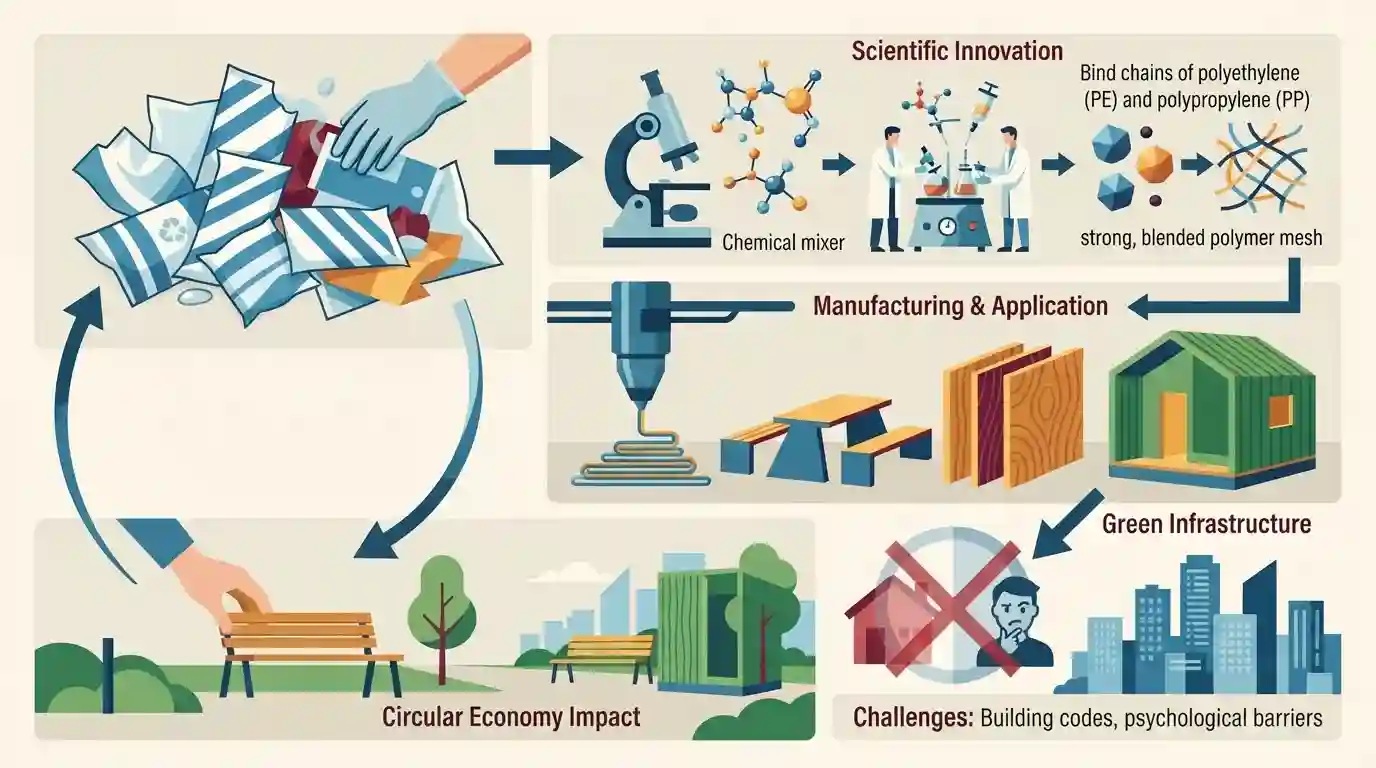
Indian Institute of Science (IISc) researchers have developed a novel technique to recycle single-use polyethylene milk packets—a major contributor to India's plastic waste crisis—into sturdy building materials. By using specialized molecules called vitrimers, they successfully blended polyethylene with polypropylene to create a resilient polymer suited for 3D printing. Start-ups like VOiLA and Unified Intelligence are leveraging such scientific breakthroughs to manufacture outdoor furniture and multi-layer plastic (MLP) panels. These zero-water, eco-friendly construction alternatives support the circular economy, though they face challenges scaling up due to traditional building codes and psychological barriers among consumers.
ముఖ్య అంశాలు
- India consumes 100-120 million single-use milk packets daily; these low-value polyethylene packets are often ignored by waste pickers and end up in landfills.
- Researchers at IISc discovered a method using 'vitrimer' molecules to successfully blend incompatible polyethylene and polypropylene into a durable polymer.
- This breakthrough material is being 3D-printed by the start-up VOiLA to create sustainable outdoor furniture and structures.
- Another Bengaluru firm, Unified Intelligence, uses a 'thermofusion' process to convert hard-to-recycle multi-layer plastics (MLPs) into strong honeycomb panels for interior walls.
- These innovations promote circular economy and zero-water construction, though regulatory hurdles remain as current building codes are tailored to traditional concrete and brick.
ముఖ్యమైన పదాలు
Bureau of Indian Standards

India's statutory national standards body under the Ministry of Consumer Affairs, Food and Public Distribution, established under the BIS Act, 2016, responsible for formulating standards, product certification, and hallmarking.
UPSC context
GS II: Statutory and regulatory bodies; GS III: Economics. Tests understanding of consumer safety, industrial standardization, and quality certification regimes.
National Building Code
A national building guidelines document (updated to National Building Construction Standards, 2026) published by BIS to provide model regulations and voluntary safety standards for building construction and fire safety.
UPSC context
GS III: Infrastructure and Disaster Management. Tests knowledge of urban safety regulations, building norms, and federal implementation challenges.
Indian Institute of Science (IISc)
A premier public research university in Bengaluru, established in 1909 with support from Jamsetji Tata, widely recognized for high-impact scientific research and technology indigenization.
UPSC context
GS III: Science & Technology. Tests knowledge of premier research institutions, technological advancements, and domestic R&D innovations in India.
Kempegowda International Airport
The international airport serving Bengaluru, Karnataka, renowned for its extensive green infrastructure initiatives, solid waste management systems, and practical adoption of circular economy models.
UPSC context
GS III: Infrastructure and Solid Waste Management. Tests understanding of urban waste-processing solutions, green airports, and public-private sustainability partnerships.
ప్రిలిమ్స్ ఉచ్చు
Vitrimers are a class of thermosetting polymers that cannot be reshaped or recycled once cured due to permanent cross-linked networks.
Unlike traditional thermosets, vitrimers contain dynamic covalent bonds that allow them to flow and be reshaped when heated, making them highly recyclable.
అనుసంధానమైన స్థిర భావనలు
How do vitrimers differ from traditional thermoplastics and thermosets?
- Thermoplastics: Possess weak intermolecular forces; they melt when heated and solidify when cooled, making them highly recyclable but mechanically weaker.
- Thermosets: Contain permanent chemical cross-links; they do not melt or flow when heated, making them strong but impossible to recycle.
- Vitrimers: Feature dynamic, reversible covalent networks; they exhibit high mechanical strength but can flow and be reshaped like thermoplastics upon heating.
What are the core mandates of India's Plastic Waste Management Rules?
- EPR Framework: Mandates Producers, Importers, and Brand Owners to collect, process, and recycle specific, escalating targets of plastic packaging waste.
- MLP Classification: Classifies Multi-Layered Plastics under Category III, subjecting them to strict recycling and resource recovery targets to reduce landfill loads.
- Targeted Bans: Bans specific single-use plastics with low utility, though vital packaging like milk pouches is excluded, necessitating chemical recycling alternatives.
అంతర-అంశ నమూనాలు
3D Printing & Zero-Water Infrastructure
Using recycled polymer filaments in additive construction eliminates the immense water footprint of traditional concrete curing, advancing green infrastructure goals.
Regulatory Lag in Eco-Innovation
Green technological innovations often stall due to static building codes, highlighting the need for dynamic regulatory standards that evolve with materials science.

Vitrimers' unique bridging of thermoset and thermoplastic properties is highly likely to feature in conceptual S&T polymer questions.
అనుసంధాన PYQలు · 3
అనుసంధాన PYQలు · 3
- 2018MainsGS3
What are the impediments in disposing the huge quantities of discarded solid wastes which are continuously being generated? How do we remove safely the toxic wastes that have been accumulating in our habitable environment?
- 2022PrelimsGS1
With reference to polyethylene terephthalate, the use of which is so widespread in our daily lives, consider the following statements : 1. Its fibres can be blended with wool and cotton fibres to reinforce their properties. 2. Containers made of it can be used to store any alcoholic beverage. 3. Bottles made of it can be recycled into other products. 4. Articles made of it can be easily disposed of by incineration without causing greenhouse gas emissions. Which of the statements given above are correct?
- 2013MainsGS3
How does the 3D printing technology work? List out the advantages and disadvantages of the technology.
