Pakistan constitutional amendment on military command supremacy
Source:Indian Express ↗
Why It Matters
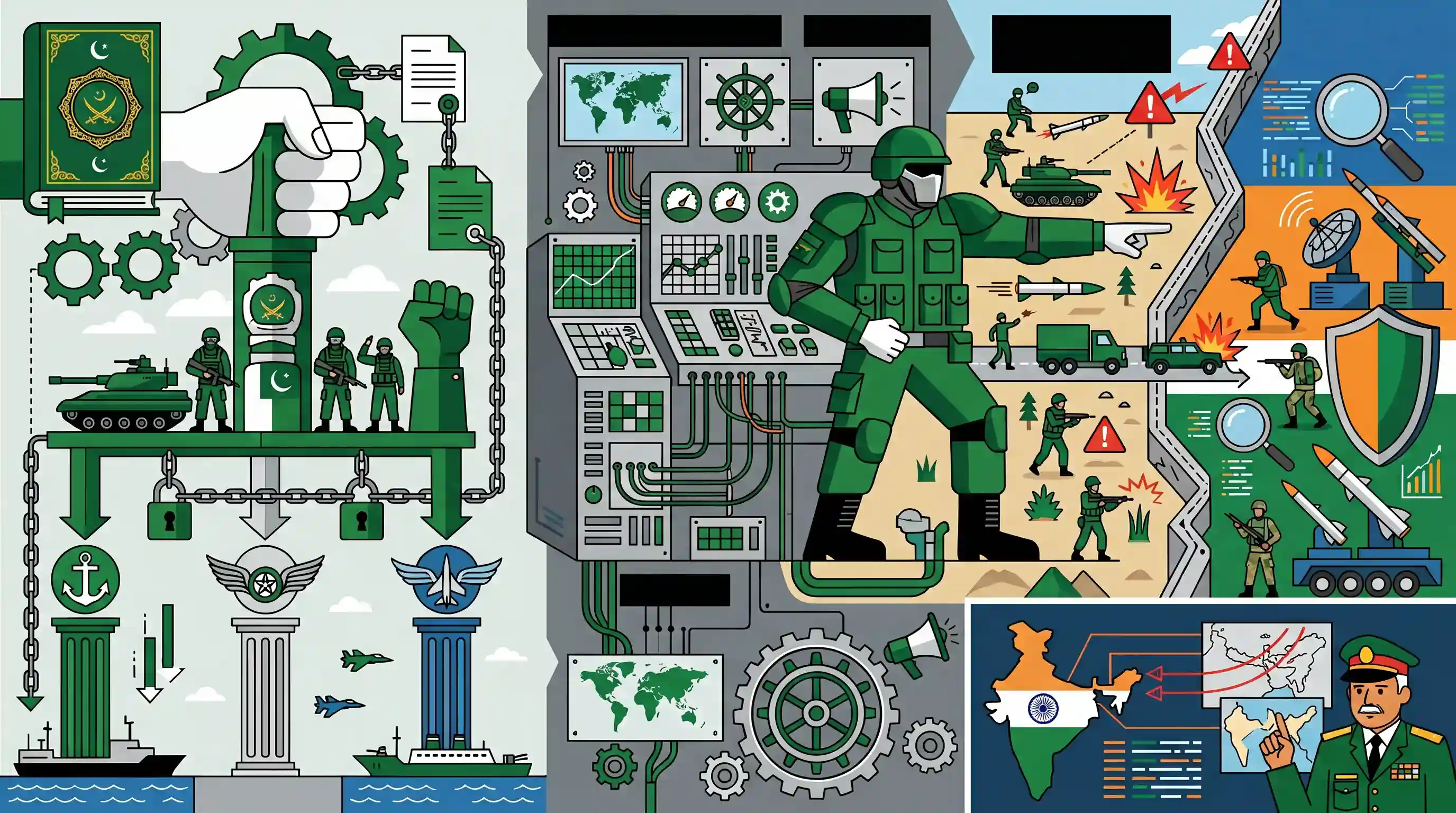
Pakistan's internal power dynamics heavily dictate its foreign policy towards India. The constitutional centralization of power within the Pakistan Army guarantees that the military establishment retains absolute control over strategic decisions, which directly impacts India's border security, counter-terrorism calculus, and bilateral relations.
Summary
A recent constitutional amendment in Pakistan has formally reinforced the structural and legal supremacy of the Pakistan Army over the nation's Navy and Air Force. By legally subjugating the other branches of the military, the amendment consolidates power within the land forces and formalizes the Army's preeminent position in Pakistan's military and political landscape. This development is significant for India, as it signals a further entrenchment of the military establishment's dominance over state affairs, ensuring that the Army remains the primary architect of Pakistan's foreign and security policies, including those concerning cross-border dynamics and regional stability.
Key Points
- Pakistan has passed a constitutional amendment that legally reinforces the supremacy of the Pakistan Army over the country's Navy and Air Force.
- The legislative move formally centralizes military command and consolidates the Army's preeminent position within Pakistan's defense and political hierarchy.
- This amendment reflects the ongoing civil-military imbalance in Pakistan, institutionalizing the Army's outsized role in state affairs and governance.
- For India, an entrenched and legally dominant Pakistan Army signals continued control of Pakistan's foreign and defense policies by Rawalpindi, potentially maintaining or hardening anti-India postures.
Important Terms
Pakistan Constitutional Amendment

Legislative changes, notably the 27th Amendment (2025), which established the Chief of Defence Forces (CDF) role, held concurrently by the Army Chief, formalizing the Army's legal supremacy over other branches.
UPSC context
GS Paper-II (International Relations); analyze how neighborhood political shifts and military-centric laws influence India’s regional security and diplomatic strategy.
Pakistan Army
The most powerful branch of Pakistan’s military; its chief now serves as the Chief of Defence Forces, exercising de jure command over all services and strategic assets.
UPSC context
GS Paper-III (Security); understanding the primary actor in Pakistan's foreign policy and its role in cross-border dynamics and regional stability.
Chief of Defence Forces (CDF)
A new supreme military post established by the 27th Amendment, held by the Army Chief, centralizing command of the Army, Navy, and Air Force under one office.
UPSC context
GS Paper-III (Security); contrast with India’s Chief of Defence Staff (CDS) and analyze the centralization of military power in the neighborhood.
Pakistan Navy and Air Force
The maritime and aerial branches of Pakistan's military, respectively. Recent amendments legally subordinated their strategic authority to the Army Chief (as CDF), ending traditional tri-service balance.
UPSC context
GS Paper-III (Security); relevant for assessing combined-arms capabilities and the unified command's impact on Arabian Sea and border security.
Pakistan Parliament
Pakistan's federal legislature. Its approval of military-empowering amendments underscores the "hybrid" governance model where civilian authorities frequently ratify the military establishment's strategic priorities.
UPSC context
GS Paper-II (Polity); tests knowledge of the structural weaknesses of democratic institutions in neighboring states and the nature of civil-military relations.
Prelims Trap
Pakistan's National Strategic Command (NSC) and its nuclear arsenal are under the ultimate control of the civilian Prime Minister.
The 27th Amendment formalized the Pakistan Army Chief's absolute and direct control over the National Strategic Command (NSC) and the nuclear arsenal, legally eliminating civilian oversight.
Static Concepts Connected
What is the mandate of India's Chief of Defence Staff (CDS)?
- First among equals: The CDS is a four-star general acting as the permanent Chairman of the Chiefs of Staff Committee, serving as a first among equals.
- No operational command: Unlike Pakistan's new CDF, India's CDS does not exercise direct military command over the three service chiefs.
- Integration mandate: Focuses on fostering jointness in procurement, training, and operations (theater commands) without subjugating the Navy or Air Force to the Army.
How is India's Nuclear Command Authority (NCA) structured?
- Civilian supremacy: The Political Council, chaired by the Prime Minister, is the sole body authorized to order a nuclear strike, ensuring strict civilian control.
- Executive Council: Chaired by the National Security Advisor (NSA), it provides inputs for decision-making and executes the directives of the Political Council.
- Strategic Forces Command: The military wing responsible for the administration and operation of nuclear weapons under the NCA's direction.
Cross-Topic Patterns
Diverging higher defense models
While India’s CDS aims for tri-service integration as "first among equals," Pakistan's new CDF model constitutionally subjugates the Navy and Air Force, centralizing absolute power in the Army Chief.
Constitutionalizing the Deep State
Creating a Federal Constitutional Court and granting lifelong immunity to commanders legally extinguishes civilian oversight, shifting Pakistan from a covert "Deep State" to an overt military-led constitutional state.

GS-2 Mains 2026 may ask to contrast India's higher defense organization (CDS/NCA) with neighboring models of civil-military relations.
Linked PYQs · 3
Linked PYQs · 3
- 2024MainsGS3
India has a long and troubled border with China and Pakistan fraught with contentious issues. Examine the conflicting issues and security challenges along the border. Also give out the development being undertaken in these areas under the Border Area Development Programme (BADP) and Border Infrastructure and Management (BIM) Scheme.
- 2016MainsGS2
Increasing cross-border terrorist attacks in India and growing interference in the internal affairs of several member-states by Pakistan are not conducive for the future of SAARC (South Asian Association for Regional Cooperation)." Explain with suitable examples.
- 2015MainsGS2
Terrorist activities and mutual distrust have clouded India-Pakistan relations. To what extent the use of soft power like sports and cultural exchanges could help generate goodwill between the two countries? Discuss with suitable examples.
