Political Transitions and Electoral Dynamics in Myanmar
Source:The Hindu ↗
Why It Matters
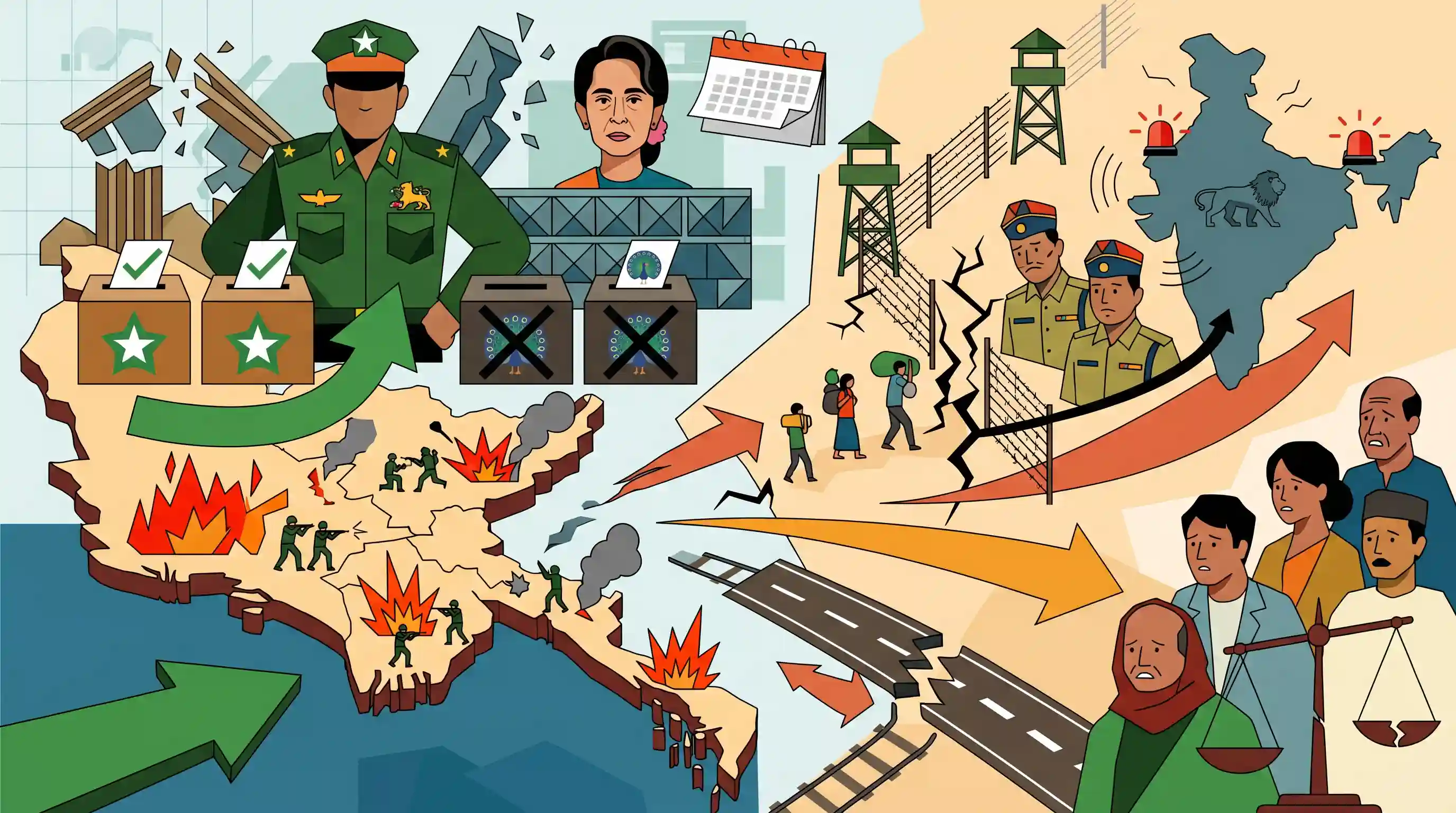
The political trajectory of Myanmar is crucial for India's strategic interests. The military coup and ensuing civil war have stalled connectivity projects under the Act East Policy and exacerbated security challenges along the porous India-Myanmar border, including cross-border insurgency, drug trafficking, and refugee inflows.
Summary
The military-backed Union Solidarity and Development Party (USDP) has taken an early lead in Myanmar's phased elections, which are taking place amidst widespread armed conflicts. The military overthrew Aung San Suu Kyi's elected government in a February 2021 coup and subsequently dissolved her National League for Democracy (NLD) party in 2023. The elections, overseen by a military-appointed commission, are widely expected to consolidate the junta's power. The ongoing civil war and political instability in Myanmar pose significant security and diplomatic challenges for neighboring countries, including India, particularly regarding border management and regional stability.
Key Points
- The military-backed Union Solidarity and Development Party (USDP) is leading in the early results of Myanmar's phased elections.
- The elections are being held in three phases due to ongoing armed conflict and widespread resistance against the military junta.
- The military seized power in February 2021, overthrowing the democratically elected government led by Aung San Suu Kyi.
- Aung San Suu Kyi's party, the National League for Democracy (NLD), was dissolved by the military-appointed election commission in 2023.
- The ongoing instability in Myanmar has direct spillover effects on India, particularly concerning border security and refugee influx in the Northeast.
Important Terms
Act East Policy

India's proactive diplomatic initiative to strengthen economic, strategic, and cultural ties with Southeast Asia. Myanmar serves as the critical "gateway" and land bridge for this policy.
UPSC context
GS Paper II (International Relations); critical for connectivity projects like the Trilateral Highway.
Free Movement Regime (FMR)
A bilateral arrangement allowing residents living within 16 km of the India-Myanmar border to cross without visas. India recently suspended it to curb insurgency and illegal migration.
UPSC context
GS Paper III (Internal Security/Border Management); involves Northeast stability and cross-border ethnic ties.
National League for Democracy (NLD)
Myanmar’s primary pro-democracy party, led by Aung San Suu Kyi. It won landslide victories in 2015 and 2020 before being overthrown and later dissolved by the military.
UPSC context
GS Paper II (International Relations); represents the struggle for democratic governance in India's neighborhood.
Union Solidarity and Development Party (USDP)
A pro-military proxy party in Myanmar, primarily composed of retired generals. It is the successor to the junta's former mass organization, the USDA.
UPSC context
GS Paper II (International Relations); relevant for understanding the junta's attempt to legitimize power through elections.
Union Election Commission (UEC)
The national electoral body of Myanmar. Currently appointed by the military junta, it is responsible for conducting elections and deregistering opposition parties like the NLD.
UPSC context
GS Paper II (International Relations); tests awareness of institutional captured by non-democratic regimes.
State Administration Council (SAC)
The official name of the military junta ruling Myanmar since the February 2021 coup. It exercises absolute legislative, executive, and judicial powers.
UPSC context
GS Paper II (International Relations); identifies the de facto ruling authority in Myanmar.
Prelims Trap
"India is legally bound by the 1951 UN Refugee Convention to provide asylum to refugees fleeing Myanmar's military junta."
India is not a signatory to the 1951 UN Refugee Convention or its 1967 Protocol. Refugee influx from Myanmar is handled via executive decisions and the Foreigners Act, 1946.
Static Concepts Connected
What was the Free Movement Regime (FMR) along the India-Myanmar border?
- Historical FMR: Permitted tribes residing along the border to travel up to 16 km into each other's territory without requiring a visa.
- Cultural logic: Facilitated people-to-people contact for ethnic groups (like Nagas and Mizos) artificially divided by the arbitrary British-drawn boundary.
- Current status: Recently scrapped by India to curb insurgent safe havens, illegal immigration, and drug smuggling. The 1,643 km border will now be fenced.
What are the components of the Kaladan Multi-Modal Transit Transport Project?
- Sea link: Connects the Kolkata seaport to the India-funded Sittwe seaport in Myanmar's Rakhine state.
- River & road: An inland waterway runs from Sittwe to Paletwa via the Kaladan river, followed by a road link connecting Paletwa to Zorinpui in Mizoram.
- Strategic aim: Provides a crucial alternative transport route to India's landlocked Northeast, bypassing the strategically vulnerable Siliguri Corridor (Chicken's Neck).
Cross-Topic Patterns
Myanmar instability & Northeast internal security
The influx of Chin-Kuki refugees fleeing the junta exacerbates local ethnic fault lines in Manipur and Mizoram, linking a diplomatic crisis directly to India's internal security challenges.
Act East vs. China's CMEC footprint
India engages the military junta pragmatically to secure the Sittwe port, acting as a strategic counterweight to China's Kyaukphyu deep-sea port under the China-Myanmar Economic Corridor (CMEC).

Expect a 2026 Prelims question mapping India-Myanmar border states against suspended FMR rules and stalled Act East routes.
Linked PYQs · 3
Linked PYQs · 3
- 2019MainsGS3
Cross-border movement of insurgents is only one of the several security challenges facing the policing of the border in North-East India. Examine the various challenges currently emanating across the India-Myanmar border. Also, discuss the steps to counter the challenges.
- 2020MainsGS3
Analyze internal security threats and transborder crimes along Myanmar, Bangladesh and Pakistan borders including Line of Control (LoC). Also discuss the role played by various security forces in this regard.
- 2016MainsGS2
Evaluate the economic and strategic dimensions of India's Look East Policy in the context of the post Cold War international scenario.
