Kishtwar Counter Terror Operations and Regional Security
Source:The Hindu ↗
Why It Matters
The article highlights the persistent security challenges in the Jammu region and the crucial issue of OGWs in terrorism. It also brings to light the socio-political marginalisation, stereotyping, and livelihood challenges faced by nomadic tribal communities like the Gujjars in conflict zones, demonstrating the intersection of internal security and social justice.
Summary
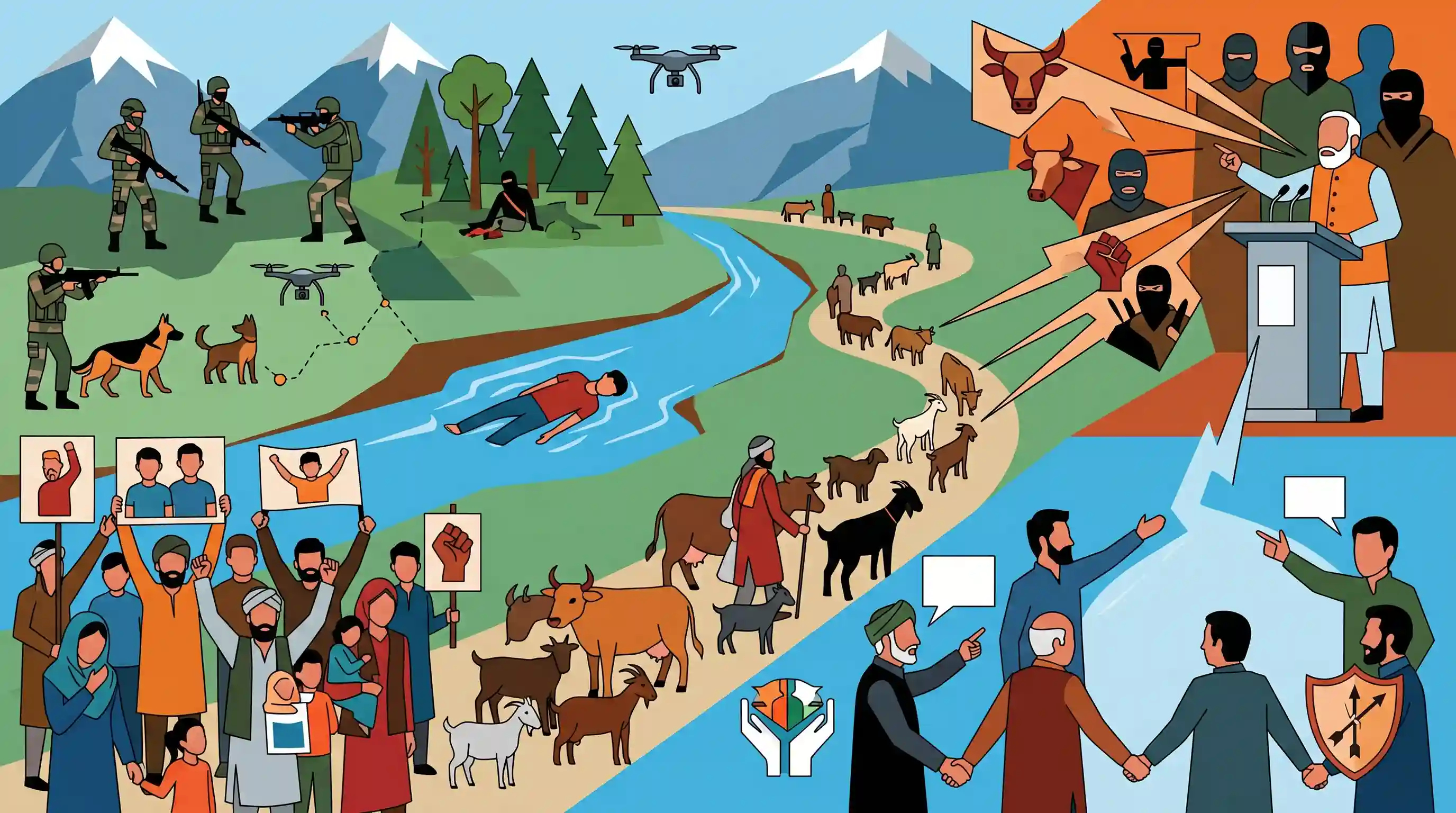
The Indian Army and J&K Police have neutralised an unidentified militant during ongoing anti-terror operations in the Chhatru forest of Kishtwar district, while search operations continue in Udhampur. Concurrently, the recovery of a missing Gujjar youth\'s body from Veshow Nallah in Kulgam has intensified protests by the tribal community, who allege foul play and police excesses regarding the disappearance of him and his two brothers. The situation is further complicated by political tensions, as a BJP leader accused the Gujjar community of bovine smuggling and acting as overground workers (OGWs) for militants, sparking strong condemnation from PDP leaders against the dangerous stereotyping of the nomadic group during their annual migration.
Key Points
- An unidentified militant was killed by security forces during an ongoing joint anti-terror operation in the Chhatru forest of Kishtwar district, marking the third day of the encounter.
- Another group of militants remains untraced in a separate ongoing search operation in Jammu\'s Udhampur district following a recent firefight.
- The body of Mukhtar Ahmad, a Gujjar youth missing since February alongside his two brothers, was recovered from Veshow Nallah in Kulgam, raising suspicions of foul play.
- The disappearance has triggered protests from the Gujjar community alleging police excesses, leading the J&K government to announce a judicial inquiry and livelihood support for the victims\' families.
- Political tensions escalated after a BJP MLA accused the Gujjar community of bovine smuggling and acting as overground workers (OGWs) for militants, drawing sharp criticism for stereotyping nomadic groups.
Important Terms
White Knight Corps

The XVI Corps of the Indian Army, headquartered in Nagrota, responsible for the security of the Jammu region south of the Pir Panjal range.
UPSC context
GS3: Internal Security. Tests knowledge of specialized military formations and their role in regional counter-insurgency operations in J&K.
Northern Army Command
The Indian Army's strategically vital command headquartered in Udhampur, overseeing all military operations across Jammu and Kashmir and Ladakh.
UPSC context
GS3: Security Forces and their Mandate. Tests understanding of India's military command structure and territorial defense.
Overground Workers (OGWs)
Individuals who provide logistical support, intelligence, and hideouts to militants without being active combatants themselves.
UPSC context
GS3: Internal Security Challenges. Tests knowledge of hybrid warfare, non-state actors, and the support systems for regional insurgencies.
Gujjars and Bakarwals
Nomadic Scheduled Tribes of J&K who practice transhumance (seasonal migration) and traditionally serve as the 'eyes and ears' for the Army.
UPSC context
GS1/GS3: Social Justice & Internal Security. Tests awareness of tribal marginalization and the security significance of nomadic border communities.
J&K Police
The primary law enforcement agency in the Union Territory, crucial for gathering local intelligence and conducting joint counter-terror operations with central forces.
UPSC context
GS3: Internal Security. Evaluates the role of state police in conflict management and inter-agency coordination.
People's Democratic Party (PDP)
A regional political party in J&K that often advocates for dialogue and the protection of civil rights in the conflict-affected region.
UPSC context
GS2: Governance/Political Parties. Relevant for understanding regional political dynamics and their impact on social stability.
Prelims Trap
"The term 'Over Ground Worker' is formally defined under the Unlawful Activities (Prevention) Act."
OGW is a security forces parlance for logistical facilitators. While they are prosecuted under UAPA for supporting terrorism, the term 'OGW' itself is not a legally defined category in the Act.
Static Concepts Connected
What are the key geographical features of the Jhelum River basin?
- Origin: Rises from the Verinag Spring situated at the base of the Pir Panjal range in the southeastern part of the Kashmir Valley.
- Key Tributaries: Major tributaries include the Vishav (Veshow), Liddar, Sind, and Pohru rivers. The Vishav River specifically originates from the Pir Panjal range.
What defines the Gujjar and Bakarwal communities of Jammu & Kashmir?
- Transhumance: They practice seasonal pastoral migration (transhumance) between high-altitude Himalayan summer pastures and lowland winter plains.
- Constitutional Status: Granted Scheduled Tribe (ST) status in J&K in 1991 to provide political and social safeguards against historical socio-economic marginalization.
- Geographic Spread: While prominent in J&K, Gujjar populations are broadly distributed across Himachal Pradesh, Punjab, Haryana, Rajasthan, and Gujarat.
Cross-Topic Patterns
Tribal Alienation and Internal Security
Stereotyping marginalized nomadic pastoralists as Over Ground Workers (OGWs) risks deep alienation, undermining the military's 'WHAM' (Winning Hearts and Minds) initiatives like Operation Sadbhavana.
Topography and Counter-Insurgency
Dense forestry in Kishtwar and the Chenab Valley (Pir Panjal region) creates natural havens for militants, making it a persistent flashpoint for tactical counter-insurgency operations.

Expect a pairs-based Prelims question matching minor J&K rivers (Vishav, Liddar) with their source ranges or main basins in 2026.
Linked PYQs · 4
Linked PYQs · 4
- 2019MainsGS3
The banning of 'Jamaat-e-Islami' in Jammu and Kashmir brought into focus the role of over-ground workers (OGWs) in assisting terrorist organizations. Examine the role played by OGWs in assisting terrorist organizations in insurgency affected areas. Discuss measures to neutralize influence of OGWs.
- 2023MainsGS3
Winning of 'Hearts and Minds' in terrorism-affected areas is an essential step in restoring the trust of the population. Discuss the measures adopted by the Government in this respect as part of the conflict resolution in Jammu and Kashmir.
- 2024MainsGS1
Critically analyse the proposition that there is a high correlation between India's cultural diversities and socio-economic marginalities.
- 2011MainsGS1
Discuss the problems specific to the denotified and nomadic tribes in India.
