Care Economy Workshop Addresses Elderly Support Amid Migration
Source:garhwal-post ↗
Why It Matters
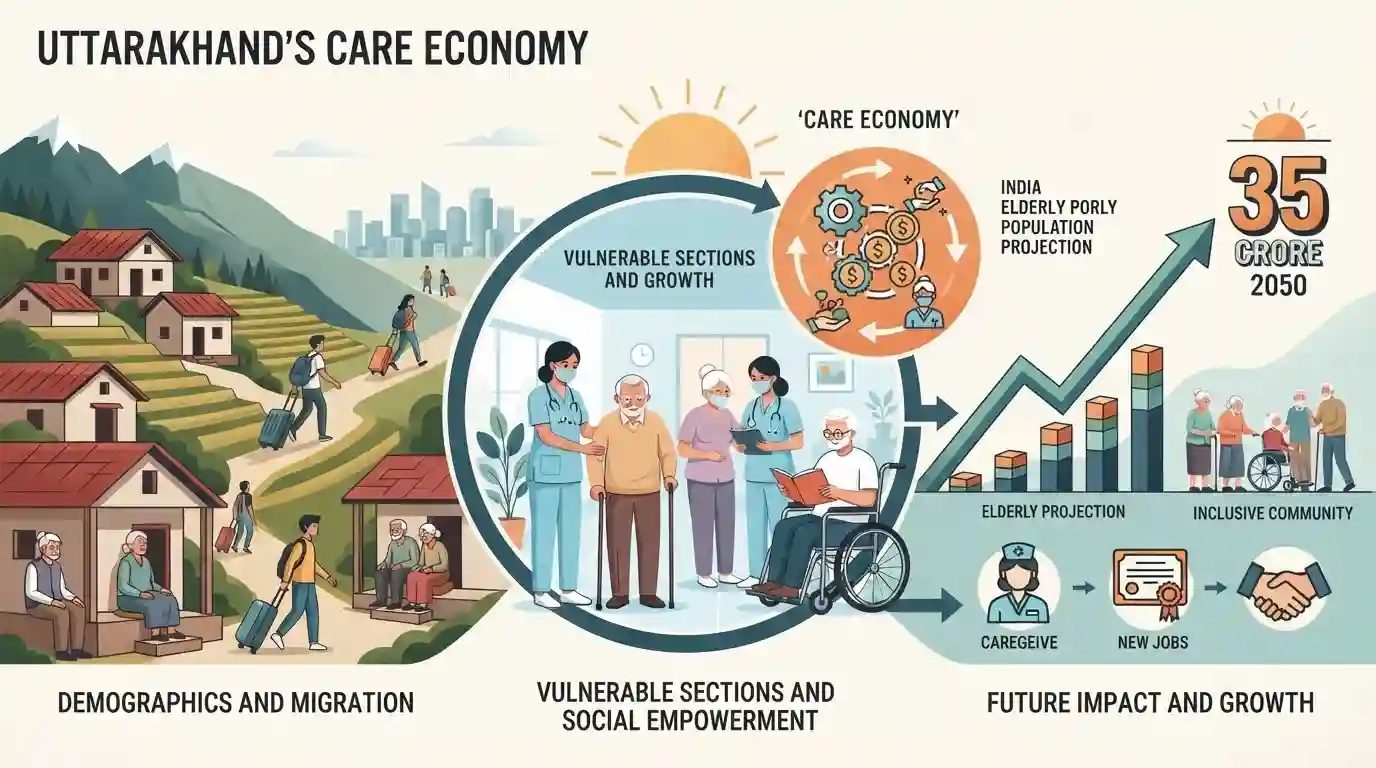
The article highlights the intersection of changing demographics (an aging population) and regional challenges like out-migration in Uttarakhand. Developing a formal care economy is crucial for providing social security to vulnerable groups while creating new employment opportunities.
Summary
Uttarakhand's Social Welfare Minister Khajan Das emphasized the urgent need for a formal 'Care Economy' during the state's first workshop on the subject in Dehradun. Driven by the out-migration of youth from hill regions, many elderly residents are left without traditional family support, making professional care systems essential. The initiative, jointly organized by the central and state social welfare departments, aims to integrate care services into the mainstream economy, providing support for the elderly and disabled while generating significant employment. This is particularly relevant as India's elderly population is projected to reach nearly 35 crore by 2050.
Key Points
- Uttarakhand hosted its first workshop on the 'Care Economy', focusing on older persons and individuals with disabilities.
- The event was a joint initiative by the Union Ministry of Social Justice and Empowerment and the Uttarakhand Social Welfare Department.
- State Minister Khajan Das highlighted that migration from hill regions has left many elderly residents isolated, increasing the need for professional care services.
- India's elderly population, which was 10.38 crore (8.6%) in 2011, is projected to reach nearly 35 crore (20%) by 2050, presenting both a challenge and an opportunity to generate employment through formal care systems.
Important Terms
Care Economy

The sum of paid and unpaid activities providing care for children, the elderly, and disabled individuals. Though critical to society, this labor is often undervalued and disproportionately performed by women.
UPSC context
GS 1 & 3. Tests knowledge on unpaid labor, demographic shifts, gender equality, and potential employment generation in India's economy.
Ministry of Social Justice and Empowerment
The central government ministry responsible for the welfare, protection, and empowerment of marginalized groups, including Scheduled Castes, Other Backward Classes, the elderly, transgender persons, and victims of substance abuse.
UPSC context
GS 2 (Social Justice). Central to analyzing federal welfare policies, affirmative action, and state support mechanisms for vulnerable sections.
Social Welfare Department of Uttarakhand
The state nodal agency executing government welfare schemes, including pensions, scholarships, and special assistance for scheduled castes, elderly, disabled, and economically backward individuals in Uttarakhand.
UPSC context
GS 2 (Welfare Schemes). Illustrates state-level implementation of social justice programs and regional public policy delivery.
Latika Roy Foundation
A Dehradun-based non-profit organization focused on providing localized, comprehensive support and specialized services—such as early intervention and vocational training—to individuals with developmental disabilities.
UPSC context
GS 2 (Role of NGOs). A vital case study representing civil society's role in delivering disability rights and inclusive education.
Happy Family Health Care and Research Association
A charitable NGO in Uttarakhand comprising health professionals and social workers dedicated to addressing community health issues like mental health, childhood nutrition, disability, and empowering vulnerable groups.
UPSC context
GS 2 (Role of NGOs). Exemplifies civil society involvement in decentralized community health, welfare, and social empowerment.
Prelims Trap
"Feminization of ageing refers to an improving sex ratio at birth or an increasing female birth rate."
It actually refers to women having a higher life expectancy than men, meaning the elderly population becomes disproportionately female, often facing widowhood and poverty.
Static Concepts Connected
What constitutes the 'Care Economy' (or Purple Economy) in India's macroeconomic framework?
- Definition: It encompasses both paid and unpaid labor related to caregiving, including childcare, eldercare, and healthcare.
- Purple Economy: Often termed the Purple Economy, it focuses on mainstreaming unrecognized care work to empower women, reduce gender disparity, and create formal employment.
- Macroeconomic Value: Generating formal eldercare jobs directly addresses the economic challenge of India's ageing population while integrating informal female labor into the GDP.
What are the key socio-demographic consequences of rural out-migration in Himalayan states?
- Ghost Villages: Heavy out-migration of working-age youth has led to the creation of thousands of uninhabited or severely depopulated settlements.
- Dependent Demography: Migration leaves behind a high dependency ratio of elderly and children, dismantling traditional joint-family safety nets and causing senior isolation.
- Feminization of Agriculture: With young men migrating for urban employment, the burden of managing local agriculture falls disproportionately on the women left behind.
Cross-Topic Patterns
Out-migration & Border Security (VVP)
Depopulation of hill areas creates 'Ghost Villages', a trend that prompted the 'Vibrant Villages Programme' to reverse out-migration and counter strategic vulnerabilities along India's northern borders.
Silver Economy & Demographic Transition
As India's elderly reach 20% by 2050, states experiencing faster demographic transitions (like Southern and Hill states) will shift economic focus from the demographic dividend to the 'Silver' and 'Purple' economies.

Expect a 2026 Prelims question testing 'Purple Economy' and 'Feminization of Ageing' alongside findings from the UNFPA India Ageing Report.
Linked PYQs · 2
Linked PYQs · 2
- 2025UKPSC_PRELIMSGS1
Arrange the following social welfare schemes in chronological order: i. Integrated Rural Development Programme (IRDP) ii. Rural Employment Generation Programme (REGP) iii. Prime Minister Rojgar Yojana (PMRY) iv. Rural Landless Employment Guarantee Programme (RLEGP)
- 2025UKPSC_PRELIMSGS1
Which of the following records is not maintained by the Panchayats in Uttarakhand?
