West Bengal Clears Pending Mid-Day Meal Portal Payments
Source:theprint ↗
Why It Matters
The Mid-day Meal Scheme (renamed PM POSHAN) is a flagship centrally sponsored scheme with high relevance in WBCS Prelims (which has previously tested its launch year, 1995). The article also touches upon key political figures of modern Indian history, such as Dr. Syama Prasad Mookerjee and Deendayal Upadhyaya, who are important personalities in the history syllabus.
Summary
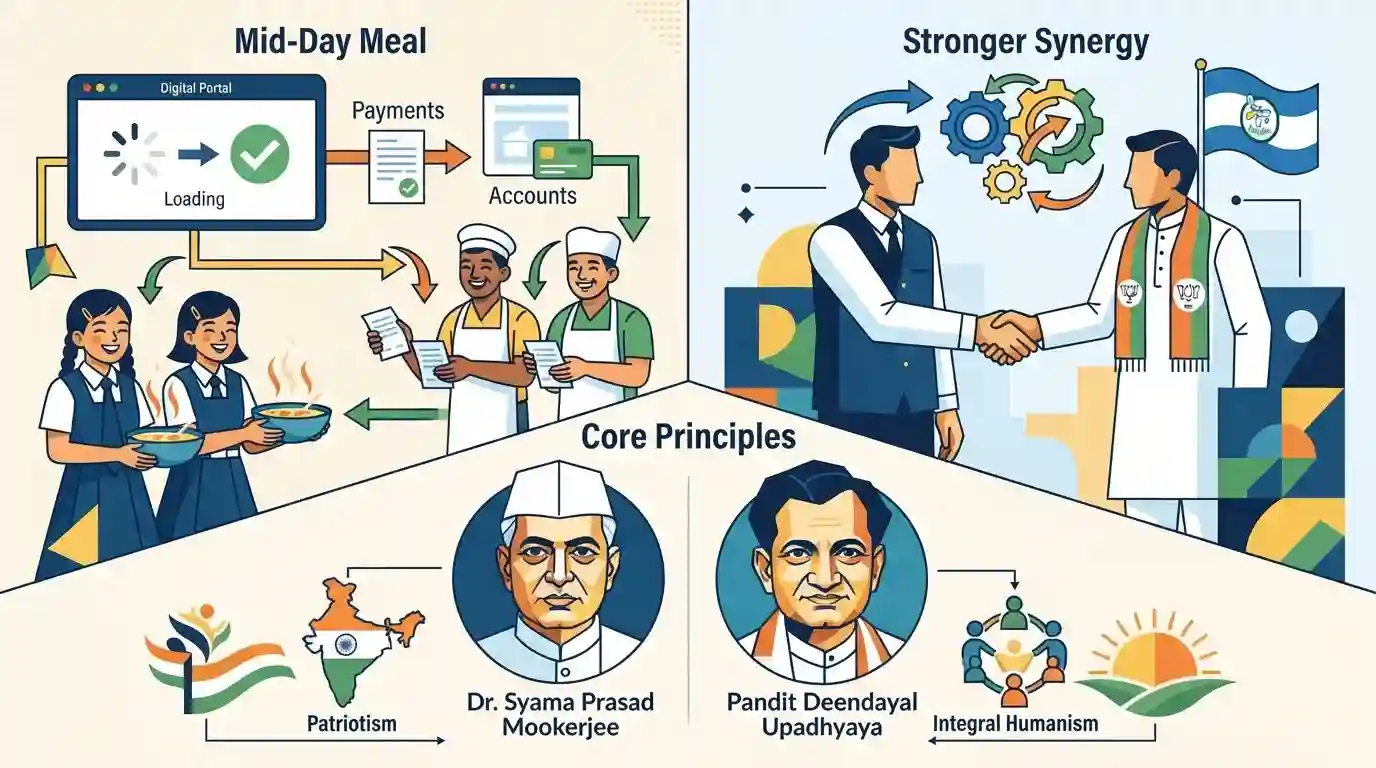
West Bengal Chief Minister Suvendu Adhikari clarified that the mid-day meal payment delays affecting schools in the state have been resolved after fixing a technical issue on the scheme's portal. All pending payments covering four months—including the dues of cooks—have been successfully cleared. Speaking in Debra, Paschim Medinipur, Adhikari emphasized stronger synergy between the state administration and the ruling party. He also invoked the ideological philosophies of Dr. Syama Prasad Mookerjee (patriotism and nationalism) and Pandit Deendayal Upadhyaya (integral humanism) as core principles for public welfare.
Key Points
- West Bengal Chief Minister Suvendu Adhikari dismissed allegations of pending mid-day meal funds for schools, stating that all dues for the past four months have been cleared.
- The delay in disbursal was attributed to a technical glitch in the online portal, which has now been fully resolved.
- The cleared payments include the pending wages and dues of cooks engaged under the mid-day meal program.
- The Chief Minister emphasized the need for closer coordination between the state government and the ruling party's organizational wing to reach out to citizens.
- Adhikari urged adherence to the core ideological tenets of Dr. Syama Prasad Mookerjee (patriotism/nationalism) and Pandit Deendayal Upadhyaya (integral humanism/public welfare).
Important Terms
Mid-day Meal Scheme (PM POSHAN)

A centrally sponsored social sector scheme providing one hot-cooked meal daily to school children in classes I–VIII, aimed at enhancing nutritional levels and school enrollment.
UPSC context
GS Paper V (Welfare Schemes & Social Sector: Education and Health).
Sabooj Sathi Scheme
A West Bengal student welfare scheme providing bicycles to class IX–XII students. In July 2026, the state government rebranded it as the 'Sarathi' scheme.
UPSC context
GS Paper V (West Bengal State Welfare Schemes & Governance).
Integral Humanism
A political and socio-economic philosophy developed by Pandit Deendayal Upadhyaya in 1965, presenting an indigenous Indian alternative to capitalism and communism.
UPSC context
GS Paper IV (Indian Philosophies & Political Ideologues).
Dr. Syama Prasad Mookerjee
A prominent Indian nationalist leader, academician, and founder of the Bharatiya Jana Sangh (1951) who served in independent India's first cabinet.
UPSC context
GS Paper I (Modern Indian History: Personalities).
Suvendu Adhikari
Indian politician who assumed office as the 9th Chief Minister of West Bengal on May 9, 2026, leading the state's first-ever BJP government.
UPSC context
WBCS Polity & West Bengal Current Affairs.
Bharatiya Janata Party (BJP)
A major national political party in India, which formed the West Bengal state government for the first time following the May 2026 assembly elections.
UPSC context
WBCS Polity & State Current Affairs.
Prelims Trap
Dr. Syama Prasad Mookerjee resigned from the Union Cabinet in 1950 over disagreements regarding the Hindu Code Bill.
Mookerjee resigned over the Nehru-Liaquat Pact (1950). It was Dr. B.R. Ambedkar who resigned in October 1951 over the Hindu Code Bill.
Static Concepts Connected
What are the key historical details and milestones of Dr. Syama Prasad Mookerjee's career?
- Academic Legacy: Served as the youngest Vice-Chancellor of Calcutta University from 1934 to 1938.
- Cabinet Portfolio: Appointed as Minister for Industry and Supply in Nehru's post-independence joint cabinet.
- Political Break: Resigned in April 1950 protesting the Nehru-Liaquat Pact, subsequently founding the Bharatiya Jana Sangh in 1951.
What are the core features and legal background of the PM-POSHAN Scheme?
- Evolution: Launched originally in 1995 as the National Programme of Nutritional Support to Primary Education (NP-NSPE).
- Judicial Mandate: The Supreme Court in PUCL v. Union of India (2001) mandated cooked mid-day meals in all government-aided primary schools.
- Funding Pattern: Financed on a 60:40 sharing basis between the Centre and general category states (90:10 for Northeast/Himalayan states).
Cross-Topic Patterns
Directive Principles + Judicial Activism
Shows how judicial interpretation expanded Article 21 (Right to Life) using Article 47 (Duty of State to raise nutrition), legalising hot cooked meals through the landmark 2001 PUCL case.
Post-Partition Diplomacy + Bengal Politics
The 1950 Delhi Pact (Nehru-Liaquat) aimed to secure minority rights post-Partition but triggered high-profile political fractures in Bengal, leading to the birth of the Jana Sangh in 1951.

WBCS prone to matching 1947-1951 cabinet ministers with their reasons for resignation; Mookerjee vs Ambedkar triggers are high-yield.
Linked PYQs · 2
Linked PYQs · 2
- 2006WBCS_PRELIMSGS1
Mid-day meal Scheme was launched in
- 2021WBCS_PRELIMSGS1
Sabooj-Sathi is a scheme for distribution of Bicycles to students of Government/Government Aided Schools/Madrasahs reading in
