Microsoft AI upgrades and multi-model workflow tools
Source:The Hindu ↗
Why It Matters
For UPSC candidates, the evolution of Generative AI into 'Agentic AI' (autonomous agents) is a key technological frontier. The multi-model approach directly addresses the prominent issue of 'AI hallucinations' (generating false information), which is critical for evaluating AI as a reliable tool in administration, governance, and the economy (relevant to GS3 Sci-Tech and GS4 Ethics regarding dependable inputs for decision-making).
Summary
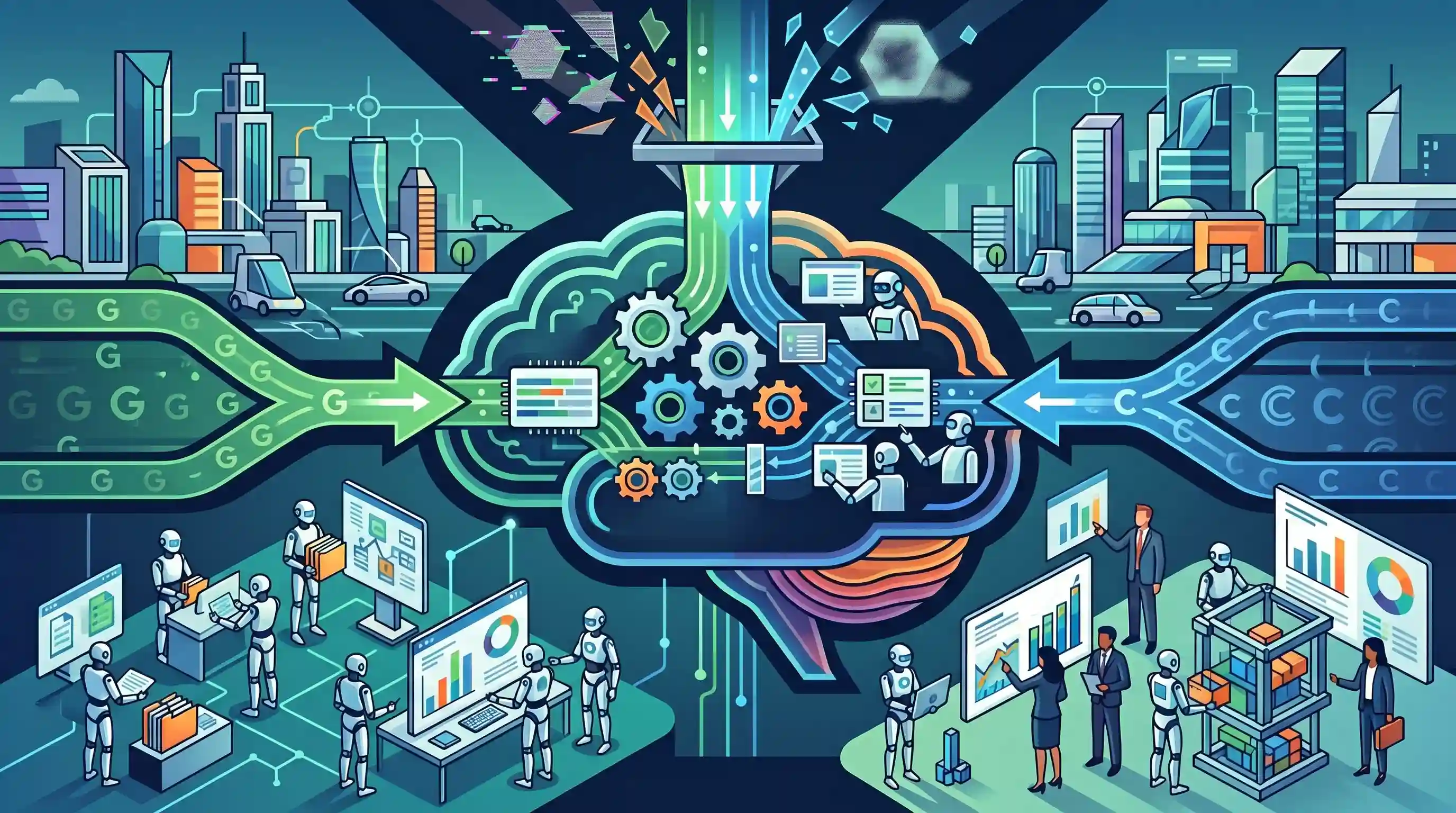
Microsoft has introduced significant upgrades to its AI suite, rolling out features like "Critique" and "Council" for its Copilot research assistant, alongside launching "Copilot Cowork" to early access customers. The upgrades uniquely enable multi-model AI workflows, allowing Copilot to leverage different language models (such as OpenAI's GPT and Anthropic's Claude) simultaneously to generate and verify outputs. This cross-checking mechanism is designed to reduce "AI hallucinations" and enhance the reliability of AI-generated content in professional settings. The introduction of autonomous agentic AI tools underscores a broader tech industry push towards advanced workplace automation and more dependable artificial intelligence.
Key Points
- Microsoft has updated its Copilot research assistant with features allowing it to utilize multiple generative AI models simultaneously.
- The new 'Critique' feature employs one model (like OpenAI's GPT) to generate a response, while another (like Anthropic's Claude) reviews and verifies it to minimize 'AI hallucinations'.
- The 'Council' feature allows users to compare responses from different AI models side-by-side to make more informed decisions.
- Microsoft is also rolling out 'Copilot Cowork', an autonomous agentic AI tool based on Anthropic’s architecture, to early access customers for complex workplace tasks.
- These developments highlight the increasing enterprise demand for reliable, autonomous AI agents capable of enhancing workplace productivity.
Important Terms
Generative AI (GenAI)

Deep-learning models capable of creating new content like text, images, or code by learning patterns from massive datasets.
UPSC context
GS-3 (Science & Tech); tests understanding of emerging technologies and their socio-economic impacts.
AI Hallucination
A phenomenon where an AI generates false, misleading, or nonsensical information while presenting it as factually correct.
UPSC context
GS-3/GS-4 (S&T/Ethics); tests awareness of AI limitations and misinformation risks.
Agentic AI
Autonomous, goal-oriented AI systems capable of reasoning, planning, and executing multi-step tasks independently with minimal human oversight.
UPSC context
GS-3 (IT & Computers); tests knowledge of autonomous systems in workplace automation.
Multi-model AI Workflow
A system architecture that orchestrates multiple AI models simultaneously to cross-check, verify, or refine outputs for higher reliability.
UPSC context
GS-3 (S&T); evaluates methods for improving technological reliability in AI.
OpenAI
A prominent US-based AI research organization known for developing the GPT series and influencing global AI regulation.
UPSC context
GS-2 (IR); relevant to global tech diplomacy and AI governance frameworks.
Anthropic
An AI safety and research company that developed the Claude model and pioneered the "Constitutional AI" framework.
UPSC context
GS-4 (Ethics); highlights industry-led ethical frameworks and the AI alignment problem.
Constitutional AI
A method of training AI systems where the model is guided by a specific set of rules or "constitution" to ensure safety.
UPSC context
GS-4 (Ethics); specific mechanism for ensuring value-alignment in autonomous systems.
Workplace Automation
The use of AI and software tools to perform repetitive or complex professional tasks to increase efficiency.
UPSC context
GS-3 (Economy/S&T); addresses labor trends, productivity, and job displacement.
Prelims Trap
"Agentic AI refers to systems that require continuous step-by-step human prompting to execute digital tasks."
False. Agentic AI is autonomous and goal-oriented; it can reason, plan, and execute multi-step tasks with minimal human intervention, unlike standard prompt-dependent Generative AI.
Static Concepts Connected
What is 'Agentic AI' and how does it differ from standard Generative AI?
- Generative AI: Focuses on producing specific outputs (text, images, code, audio) directly in response to a user's prompt.
- Agentic AI: Autonomous, goal-oriented systems that can reason, break down problems, plan, and execute complex multi-step digital workflows with minimal human intervention.
What are 'AI Hallucinations' and why do they occur?
- Definition: A phenomenon where Large Language Models confidently generate and present false, fabricated, or completely nonsensical information as fact.
- Cause: They occur because LLMs probabilistically predict the next word in a sequence based on training data, without actual factual grounding or cognitive understanding.
- Mitigation: Addressed through techniques like multi-model cross-checking (using a second AI to critique the first) and human-in-the-loop oversight.
Cross-Topic Patterns
Agentic AI + Labour Productivity
Autonomous AI shifts routine cognitive tasks from humans to machines, raising economic questions about white-collar job displacement versus productivity-driven economic growth.
AI Hallucinations + Tech Governance
As AI starts handling professional decisions, mitigating hallucinations becomes a regulatory priority, linking corporate AI tools to global frameworks like the EU AI Act and India's AI Mission.

Expect a 2026 Prelims statement differentiating Agentic AI's autonomous multi-step execution from standard Generative AI's prompt-response model.
Linked PYQs · 3
Linked PYQs · 3
- 2023MainsGS3
Introduce the concept of Artificial Intelligence (AI). How does Al help clinical diagnosis? Do you perceive any threat to privacy of the individual in the use of Al in healthcare?
- 2020PrelimsGS1
With the present state of development, Artificial Intelligence can effectively do which of the following? 1. Bring down electricity consumption in industrial units 2. Create meaningful short stories and songs 3. Disease diagnosis 4. Text-to-Speech Conversion 5. Wireless transmission of electrical energy Select the correct answer using the code given below:
- 2024MainsGS4
The application of Artificial Intelligence as a dependable source of input for administrative rational decision-making is a debatable issue. Critically examine the statement from the ethical point of view.
