Microsoft Corporate Restructuring and Artificial Intelligence Strategy
Source:The Hindu ↗
Why It Matters
Illustrates the strategic pivot of major global technology corporations towards Artificial Intelligence and cloud computing infrastructure, which drives global digital transformation and influences emerging technology policies.
Summary
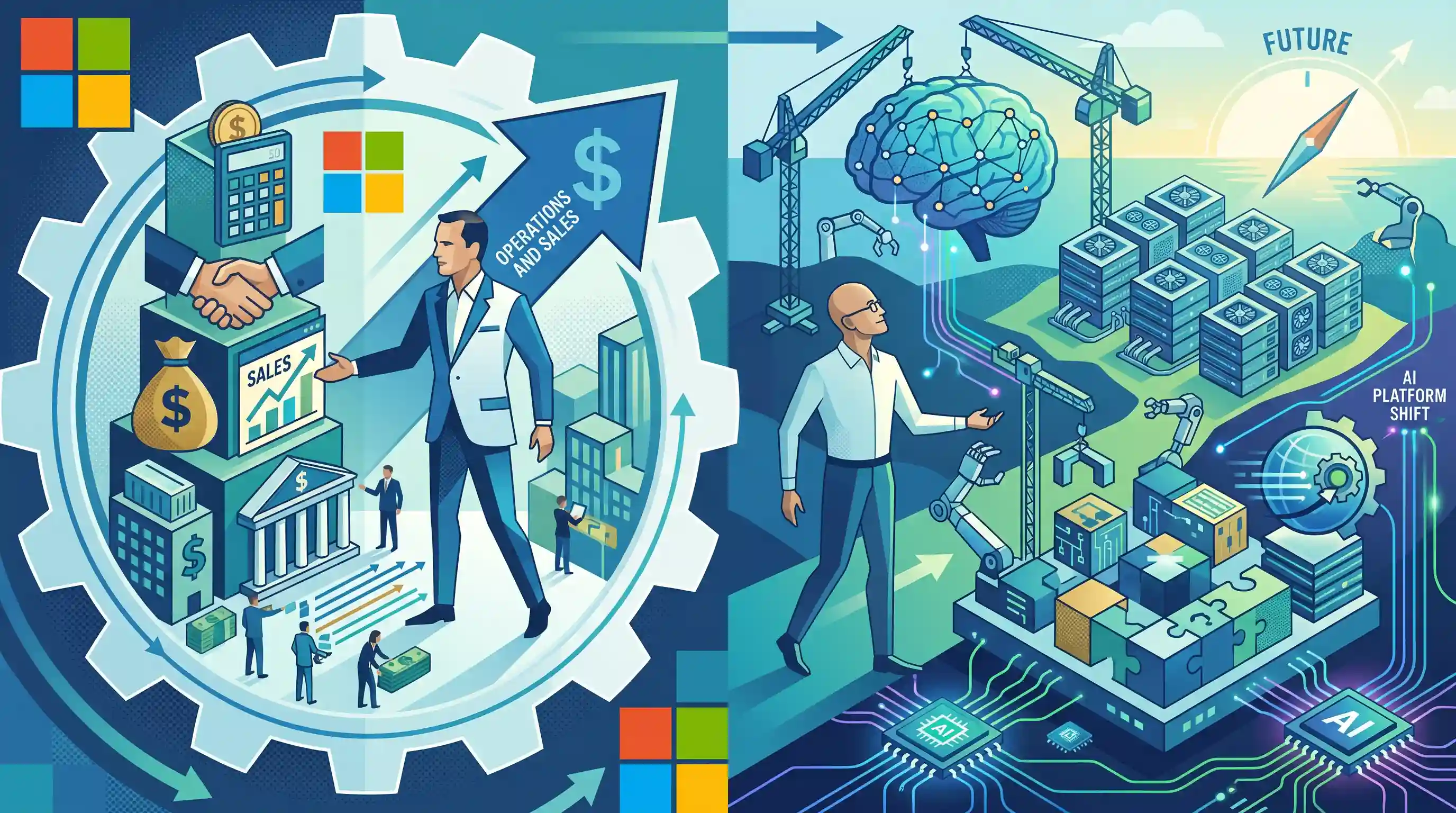
Microsoft is restructuring its leadership by naming Judson Althoff as the CEO of its commercial business. This strategic move frees up Microsoft CEO Satya Nadella from commercial and sales operations, allowing him to focus exclusively on leading the company's technological innovations. Nadella's efforts will be heavily concentrated on the current "AI platform shift," including the development of artificial intelligence technologies, massive data center build-outs, and new systems architecture, reflecting AI's central role in the future of the tech industry.
Key Points
- Microsoft has appointed Judson Althoff as CEO of its commercial business to lead global sales, marketing, and commercial operations.
- This leadership restructuring allows Microsoft CEO Satya Nadella to focus his attention entirely on core technological advancements and product innovation.
- Nadella's primary focus will be steering the company through the ongoing "AI platform shift," which involves building AI agents, expanding data center infrastructure, and redefining systems architecture.
- The move underscores the immense strategic and financial importance of Artificial Intelligence and cloud infrastructure in the modern technology sector.
Important Terms
Artificial Intelligence (AI)

Simulation of human intelligence by computer systems, enabling machines to learn, reason, and solve problems typically requiring human cognition.
UPSC context
GS Paper 3 (S&T); essential for India’s National Strategy for AI (#AIForAll) and the IndiaAI Mission's socioeconomic impact.
Data Center
Centralized physical facilities housing servers, storage, and networking systems used to process, store, and distribute large volumes of electronic data.
UPSC context
GS Paper 3 (Infrastructure); critical for data localization, strategic autonomy, and the Digital Personal Data Protection (DPDP) Act.
AI Platform Shift
A fundamental technological transition where AI becomes the primary foundation for building new applications, business models, and industrial processes.
UPSC context
GS Paper 3 (S&T); tests awareness of paradigm shifts in technology and their influence on the global digital economy.
Systems Architecture
The conceptual blueprint that defines the structure, components, and interactions of hardware and software within a complex information system.
UPSC context
GS Paper 3 (S&T); relevant for understanding the design of large-scale digital public infrastructure and AI-integrated systems.
Cloud Computing
On-demand delivery of computing services—such as servers, storage, and databases—over the internet, allowing for scalable and flexible IT resource management.
UPSC context
GS Paper 3 (S&T/Economy); foundational to the Digital India program and the scalability of government-to-citizen (G2C) digital services.
Digital Transformation
The process of using digital technologies to create new—or modify existing—business processes, culture, and customer experiences to meet changing market requirements.
UPSC context
GS Paper 2 & 3 (Governance/Economy); central to E-governance, administrative reforms, and the modernization of public service delivery.
Prelims Trap
AI Agents and Large Language Models (LLMs) operate identically by relying strictly on continuous human prompts.
AI agents are autonomous systems capable of executing complex real-world tasks without constant intervention, whereas traditional LLMs primarily generate outputs based on continuous human prompts.
Static Concepts Connected
What are the core components of the India AI Mission?
- Financial Outlay: A ₹10,300 crore initiative designed to build sovereign computing capabilities and democratize access to artificial intelligence across India.
- India AI Stack: A 5-layer Digital Public Infrastructure comprising Compute, Data Centre/Network, Energy, AI Model, and Application layers.
- Foundational Models: Focuses on creating indigenous, multi-modal foundational models like 'Bharat Gen' to reduce reliance on foreign tech ecosystems.
How do AI data centers impact the environment and what are mitigation strategies?
- Resource Intensity: Generative AI requires specialized hardware that consumes 5 to 20 times more electricity than traditional data centers, straining grids and water tables.
- Immersion Cooling: An emerging green IT technique that submerges AI hardware in synthetic dielectric fluids to drastically reduce facility water consumption.
- Direct-to-Chip Cooling: A system utilizing microchannel heat exchangers directly on processors to efficiently dissipate heat without excessive reliance on air cooling.
Cross-Topic Patterns
AI Infrastructure + Ecological Footprint
The massive data center build-out for AI requires a heavy focus on "Green IT", linking S&T advancements directly to national energy grid stress and water conservation mandates.
Corporate AI + Sovereign India AI Stack
As global tech giants consolidate AI development, India's push for "sovereign AI" through the India AI Mission extends the Digital Public Infrastructure (DPI) model into fundamental computational layers.

Expect a multi-statement S&T/Environment question linking generative AI training to massive water consumption and immersion cooling.
Linked PYQs · 4
Linked PYQs · 4
- 2023MainsGS3
Introduce the concept of Artificial Intelligence (AI). How does Al help clinical diagnosis? Do you perceive any threat to privacy of the individual in the use of Al in healthcare?
- 2020PrelimsGS1
With the present state of development, Artificial Intelligence can effectively do which of the following? 1. Bring down electricity consumption in industrial units 2. Create meaningful short stories and songs 3. Disease diagnosis 4. Text-to-Speech Conversion 5. Wireless transmission of electrical energy Select the correct answer using the code given below:
- 2024PrelimsGS1
Consider the following statements: I. It is expected that Majorana 1 chip will enable quantum computing. II. Majorana 1 chip has been introduced by Amazon Web Services (AWS). III. Deep learning is a subset of machine learning. Which of the statements given above are correct?
- 2025PrelimsGS1
Consider the following statements: I. It is expected that Majorana 1 chip will enable quantum computing. II. Majorana 1 chip has been introduced by Amazon Web Services (AWS). III. Deep learning is a subset of machine learning. Which of the statements given above are correct?
