Microsoft Launches Initiative to Improve European Language AI Models
Source:The Hindu ↗
Why It Matters
Highlights the intersection of cutting-edge technology, culture, and geopolitics. It illustrates how language dominance in AI training data creates biases, and how global tech giants are navigating international demands for data localization and strategic autonomy. This is highly relevant for GS3 (AI localization, open-source tech) and GS2 (digital sovereignty and global tech regulation).
Summary
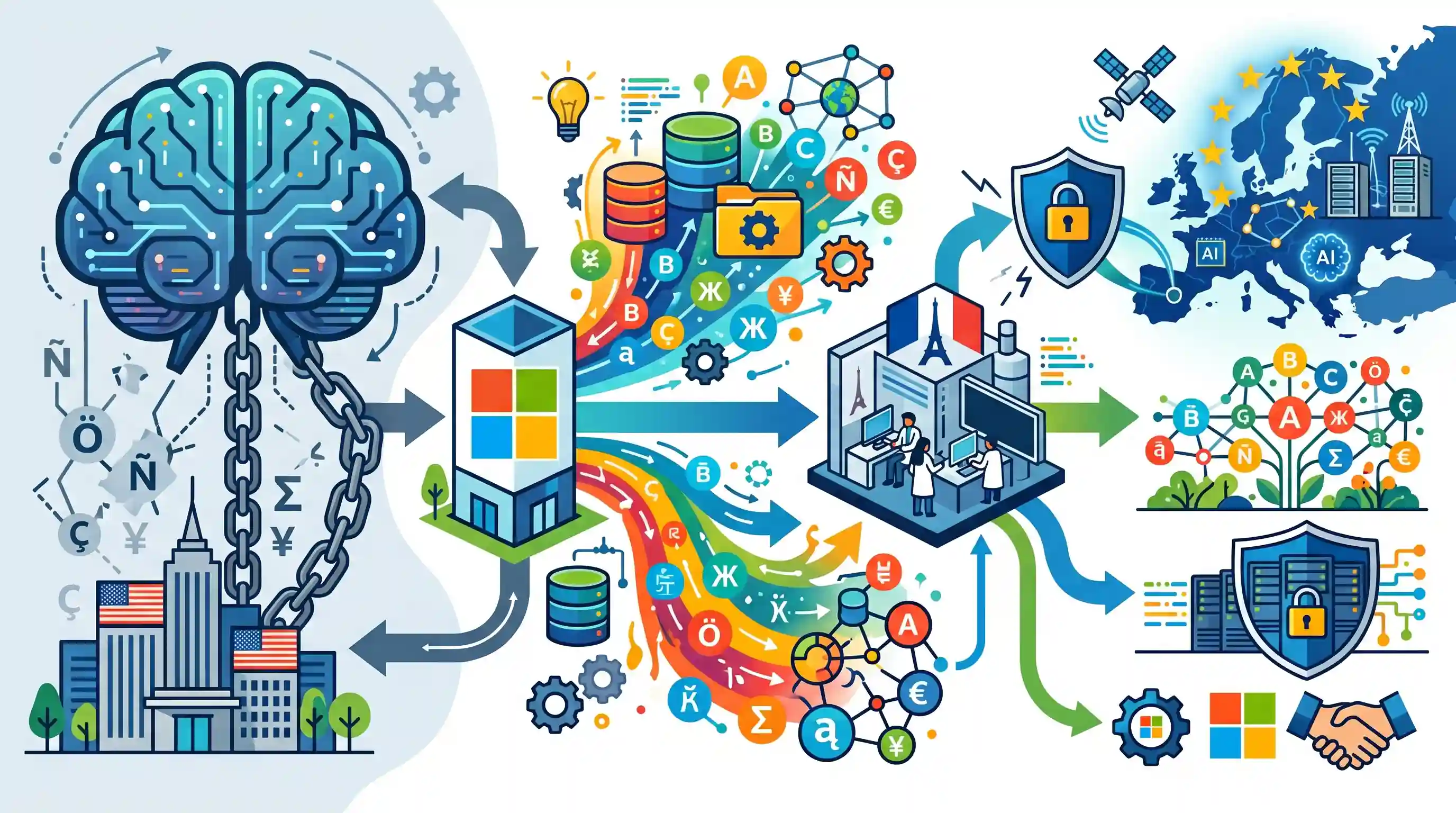
Microsoft announced a major initiative to create open-source, multilingual datasets tailored for European languages to train AI models. This aims to counter the current English dominance in AI capabilities, which makes models less effective in other languages. By establishing research units in France and committing to open-source data, Microsoft seeks to address Europe's push for "technological sovereignty," preserve linguistic diversity, and secure its market position amid geopolitical anxieties regarding European dependence on US tech firms. Microsoft also highlighted its data sovereignty measures allowing European processing and storage.
Key Points
- Microsoft launched an initiative to generate high-quality, open-source data in at least 10 European languages to improve AI model performance.
- Current dominant AI models suffer from an English language bias, leading to reduced capabilities and increased errors (hallucinations) in other languages.
- The initiative aims to help preserve European linguistic and cultural diversity by making this generated data openly available to local developers.
- The move addresses the European Union's push for 'technological sovereignty' and aims to reduce regional anxieties over dependence on American tech giants.
- Microsoft's broader strategy includes localized data sovereignty measures, allowing European customers to process and store data entirely within Europe.
Important Terms
Technological Sovereignty

A state's capacity to independently develop and govern critical technologies (e.g., AI, semiconductors), ensuring strategic autonomy and reducing one-sided dependencies on external powers like the US or China.
UPSC context
GS Paper 2 (International Relations) and GS 3 (S&T). Tests understanding of strategic autonomy and geopolitical tech-dependence.
Data Sovereignty
The principle that digital data is subject to the laws and governance of the jurisdiction where it is collected, processed, or stored, crucial for national security and privacy.
UPSC context
GS Paper 3 (S&T/Internal Security). Relevant for data protection frameworks (DPDP Act) and cybersecurity policies.
TildeLM
An open-source, multilingual foundational Large Language Model developed by the Latvian company Tilde, optimized for 24+ European languages to provide a sovereign alternative to English-centric AI.
UPSC context
GS Paper 3 (S&T). A case study for sovereign AI development and indigenous technological innovation.
Open Source AI
AI systems whose source code and training datasets are publicly accessible, facilitating transparency, collaborative research, and the democratization of technology against proprietary "black-box" models.
UPSC context
GS Paper 3 (S&T). Tests concepts of Digital Public Infrastructure and inclusive technological growth.
Linguistic Diversity (in AI)
The equitable representation of various languages in digital datasets; in AI, it prevents cultural bias and ensures high-performance technology for non-English speakers.
UPSC context
GS Paper 1 (Social Issues) and GS 3 (S&T). Concerns the digital divide and cultural preservation.
Large Language Models (LLMs)
Deep learning algorithms that process vast datasets to understand and generate human-like text; currently the foundation for generative AI tools like ChatGPT and Mistral.
UPSC context
GS Paper 3 (S&T). Fundamental concept in Artificial Intelligence and emerging technologies.
Prelims Trap
Data sovereignty mandates that all digital data must be physically stored within a country's geographic borders.
This describes Data Localization. Data Sovereignty means data is subject to the laws of the collecting country, which may allow cross-border flows depending on the legal framework.
Static Concepts Connected
What is the distinction between Data Sovereignty and Data Localization?
- Data Localization: Mandating the physical storage and processing of citizen data strictly within a country's territorial boundaries.
- Data Sovereignty: The principle that data is subject to the laws and governance structures of the nation where it is collected, regardless of physical storage location.
How is India tackling linguistic AI bias indigenously?
- Project Bhashini: India's National Language Translation Mission building open-source AI datasets to break language barriers in digital service delivery.
- Voice-based e-Governance: Using localized AI models (like Jugalbandi) to allow rural citizens to interact with government schemes via native languages.
Cross-Topic Patterns
Tech Sovereignty via Digital Public Infrastructure
While Europe relies on foreign tech giants for open-source AI datasets, India builds indigenous Digital Public Infrastructure (like Bhashini) to ensure independent technological sovereignty.
Algorithmic Bias and Cultural Hegemony
AI trained exclusively on English data threatens linguistic diversity. UPSC often links such emerging technologies with the sociological impacts of globalization and cultural homogenization.

Expect a comparative Mains question on how India (DPI/Bhashini) vs the EU (AI Act) tackles AI linguistic bias and data sovereignty.
Linked PYQs · 5
Linked PYQs · 5
- 2023MainsGS3
Introduce the concept of Artificial Intelligence (AI). How does Al help clinical diagnosis? Do you perceive any threat to privacy of the individual in the use of Al in healthcare?
- 2015MainsGS3
India's Traditional Knowledge Digital Library (TKDL), which has a database containing formatted information on more than 2 million medicinal formulations is proving a powerful weapon in the country's fight against erroneous patents. Discuss the pros and cons of making this database publicly available under open-source licensing.
- 2022PrelimsGS1
Consider the following : 1. Aarogya Setu 2. CoWIN 3. DigiLocker 4. DIKSHA Which of the above are built on top of open-source digital platforms?
- 2022MainsGS1
Elucidate the relationship between globalization and new technology in a world of scarce resources, with special reference to India.
- 2020MainsGS1
Is diversity and pluralism in India under threat due to globalisation ? Justify your answer.
