Microsoft Warns of Zero Day Cyber Attacks on Server Software
Source:The Hindu ↗
Why It Matters
Highlights the ongoing threat of sophisticated cyber attacks like zero-day exploits and spoofing against critical infrastructure, servers, and government networks. Important for GS-3 Internal Security sections evaluating cyber security preparedness and defensive measures.
Summary
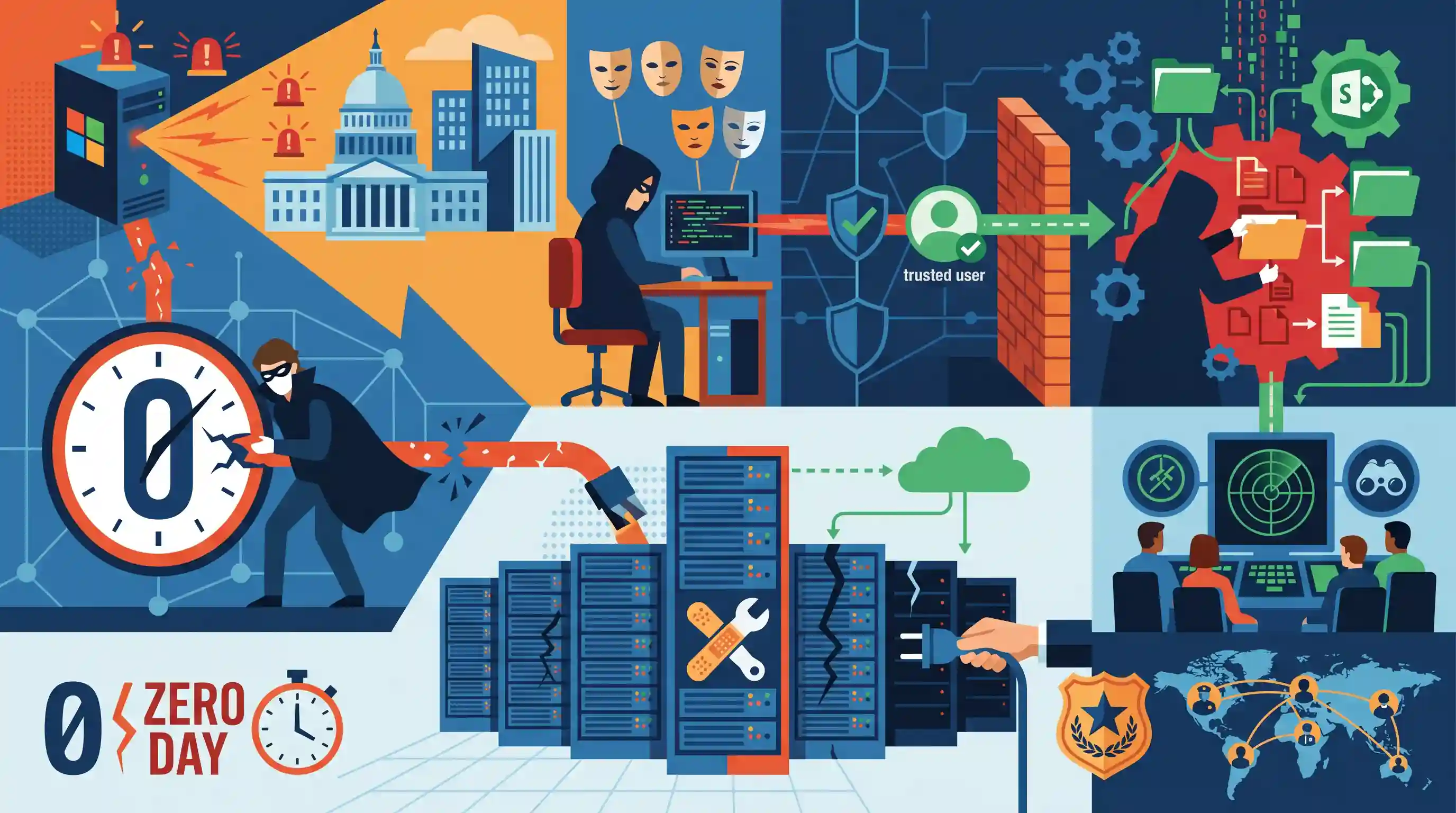
Microsoft has alerted government agencies and businesses about active "zero-day" cyber attacks exploiting a previously unknown vulnerability in its SharePoint Server software. The flaw allows unauthorized attackers to perform "spoofing" by disguising their identity to bypass network security controls and appear as trusted users. The breach targets on-premises versions of SharePoint (Subscription Edition, 2016, and 2019) utilized for internal document sharing, but does not impact cloud-based SharePoint Online. Microsoft has issued a critical security patch for the Subscription Edition and is developing updates for older versions, recommending that organizations either deploy patches immediately or temporarily disconnect servers from the internet. The US FBI is actively monitoring the situation and collaborating with international partners.
Key Points
- Unidentified hackers are actively exploiting a "zero-day" vulnerability in Microsoft's SharePoint Server software, targeting government and business networks.
- The flaw allows attackers to use a technique called "spoofing," masking their identity to bypass security controls and gain unauthorized access on a network.
- The cyber attacks are exclusively targeting on-premises SharePoint deployments (Subscription Edition, 2016, and 2019) and do not affect the cloud-based SharePoint Online.
- Microsoft has released a security patch for the Subscription Edition and advised affected organizations to deploy patches immediately or disconnect servers from the internet.
- The active involvement of the US Federal Bureau of Investigation (FBI) highlights the severity and widespread potential impact of the cyber breach on critical infrastructure.
Important Terms
Zero-Day Vulnerability

A software flaw unknown to the developer that is exploited by attackers before a fix or patch can be created.
UPSC context
GS Paper III: Cyber Security. Tests knowledge of emerging digital threats and the 'National Cyber Security Policy'.
Critical Information Infrastructure (CII)
A computer resource whose destruction would have a debilitating impact on national security, economy, public health, or safety, as defined under the IT Act, 2000.
UPSC context
GS Paper III: Internal Security. Crucial for understanding protected systems and the role of NCIIPC.
Spoofing
A cyber attack where an unauthorized actor disguises their identity as a trusted entity to deceive systems and bypass security controls.
UPSC context
GS Paper III: Cyber Security. Tests technical understanding of threat vectors in the internal security landscape.
NCIIPC
India's nodal agency, created in 2014, responsible for taking all measures to protect the nation's critical information infrastructure from cyber threats.
UPSC context
GS Paper III: Security. Essential for discussing India's institutional framework for cybersecurity.
Federal Bureau of Investigation (FBI)
The primary domestic intelligence and security service of the United States, which collaborates internationally to monitor and mitigate global cyber threats.
UPSC context
GS Paper II/III: International Relations/Security. Relevant for discussing global cooperation and legal frameworks against transnational cybercrime.
SharePoint Server
A collaborative platform by Microsoft used for document management and storage, with the 'on-premises' version being the specific target of the 2026 attack.
UPSC context
GS Paper III: Science and Technology. Illustrates the risks associated with legacy on-premises infrastructure compared to cloud-based systems.
Prelims Trap
"Zero-day vulnerabilities are flaws that a software vendor has known about but given users zero days to patch."
The term 'zero-day' actually means the software developer has had zero days of awareness/notice to fix the flaw before hackers started exploiting it, not that users have zero days to update.
Static Concepts Connected
What is the statutory mandate of CERT-In under the IT Act, 2000?
- Nodal Agency: Acts as the national nodal agency for responding to computer security incidents as and when they occur.
- Intelligence & Advisory: Collects, analyzes, and disseminates information on cyber incidents, issuing timely vulnerability notes and advisories to organizations.
- Emergency Measures: Coordinates cyber incident response activities and issues guidelines for securing IT infrastructure across the country.
What are the key technical definitions of cyber threats like Zero-day and Spoofing?
- Zero-day Exploit: Attackers exploit a previously unknown software vulnerability before the software vendor has created or released a security patch.
- Spoofing: A deceptive technique where an attacker disguises their identity, device, or IP address to appear as a legitimate, trusted entity.
- Phishing: Fraudulent communications (often emails) designed to trick users into revealing sensitive information or deploying malicious software.
Cross-Topic Patterns
Critical Information Infrastructure (CII)
Breaches in government networks frequently connect to the mandate of NCIIPC and CERT-In, highlighting the continuous risk to sovereign data and critical infrastructure.
Cloud vs On-Premises Security
The article's focus on on-premises vulnerabilities connects to UPSC's interest in cloud computing models (IaaS/PaaS/SaaS) and India's data localization debates.

Expect a multi-statement Prelims question matching cyber-threat terms (Zero-day, Spoofing, Phishing) with their exact definitions.
Linked PYQs · 5
Linked PYQs · 5
- 2020MainsGS3
Discuss different types of cyber crimes and measures required to be taken to fight the menace.
- 2017MainsGS3
Discuss the potential threats of Cyber attack and the security framework to prevent it.
- 2021MainsGS3
Keeping in view India's internal security, analyse the impact of cross-border cyber attacks. Also discuss defensive measures against these sophisticated attacks.
- 2020PrelimsGS1
In India, under cyber insurance for individuals, which of the following benefits are generally covered, in addition to payment for the loss of funds and other benefits? 1. Cost of restoration of the computer system in case of malware disrupting access to one's computer 2. Cost of a new computer if some miscreant wilfully damages it, if proved so 3. Cost of hiring a specialized consultant to minimize the loss in case of cyber extortion 4. Cost of defence in the Court of Law if any third party files a suit Select the correct answer using the code given below:
- 2018PrelimsGS1
The terms 'WannaCry, Petya and EternalBlue' sometimes mentioned in the news recently are related to
