Soil Arsenic Contamination and Rice Yield Microbiome Impact
Source:The Hindu ↗
Why It Matters
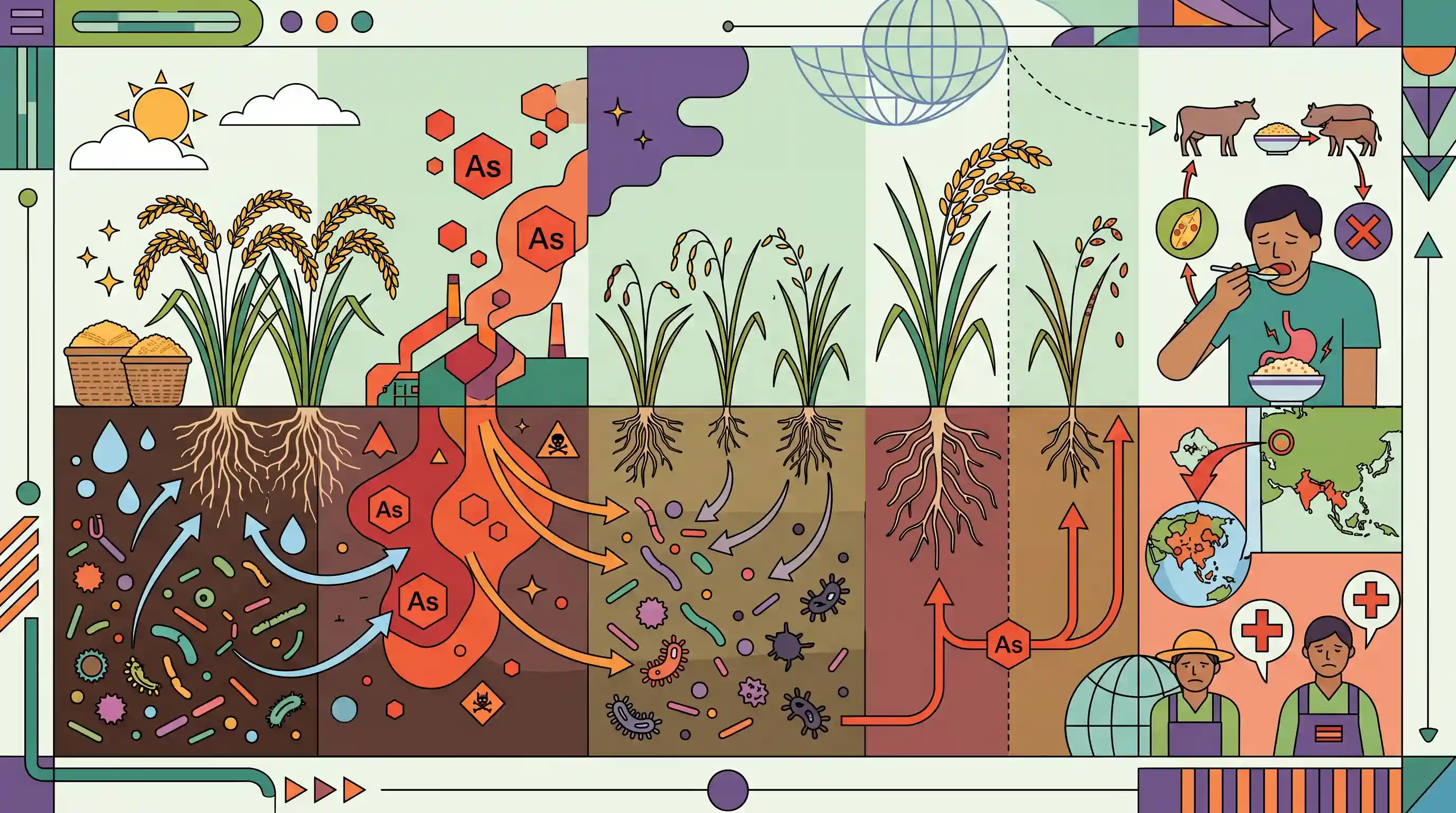
Arsenic contamination of groundwater and soil is a severe public health and environmental crisis in India, especially in the Gangetic plains. Understanding its impact on rice yields via the soil microbiome is highly relevant for GS3 topics covering agriculture, environmental degradation, and food security.
Summary
A recent study has discovered a direct link between arsenic contamination in soil and lower rice yields, mediated by the soil microbiome. Arsenic toxicity negatively alters the composition and function of beneficial soil microorganisms that are crucial for plant growth and nutrient uptake. This disruption not only leads to a decline in rice productivity but also exacerbates the bioaccumulation of arsenic in the food chain, posing severe agricultural and public health challenges in arsenic-endemic regions.
Key Points
- Research reveals that arsenic contamination in soil significantly alters the soil microbiome, suppressing beneficial microbial functions necessary for plant growth.
- The disruption of these microbial communities is a primary factor contributing to reduced rice yields in arsenic-affected agricultural lands.
- Arsenic accumulation in rice paddies poses a dual threat by lowering food production and introducing toxic heavy metals into the human diet.
- The findings highlight the potential for bioremediation and microbiome-based agricultural interventions to restore soil health and maintain crop productivity.
Prelims Trap
Flooding rice paddies mitigates arsenic toxicity by diluting heavy metal concentrations in agricultural soils.
False. Flooding creates anaerobic conditions. Here, specific soil microbes transform insoluble inorganic arsenic into highly soluble, bioavailable forms, exacerbating arsenic bioaccumulation in rice plants.
Static Concepts Connected
How does the System of Rice Intensification (SRI) alter soil dynamics?
- Water efficiency: It uses alternate wetting and drying (AWD) instead of continuous flooding, drastically reducing irrigation requirements.
- Methane reduction: Aerobic soil conditions inhibit methanogenic bacteria, significantly lowering methane (greenhouse gas) emissions compared to traditional flooded paddies.
- Toxin mitigation: By introducing oxygen, SRI prevents anaerobic microbes from converting insoluble geogenic arsenic into highly toxic, bioavailable forms.
What are the primary biological mechanisms used in heavy metal bioremediation?
- Biosorption: Microorganisms or plants passively bind and concentrate heavy metals from the environment onto their cellular structures without requiring cellular energy.
- Bioaccumulation: Microbes actively transport heavy metals into their cells, sequestering and isolating them away from the vulnerable soil matrix.
- Phytoremediation: The use of specific plants (hyperaccumulators) to absorb, extract, or stabilize heavy metals like arsenic directly from the contaminated soil.
Cross-Topic Patterns
Geogenic pollution meets food security
Arsenic is traditionally tested as a drinking water issue (e.g., Blackfoot disease). This news bridges geogenic aquifer pollution in the Ganga-Brahmaputra basin directly to crop yield stagnation and food chain bioaccumulation.
SRI as a dual-purpose climate solution
Alternate Wetting and Drying (AWD) in rice is usually tested for methane reduction. This adds a critical new layer: AWD also suppresses anaerobic microbes that mobilize toxic arsenic in the soil.

Expect a multi-statement Prelims question combining geogenic arsenic in the Ganga basin, anaerobic microbial action, and SRI mitigation.
Linked PYQs · 4
Linked PYQs · 4
- 2017MainsGS3
What are the major reasons for declining rice and wheat yield in the cropping system? How crop diversification is helpful to stabilise the yield of the crops in the system?
- 2015PrelimsGS1
What can be the impact of excessive/inappropriate use of nitrogenous fertilizers in agriculture? 1. Proliferation of nitrogen-fixing microorganisms in soil can occur. 2. Increase in the acidity of soil can take place. 3. Leaching of nitrate to the groundwater can occur. Select the correct answer using the code given below.
- 2022PrelimsGS1
Among the following crops, which one is the most important anthropogenic source of both methane and nitrous oxide?
- 2025MainsGS3
Examine the factors responsible for depleting groundwater in India. What are the steps taken by the government to mitigate such depletion of groundwater?
