Rajasthan Unveils New MSME Policy on International MSME Day
Source:timesofindia ↗
Why It Matters
This article provides crucial macroeconomic facts about Rajasthan's industrial stance, specific parameters of RIPS, district-specific PPP initiatives, and welfare numbers which are central to RPSC RAS Prelims and Mains (Economy of Rajasthan).
Summary
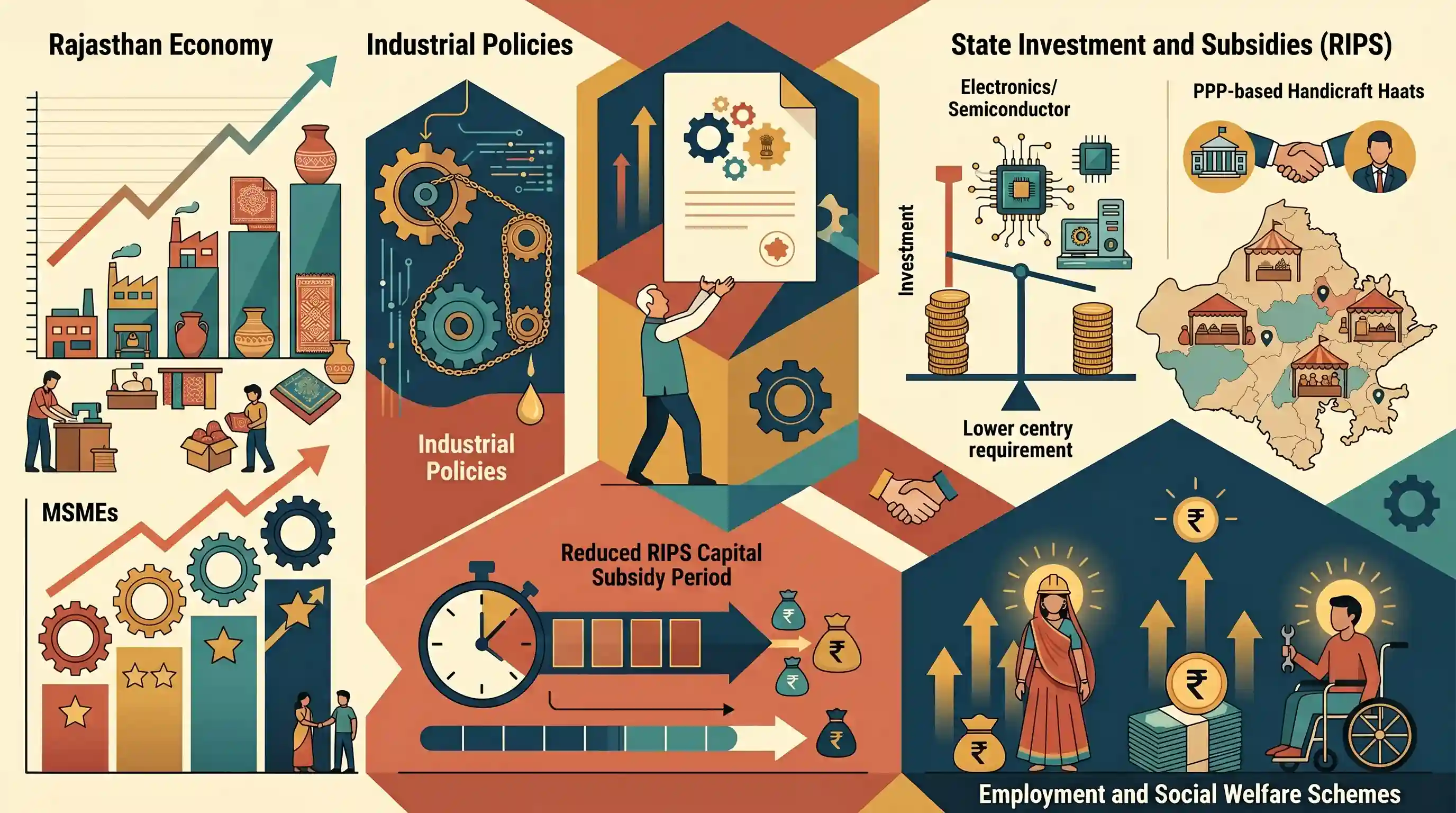
On International MSME Day, Rajasthan Chief Minister Bhajan Lal Sharma launched the Rajasthan Industrial Policy 2026, aimed at strengthening the state's position as the country's fourth-largest MSME hub. Major announcements include reducing the RIPS capital subsidy period to 7 years, setting up PPP-based handicraft haats in four districts, lowering investment thresholds for electronics/semiconductor units to Rs 15 crore, and increasing allowances for women and differently-abled workers.
Key Points
- On International MSME Day, Chief Minister Bhajan Lal Sharma unveiled the Rajasthan Industrial Policy 2026 to bolster the state's industrial ecosystem and promote MSMEs, artisans, and startups.
- Rajasthan is currently the fourth-largest MSME state in India, hosting more than 33 lakh units.
- Handicraft and handloom haats will be developed under the Public-Private Partnership (PPP) model in four key cultural towns: Pushkar, Nathdwara, Jaisalmer, and Alwar.
- The state reduced the capital subsidy period for MSMEs under the Rajasthan Investment Promotion Scheme (RIPS) from 10 years to 7 years.
- To attract IT and electronics manufacturing, the minimum investment threshold for electronics and semiconductor component units was reduced to Rs 15 crore. Projects under the Centre's ECMS can now be executed in up to five phases.
- Monthly allowance support for women and differently abled workers in the industrial sector was raised from Rs 4,000 to Rs 6,000.
- Venture capital funding will be provided to 25 startups this year. In addition, the ODOP Coffee Table Book and the RAMP portal were launched.
Important Terms
Rajasthan Industrial Policy 2026

A state policy launched in Rajasthan to strengthen its industrial ecosystem, prioritizing MSME growth, startup venture capital, PPP-based handicraft haats, and reduced investment thresholds for semiconductor manufacturing.
UPSC context
GS Paper III (Industrial Policy), tests state-level initiatives, regional industrial growth, and ease of doing business.
Rajasthan Investment Promotion Scheme (RIPS)
A flagship initiative of the Government of Rajasthan providing investment subsidies, interest subventions, and tax exemptions to attract industrial investments and stimulate job creation.
UPSC context
GS Paper III (Subsidies & Investment), tests fiscal incentives, investment promotion models, and state economic policies.
Raising and Accelerating MSME Performance (RAMP)
A World Bank-assisted Central Sector Scheme launched to improve credit and market access, strengthen institutions, and facilitate greening and technology upgradation for MSMEs.
UPSC context
GS Paper III (MSME Sector), tests central schemes, institutional reforms, and international funding in economic development.
RIICO
The Rajasthan State Industrial Development and Investment Corporation, an apex state agency tasked with land acquisition, infrastructure development, and financial assistance for industrial promotion.
UPSC context
GS Paper III (Infrastructure), tests the role of state agencies in industrial corridor development and investment facilitation.
One District One Product (ODOP) Scheme
An initiative aimed at identifying, promoting, and branding one unique product from each district to foster local entrepreneurship, boost exports, and encourage balanced regional development.
UPSC context
GS Paper III (Balanced Regional Development), tests decentralized economic planning, MSME exports, and rural employment.
Prelims Trap
The RAMP portal is a state-designed initiative funded entirely by Rajasthan's state budget.
RAMP is a World Bank-assisted Central Sector Scheme. While Rajasthan launched a state-level portal, the overarching program is federally guided and World Bank-financed.
Static Concepts Connected
What are the revised criteria for MSME classification in India?
- Composite Criteria: Combines investment in plant/machinery and annual turnover, merging manufacturing and services.
- Micro Limit: Investment up to Rs 1 crore and turnover up to Rs 5 crore.
- Small and Medium: Small (investment up to Rs 10cr/turnover Rs 50cr) and Medium (investment up to Rs 50cr/turnover Rs 250cr).
What is the mandate of the World Bank-assisted RAMP scheme?
- Institutional Capacity: Aims to improve center-state collaboration, market access, credit delivery, and greening of MSMEs.
- Funding Structure: Launched as a Central Sector Scheme with World Bank financial assistance of $500 million.
Cross-Topic Patterns
Competitive Federalism + Semiconductor Clusters
States lowering minimum investment thresholds to bypass national bottlenecks shows how competitive federalism is accelerating India’s semiconductor and electronics manufacturing goals.
Inclusivity in Industrial Policy
Combining high-tech sub-thresholds with targeted wage allowances for women and differently-abled workers represents a model of socially inclusive industrialization.

Mains 2026 may evaluate how state-level RIPS adaptations and RAMP integration showcase competitive federalism in MSME formalization.
Linked PYQs · 3
Linked PYQs · 3
- 2023RPSC_PRELIMSGS1
Which of the following facts about the Rajasthan Chief Minister Small Industry Promotion Scheme is not correct?
- 2025RPSC_PRELIMSGS1
For how long will the ‘Rajasthan ‘MSME Policy 2024’ remain in effect?
- 2021RPSC_PRELIMSGS1
’Mission Become an Exporter’ has been initiated for people aspiring to become exporters
