Medical Shabd Sindhu dictionary and regional language education
Source:The Hindu ↗
Why It Matters
Translating specialized medical curricula into regional languages is a pivotal governance step under NEP 2020. For UPSC, this highlights the intersection of official language policies, inclusive education, and the roles of institutional bodies like the CSTT and NMC in reshaping India's higher education framework.
Summary
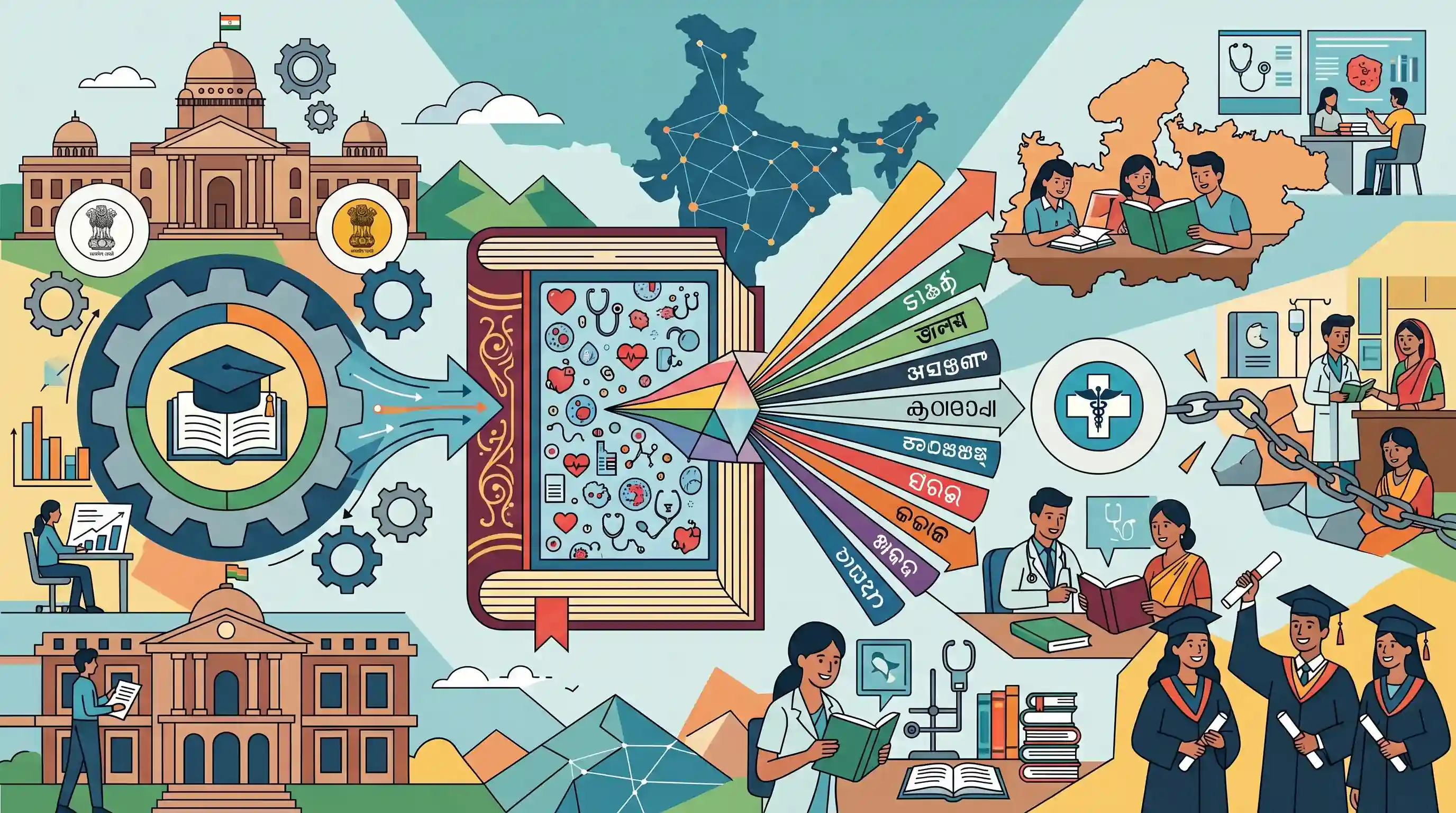
The Union Ministry of Home Affairs (MHA), via the Department of Official Language, is developing a comprehensive medical dictionary called 'Medical Shabd Sindhu'. It will contain around 1,00,000 English medical terms standardized and translated into 15 Indian languages. This move advances the National Education Policy (NEP) 2020's goal of imparting higher and technical education in regional languages. With the National Medical Commission (NMC) already permitting medical studies in 11 languages and Madhya Pradesh leading the way with a Hindi MBBS program, this dictionary will eliminate linguistic barriers and standardize medical terminology across Indian languages.
Key Points
- The MHA's Department of Official Language is compiling 'Medical Shabd Sindhu', a standard dictionary of 1,00,000 English medical terms to be translated into 15 Indian languages.
- The initiative aligns with NEP 2020 to promote higher education, specifically in medical sciences, in students' mother tongues.
- The National Medical Commission (NMC) has officially allowed medical education in 11 Indian languages.
- Madhya Pradesh became the first Indian state to offer an MBBS course in Hindi.
- Previously, the Commission for Scientific and Technical Terminology (CSTT) under the Ministry of Education had created a repository of 60,000 translated medical terms.
Important Terms
National Education Policy 2020 (NEP 2020)

India's 2020 framework for reforming education, which prioritizes multilingualism and promotes teaching technical subjects—like medicine and engineering—in regional languages to ensure equitable access and inclusive learning.
UPSC context
GS Paper II: Social Justice/Education; relevant for questions on linguistic inclusion and human resource development.
National Medical Commission (NMC)
India's apex statutory regulator for medical education and professionals, which has recently permitted bilingual instruction (English plus regional languages) to align with national linguistic goals.
UPSC context
GS Paper II: Statutory Bodies and Issues relating to Health and Education.
Department of Official Language (DoL)
A department under the Ministry of Home Affairs (MHA) responsible for implementing constitutional provisions and the Official Languages Act to promote Hindi and other Indian languages in administration.
UPSC context
GS Paper II: Governance and executive functions related to Official Language Policy (Article 343-351).
Commission for Scientific and Technical Terminology (CSTT)
An autonomous body established in 1961 under Article 344(4) of the Constitution to standardize and evolve scientific and technical terminology in Hindi and other Indian languages.
UPSC context
GS Paper II: Statutory/Constitutional bodies; relevant for language development and technical education.
Bharatiya Bhasha Anubhag
A specialized section within the Home Ministry launched to promote the use of Indian languages in governance and decision-making, aiming to reduce dependence on foreign languages.
UPSC context
GS Paper II: Governance and administrative reforms regarding linguistic inclusion in official work.
Eighth Schedule to the Constitution
A constitutional list of 22 languages (Articles 344(1) and 351) that the Union of India is obligated to develop and represent in official and educational spheres.
UPSC context
GS Paper II: Indian Constitution (Polity); essential for understanding language-related rights and federalism.
Prelims Trap
"Medical Shabd Sindhu is an initiative developed by the Ministry of Education to translate medical terms."
The dictionary is compiled by the Department of Official Language, which operates under the Ministry of Home Affairs, not the Ministry of Education or Health.
Static Concepts Connected
What are the constitutional provisions regarding India's Official Language?
- Part XVII: Articles 343 to 351 deal with the official language of the Union, regional languages, and the language of the judiciary.
- Article 344: Empowers the President to constitute a Commission to make recommendations on the progressive use of Hindi for official purposes.
- Article 351: Provides a special directive for the Union to promote the spread and development of the Hindi language.
What is the mandate and origin of the CSTT?
- Establishment: Established in 1961 via a Presidential Order under Article 344(4) of the Constitution.
- Nodal Ministry: It operates under the Department of Higher Education, Ministry of Education, not under the MHA.
- Core Mandate: To evolve and define standard terminology in Hindi and other Indian languages for scientific and technical subjects.
Cross-Topic Patterns
NEP 2020 & Technical Education Multilingualism
Promoting regional languages in technical fields bridges the rural-urban divide, actualizing NEP 2020 goals while rejecting colonial-era educational models like Macaulay’s downward filtration theory.
MHA's Linguistic Mandate vs Nodal Ministries
The Department of Official Language (MHA) actively executes language policies that intersect with Education (CSTT) and Health (NMC), showing increasing inter-ministerial convergence on NEP directives.

Expect a Prelims question confusing the nodal ministries for language promotion: MHA (Official Language) vs Ministry of Education (CSTT).
Linked PYQs · 4
Linked PYQs · 4
- 2020MainsGS2
National Education Policy 2020 is in conformity with the Sustainable Development Goal-4 (2030). It intends to restructure and reorient education system in India. Critically examine the statement.
- 2024PrelimsGS1
The Constitution (71st Amendment) Act, 1992 amends the Eighth Schedule to the Constitution to include which of the following languages? 1. Konkani 2. Manipuri 3. Nepali 4. Maithili Select the correct answer using the code given below:
- 2008PrelimsGS1
Under which one of the following Constitution Amendment Acts, four languages were added to the languages under the Eighth Schedule of the Constitution of India, thereby raising their number to 22?
- 2015MainsGS2
The quality of higher education in India requires major improvements to make it internationally competitive. Do you think that the entry of foreign educational institutions would help improve the quality of higher and technical education in the country? Discuss.
